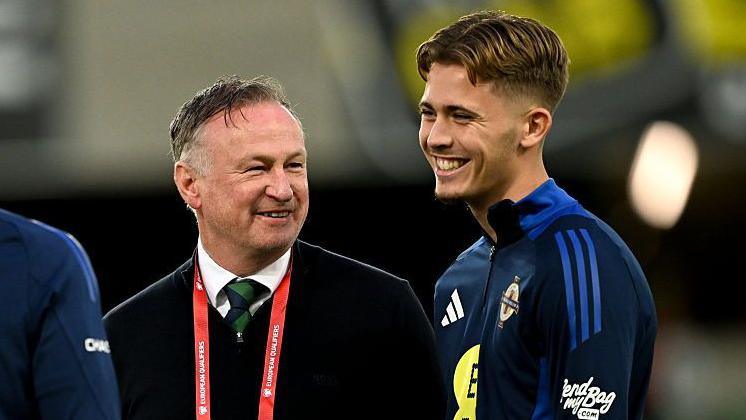
Michael O'Neill has chosen his country over the allure of permanent club management, signing a contract extension to lead Northern Ireland through 2032 in a decision that has sent waves of optimism through the squad. After guiding Blackburn Rovers to safety in the Championship while juggling his role with the national team, the Northern Ireland manager rejected a permanent offer from the Lancashire club to stay committed to building something deeper with the players who believe in his vision.
The news carries particular weight in a football landscape where international football is often treated as a secondary pursuit. O'Neill's decision signals a rare long-term commitment to a national team, offering stability and continuity that players crave. For a country the size of Northern Ireland, landing a manager willing to invest a decade in development and competition is significant—it allows for genuine squad building rather than constant tactical shifts and uncertainty.
Isaac Price, the 22-year-old midfielder who joined the squad for the upcoming friendlies against Guinea on Thursday and France on Monday, 8 June, articulated what O'Neill's commitment means to the players. "We all love playing for him," Price said, his words reflecting a rare warmth in how athletes speak about their managers. The midfielder credits O'Neill as a major influence on his career trajectory, having been drafted into the senior squad as a teenager in 2023 when he had barely established himself at club level. "He trusted me, he threw me in when I wasn't playing any real senior games," Price reflected, describing a manager willing to take chances on young talent.
O'Neill's influence extends beyond individual players. He is inheriting and nurturing a distinctly young squad, one with room to grow and develop over the next seven years. This kind of extended timeframe allows for genuine project building rather than the knee-jerk decisions that often plague international football. The Nations League campaign beginning in September will be the first test under this renewed commitment, but the broader narrative is one of patience and faith in youth development.
What makes this decision particularly noteworthy is its countercurrent nature. In an era when top-tier club management represents the pinnacle of ambition for most coaches, O'Neill's choice to stay with a smaller football nation speaks to either deep conviction about what can be built or genuine affection for the role itself—likely both. He proved his ability at Blackburn, managing the interim position with enough competence that a permanent offer materialized. That he turned it down to remain with Northern Ireland sends a clear message about his priorities.
The players clearly feel that message. Beyond Price's comments, there is a palpable sense across the squad that O'Neill's commitment translates to belief in their collective potential. For young footballers often overlooked by larger nations, having a manager demonstrate such faith through actions—not just words—matters immensely. The forthcoming friendly fixtures against Guinea and France will be the immediate focus, but O'Neill's extended contract reshapes the entire trajectory of Northern Ireland football for the next seven years.