On a quiet campus in State College, Pennsylvania, a team of scientists and engineers has been guiding a space telescope through the cosmos for nearly two decades—long after its expected retirement. The Neil Gehrels Swift Observatory, launched in 2004 to chase the universe’s most violent explosions, is now slowly succumbing to Earth’s gravity, its orbit decaying. But this summer, in a first-of-its-kind mission, a spacecraft will launch to meet Swift in orbit, not to repair or replace it, but to give it a boost—literally—propelling it to a higher altitude and a new lease on life. This unprecedented rescue mission, led by Katalyst Space of Flagstaff, Arizona, in collaboration with NASA’s Swift team, Penn State’s Mission Operations Center, NASA’s Goddard Space Flight Center, and Northrop Grumman, could extend Swift’s legacy of discovery for years to come.
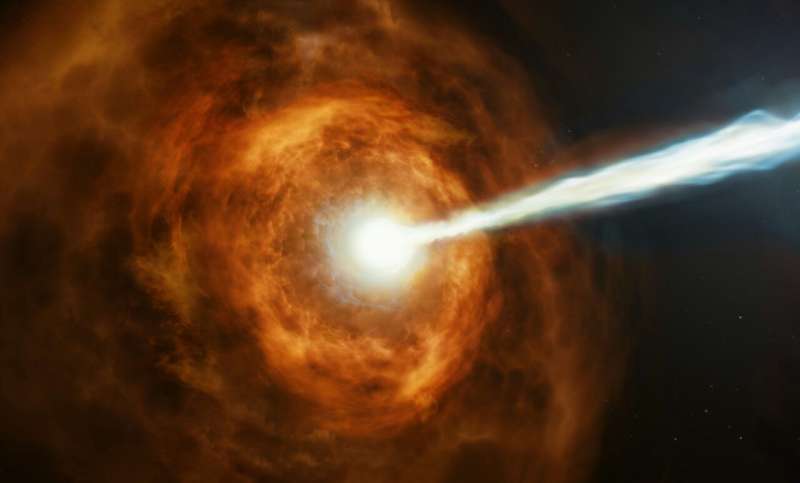
Swift was built to move fast. When its Burst Alert Telescope detects a gamma-ray burst—some of the most powerful explosions in the universe, lasting mere milliseconds to minutes—it automatically reorients the spacecraft within seconds. It then deploys its X-ray and Ultraviolet/Optical Telescopes to capture the afterglow, while simultaneously alerting observatories around the world to follow up. This rapid-response capability has made Swift a cornerstone of time-domain astronomy, enabling breakthroughs in understanding neutron star collisions, black hole formation, and supernovae. Since 2004, Swift has detected over 1,760 gamma-ray bursts—each one a window into the extreme physics of the distant cosmos.
What makes Swift even more remarkable is that it’s operated not from a major NASA center, but from Penn State’s campus, one of the few universities in the world to host a space mission control center. John Nousek, Swift’s director of mission operations, fought to keep operations at Penn State so that the very people who built the instruments could continue to operate them. That continuity has paid off. The team manages both the health of the spacecraft and the science planning, coordinating observations with researchers worldwide. And Swift’s agility has allowed it to pivot beyond its original mission—studying comets, rare stars, and even gravitational wave events detected by LIGO, often responding automatically within minutes.
The upcoming boost mission is more than a technical marvel—it’s a testament to the enduring value of Swift’s science. Without intervention, atmospheric drag would eventually pull the satellite down, ending a legacy of discovery. But with a successful boost, Swift could continue its rapid-response observations, capturing cosmic fireworks for years more. As the boundaries of astronomy expand, so too does the role of nimble, responsive observatories. And if all goes well, the little telescope that could—guided by a university team on Earth—will keep its eyes on the sky, ready to pivot at a moment’s notice, watching the universe explode.