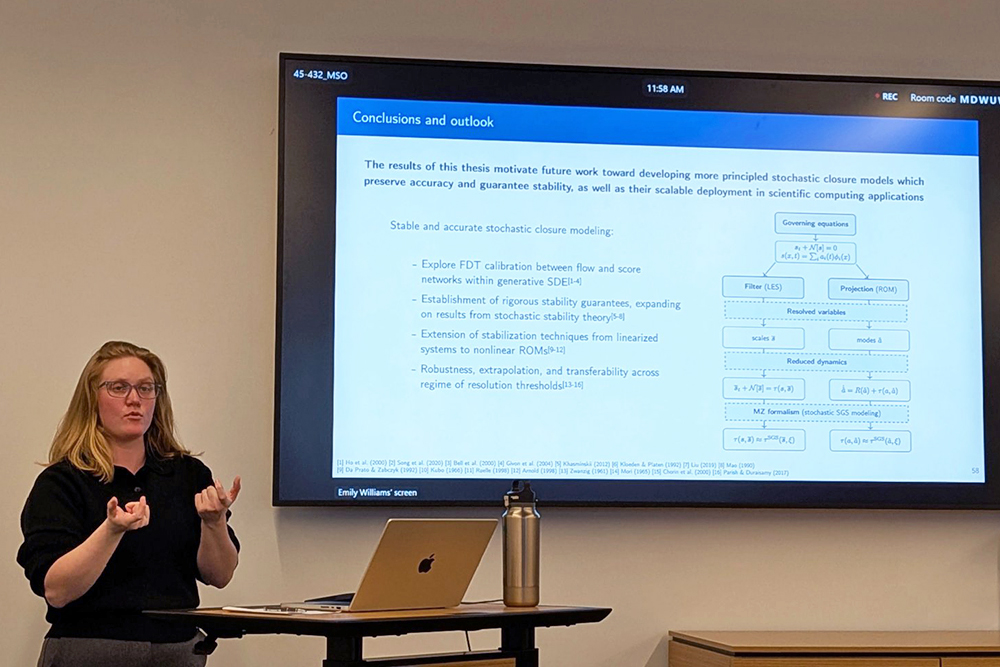
Emily Williams is on the verge of making history at MIT, where she’s set to become the first graduate of a bold new PhD program that didn’t exist just two years ago. Based in Cambridge at the heart of one of the world’s most innovative academic ecosystems, Williams is wrapping up her doctoral journey through the Center for Computational Science and Engineering (CCSE)—a standalone PhD launched in 2023 within the MIT Schwarzman College of Computing. Her path reflects a growing recognition that the future of science isn’t confined to siloed disciplines, but thrives at their intersections. With a background in aerospace engineering and applied mathematics, Williams has focused her research on stochastic and generative modeling for multiscale chaotic systems—complex phenomena that range from atmospheric turbulence to molecular dynamics. Her academic journey began with a BS from the University of Illinois Urbana-Champaign, followed by an MS in aeronautics and astronautics at MIT, and now culminates in a degree that didn’t exist when she first arrived on campus.
The CCSE PhD is designed to be both broad and deep, combining rigorous coursework with original thesis research that spans engineering, applied math, and high-performance computing. Unlike traditional programs anchored in a single department, this interdisciplinary model gives students like Williams the freedom to explore computational methods across domains. Funded by the prestigious Department of Energy Computational Science Graduate Fellowship—a competitive award supporting the nation’s top computational researchers—Williams found room to tailor her studies in ways a conventional PhD might not allow. She points to the program’s thoughtful curriculum, which aligns closely with the DoE CSGF’s requirements, as a key enabler of her academic flexibility.
What makes this program stand out isn’t just its structure, but its vision. By establishing a dedicated PhD in computational science and engineering, MIT is signaling that CSE is not just a toolset, but a discipline in its own right. Williams notes that while joint programs let students apply computational methods within their home fields, the standalone degree fosters broader collaboration and methodological innovation. She’s had opportunities to work across labs and departments, applying her models to diverse scientific challenges—a testament to the program’s collaborative DNA.
For aspiring students, Williams offers a simple but powerful piece of advice: keep an open mind. Her own path wasn’t linear, but shaped by threads she only recognized in hindsight. Now, as she prepares to graduate, she’s helping to chart a new course for computational research—one where boundaries blur, and breakthroughs emerge from unexpected connections. As MIT continues to expand this program, Williams’ journey stands as a beacon for the next generation of interdisciplinary scientists.