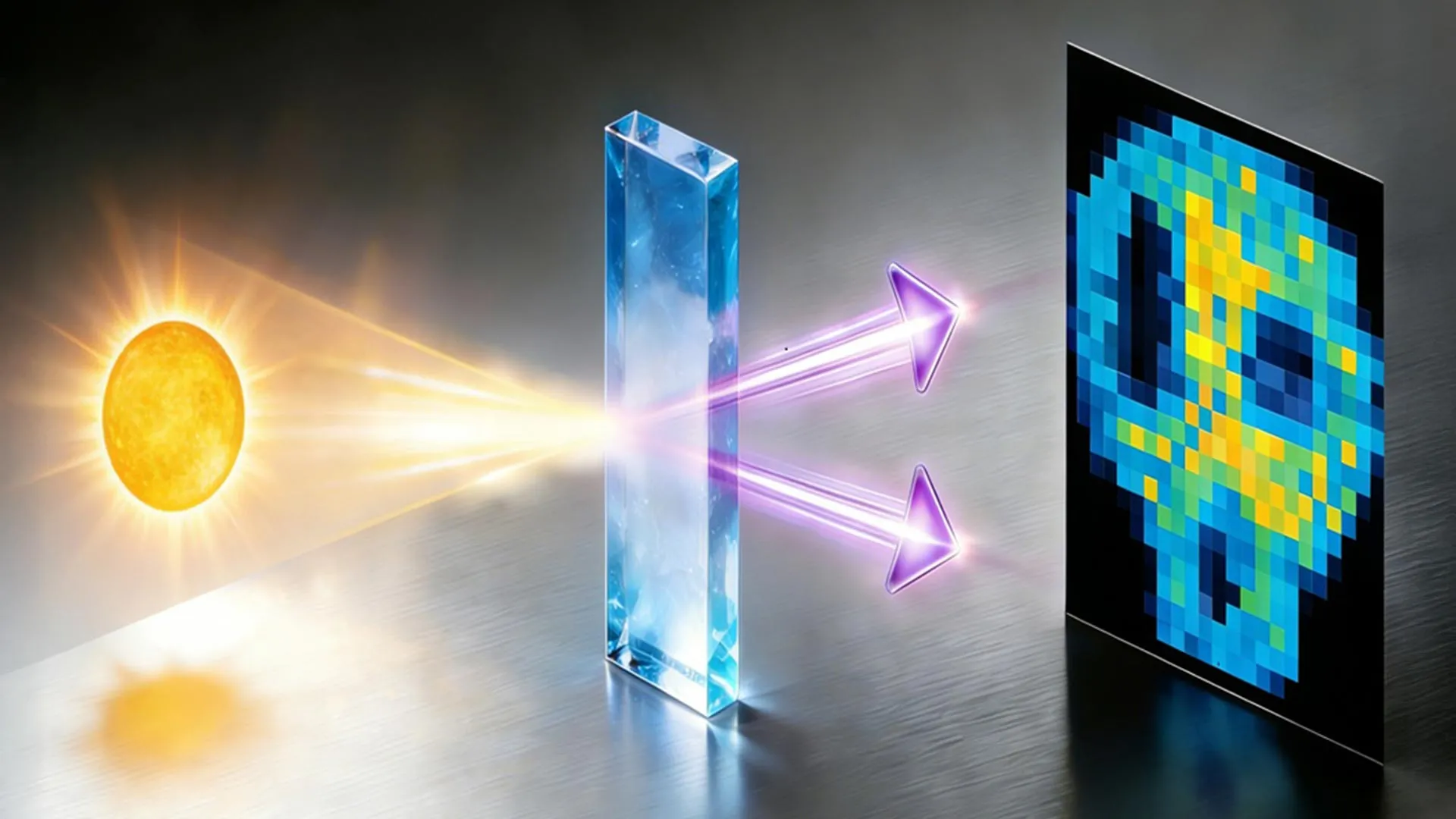
Deep in a laboratory at Xiamen University, sunlight travels 20 meters through a plastic fiber and strikes a crystal, splitting into ghostly pairs of quantum-linked photons—no laser, no electrical outlet, nothing but the sun's raw energy doing the work of quantum optics. What sounds like science fiction is now real, and it rewrites what researchers thought possible about the equipment quantum imaging demands.
For decades, scientists believed that creating entangled photon pairs required a specific kind of tool: a powerful, stable laser firing into a nonlinear crystal through a process called spontaneous parametric down-conversion. Lasers were seen as non-negotiable. But that assumption has begun to crack. Recent studies showed that perfectly coherent light—the kind lasers produce—isn't actually essential. Even partially coherent sources can generate correlated photons. That realization sparked a radical question: what if you used sunlight itself?
The challenge was enormous. Sunlight fluctuates constantly in brightness, direction, and position as it crosses Earth's atmosphere and moves across the sky. Maintaining the precise alignment required for quantum optics experiments seemed nearly impossible. Yet sunlight offers something lasers cannot: it requires no electricity, no complex machinery, no infrastructure. A working sunlight system could operate in remote locations or in space where traditional equipment fails.
Wuhong Zhang and Lixiang Chen's team at Xiamen University solved the puzzle with elegant engineering. They built an automatic sun-tracking device—essentially an equatorial telescope mount—that follows the sun throughout the day. The tracker directs sunlight into a 20-meter plastic multimode optical fiber that carries it into a darkened indoor laboratory. There, the sunlight strikes a crystal of periodically poled potassium titanyl phosphate (PPKTP), pumping the production of correlated photon pairs.
The results were striking. Using those photon pairs for ghost imaging—a quantum technique that reconstructs images from correlated photons rather than direct detection—the sunlight-driven system achieved 90.7% visibility. That nearly matches the 95.5% visibility produced by a standard 405 nanometer laser operating at identical pump power. The team went further, reconstructing a detailed two-dimensional image they called a "ghost face," proving the system could handle complex spatial patterns. Sunlight's broad spectrum, the researchers found, naturally supports the crystal's physics, allowing the creation of large numbers of position-correlated photon pairs. By collecting data over extended periods, they improved signal quality despite the sun's constant fluctuations.
What makes this breakthrough matter is what it removes: the laser, the electrical grid, the laboratory infrastructure. For the first time, scientists have demonstrated a fully passive quantum imaging system powered by sunlight alone. No moving parts except the tracker. No energy input except photons from a star 93 million miles away.
The researchers see applications wherever traditional quantum systems cannot reach: mountaintops, deserts, satellites. They also note that ongoing advances in crystal engineering, sunlight collection, and image reconstruction—potentially using machine learning and compressed sensing—could push the technology toward practical deployment. Quantum optics just took a step toward the open sky.