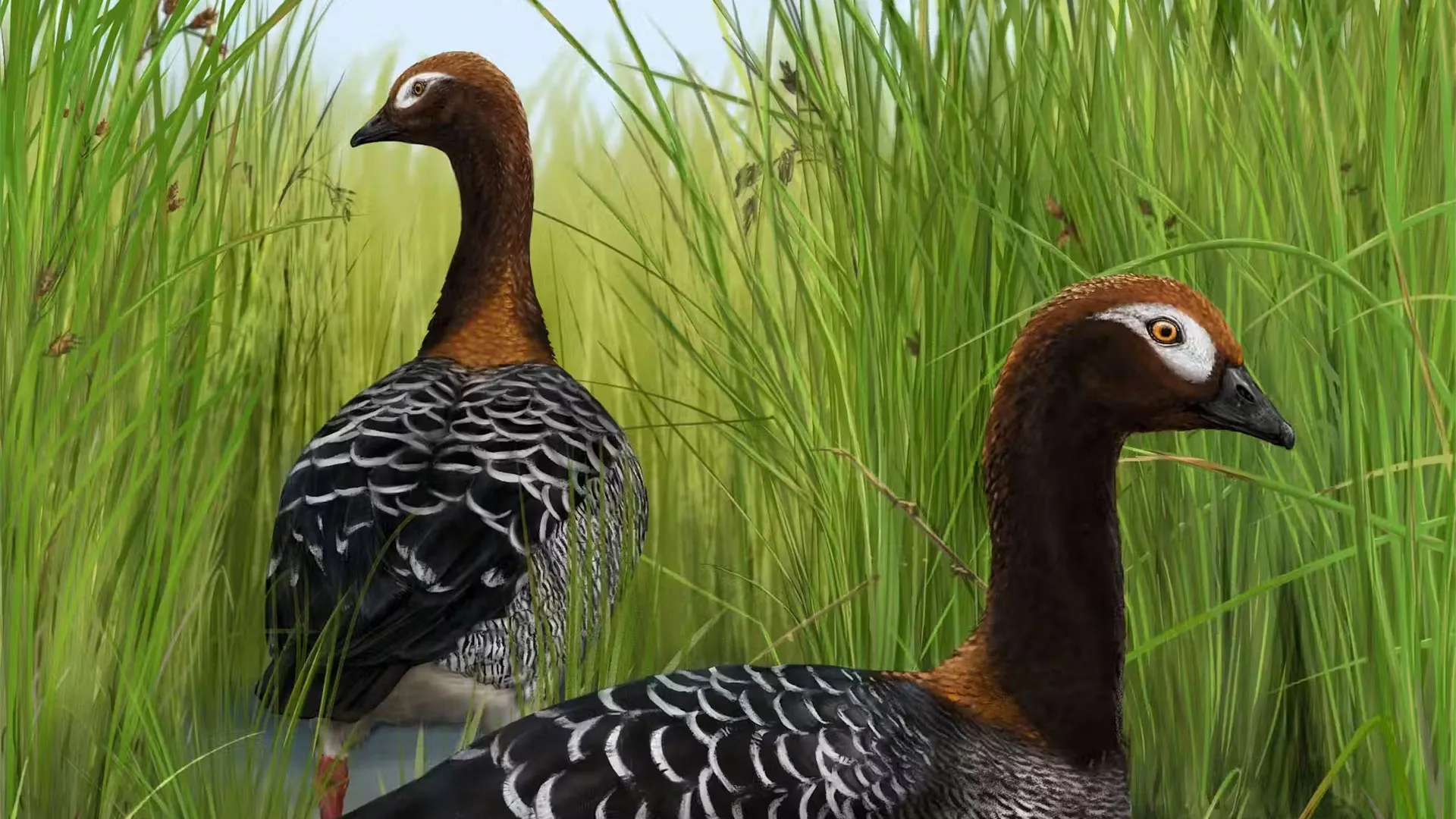
Deep in the red mud of an ancient lake bed, scientists have uncovered a goose that tells a surprising story about New Zealand's past.
The newly identified bird, named Meterchen luti, was discovered among fossils at St Bathans in Central Otago. The name itself tells a story—"Meterchen" means "mother goose" in ancient Greek, while "luti" means "of the mud" in Latin. It's a nod to the nursery rhyme Old Mother Goose, the researchers say.
The find comes from one of the most important fossil sites in the Southern Hemisphere. Although fossils of ducks and other waterfowl are common at St Bathans, goose bones are rare. To confirm the discovery, researchers from the University of Otago, the Museum of New Zealand Te Papa, and the University of Cambridge in the UK carefully re-examined every bone ever labeled as a goose fossil. They compared these bones with both modern birds and other fossils from the site, eventually confirming the bones belonged to an entirely new species about the size of a small goose.
The discovery is reshaping what scientists thought they knew about New Zealand's bird history. The ancestors of Meterchen luti arrived in the region more than 14 million years ago, but that lineage eventually died out without leaving any living descendants. An earlier theory suggested the St Bathans goose was the direct ancestor of the giant flightless Cnemiornis geese that once roamed New Zealand, implying that lineage had been there for at least 14 million years. But genetic evidence contradicts this. Scientists now believe the Cnemiornis geese actually arrived from Australia only about 7 million years ago—a surprisingly recent arrival. The new study confirms that the earlier theory doesn't hold up.
The Cnemiornis geese that did make it to New Zealand were remarkable creatures. Standing roughly one metre tall and weighing as much as 18 kilograms, they were the largest geese the world has ever known. Associate Professor Nic Rawlence from the Otago Palaeogenetics Laboratory says this shows how quickly species can change once they end up on islands, away from their usual predators and competitors.
"Using all the tools in the toolbox, including DNA and fossils, we can reconstruct how the dynamic geological, climatic and human history of Zealandia has shaped the evolution of Aotearoa fauna in ever more detail," Rawlence said. The research was published in the journal Historical Biology.
Alan Tennyson from Te Papa, who led the study, noted that many bird species have reached New Zealand over millions of years, but some of the country's most iconic birds—including the takahē, Forbes' harrier, and the massive Haast's eagle—arrived surprisingly recently, just four to five million years ago. The story of New Zealand's birds, it turns out, is still full of surprises.