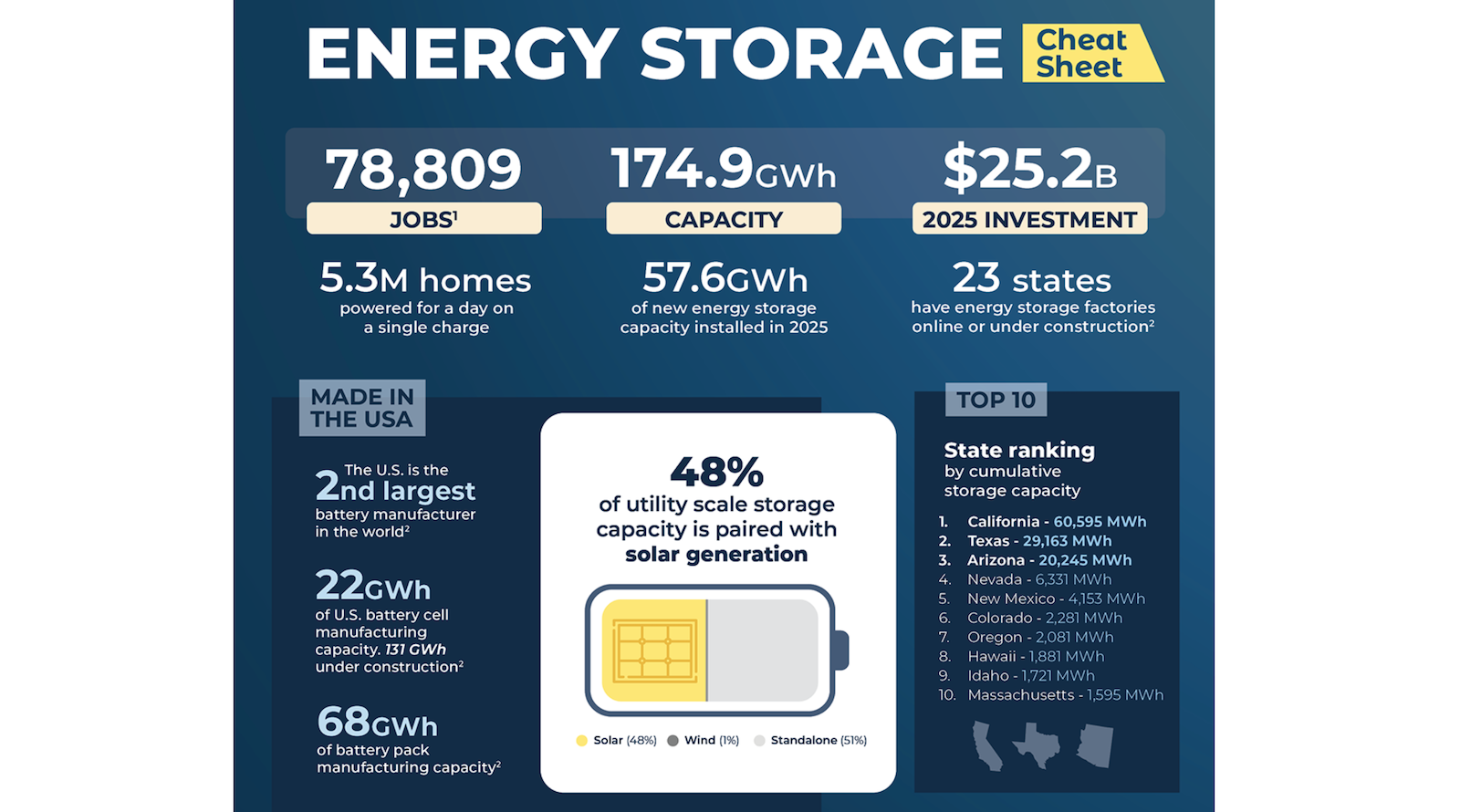
The United States installed 9.7 gigawatt-hours of new energy storage capacity in the first quarter of 2026—the strongest opening quarter the sector has ever recorded. The milestone represents far more than a technical achievement: it signals a fundamental shift in how America is thinking about power, security, and the future of its electrical grid.
This surge matters because energy storage has quietly become one of the most reliable tools for insulating economies from the chaos of global energy markets. As disruptions to international gas supplies ripple through electricity prices worldwide, utilities, corporations, and grid operators are increasingly turning to batteries and storage systems that aren't tethered to volatile fuel costs. Solar and storage installations are also increasingly manufactured domestically, which ties energy security directly to American manufacturing.
The numbers tell a compelling story of momentum. Q1 installations were up 32 percent year-over-year, and forecasters have revised their five-year outlook upward significantly: the sector now expects to install over 610 GWh of energy storage by 2030, a substantial increase from earlier projections. Within that total, 7.8 GWh came from utility-scale installations, while commercial and industrial facilities added 648 megawatt-hours and residential customers deployed 515 megawatt-hours.
Big Tech is driving much of the current demand. Google, Meta, and other data center operators have announced plans to procure tens of thousands of megawatt-hours of energy storage this year alone as they race to power artificial intelligence infrastructure. These companies are explicitly seeking the cost stability and grid reliability that storage provides—a calculus that's increasingly hard to ignore as computing demands soar.
Geography reveals another interesting pattern. Texas, Arizona, and California continue to dominate the energy storage market, but the growth is spreading. Notably, 71 percent of all utility-scale battery storage installed in Q1 was built in states that voted for President Donald Trump in the last election, suggesting the appeal of energy storage cuts across political divides. Georgia, Iowa, and Mississippi all posted notable gains, while thirteen states now have explicit energy storage targets written into policy, creating predictable incentives for continued investment.
Yet the momentum faces real headwinds. According to analysis from the Solar Energy Industries Association, 467 solar and storage projects currently have permits pending in the federal system and remain vulnerable to delays or cancellations. Darren Van't Hof, the interim president and CEO of SEIA, warned that "actions in Washington to stall permitting are threatening to slow that progress," even as the data proves that storage can help America meet rising energy demand while strengthening independence. The concern is concrete: permitting bottlenecks could raise household electric bills and cede ground to international competitors in artificial intelligence development.
Shan Tomouk, energy lead at Benchmark Minerals, reframed storage as "critical energy security infrastructure"—no longer simply a backup system but foundational to both economic competitiveness and consumer protection. As global energy markets remain volatile and AI computing demands grow, that framing will likely shape policy conversations for years to come. The strong first quarter suggests demand is real and durable, but whether America's permitting systems can keep pace remains an open question.