In Newham, east London, a 5-acre industrial site called Tipping Point East has become the largest salvage and reuse yard in the entire United Kingdom—a place where the city's architectural heritage gets a second life instead of a one-way trip to the dump. Yes Make, the salvage operation that calls the site home, is quietly reversing one of modern cities' greatest waste problems: the thoughtless demolition of beautiful, functional materials that could serve London for decades more.
The operation exists because Joel De Mowbray, the founder, grew frustrated watching the city's bones get thrown away. "We're creating a regenerative supply chain for the city we love," he told the Guardian, describing his mission to turn materials destined for landfill "into objects that have cultural potential." More than half of the UK's construction waste never gets recycled at all—a staggering gap that Yes Make is determined to close, one beam and brick at a time.
The work begins with salvage. When a 105-year-old sequoia tree from the Linford Arboretum faced the scrap heap, Yes Make brought it to Tipping Point East and organized an educational workshop with the National Saw Mills organization to mill it into usable lumber. But the yard's real focus is the vast quantities of exotic and high-quality timber—mahogany, teak, afromasia—that London's construction history has locked inside older buildings. As the city balances modernization with preservation, De Mowbray and his team ensure these precious woods don't slip through the cracks.
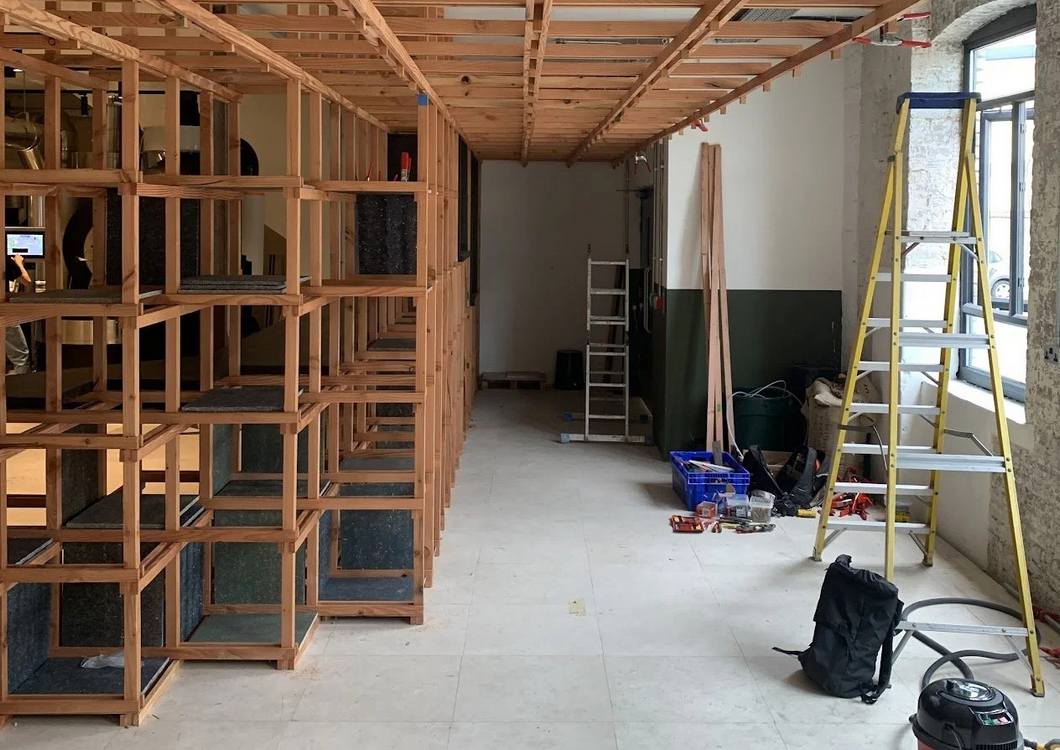
The results are striking. For the new HEJ Coffee Roastery on Old Kent Road, Yes Make's team crafted a custom structure from reclaimed Douglas fir and oak salvaged from the London Docklands. "Designed to frame the roasting space and invite the public in, this piece holds stories of the tides and the city alike," they wrote, capturing something that new timber simply cannot: a narrative woven through decades of London's working life.
Beyond lumber, Tipping Point East refurbishes and certifies construction materials in bulk—brick, steel, glass, porcelain, and more—selling them to contractors at sometimes just one-tenth the price of new stock. That economics matters. It means circular building isn't a luxury reserved for heritage projects; it's becoming a viable choice for ordinary development.
Yes Make operates in partnership with Material Cultures, a collaboration that proved essential in securing Tipping Point East's valuable real estate in London's expensive property market. The yard's scale and reach signal something larger: that salvage is no longer a niche practice but an emerging backbone of London's construction future. Similar operations are taking root elsewhere—Re:purpose Savannah, for instance, has spent years carefully dismantling condemned buildings in Georgia to recover their components for new homes—but Tipping Point East's status as the UK's largest salvage operation suggests London is approaching circular construction at genuine scale.
Every piece of wood, brick, and steel that passes through Tipping Point East represents a choice: to honor what was built before, to reduce the environmental toll of new extraction, and to prove that a truly regenerative city isn't a distant dream but something being built right now, one reclaimed board at a time.