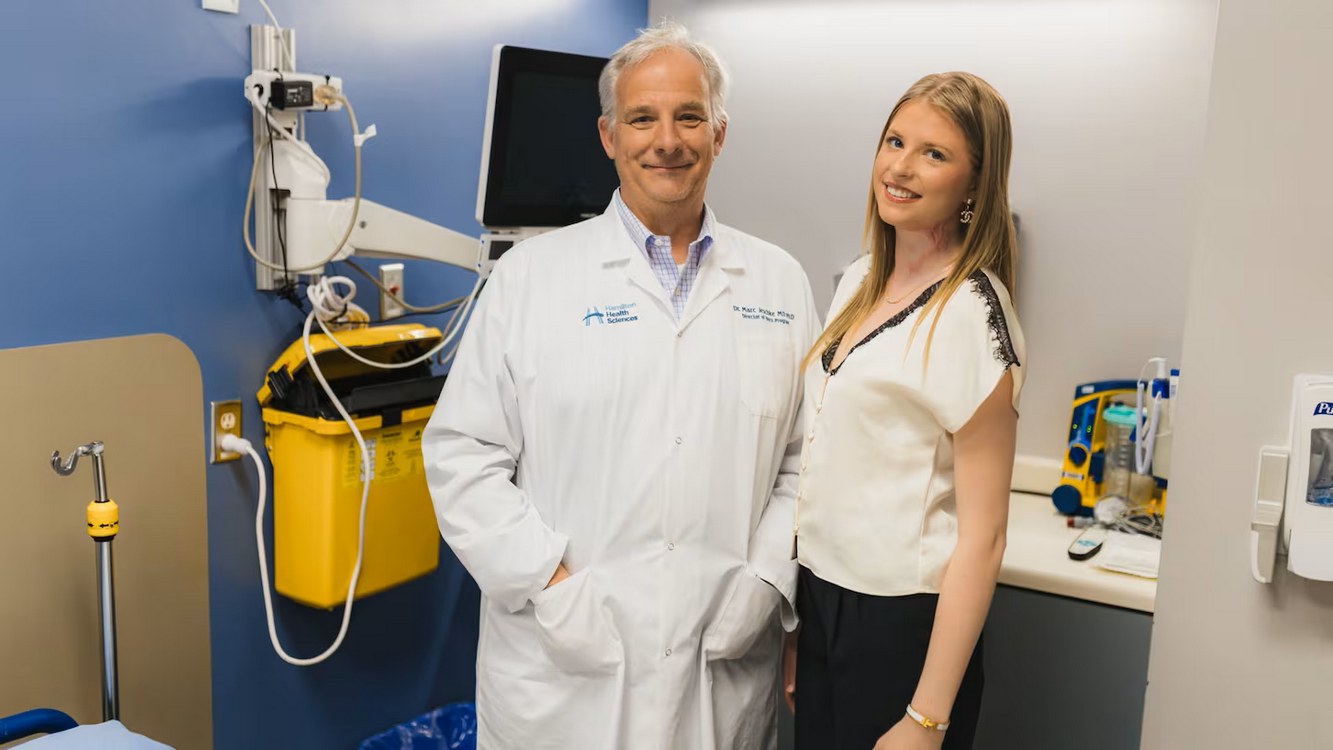
The faint pink line just below Kaitlin Jeffrey’s left ear is the only visible trace of a fire that once threatened to rewrite her life. On December 2nd, during a fraternity party in Toronto, her hair and clothing ignited in a sudden blaze, leaving her with full-thickness, third-degree burns across her face—damage so severe that doctors initially predicted permanent disfigurement and the inevitability of skin grafts. But today, Kaitlin’s face is whole again, healed not by surgery, but by a groundbreaking treatment that has never before been used on a human: exosome therapy.
At Hamilton Health Sciences, Dr. Marc Jeschke—burn surgeon, researcher, and vice president of research and innovation—faced a daunting challenge. Traditional skin grafts, while life-saving, often leave patients with mismatched skin tone, limited mobility, and emotional scars that run deeper than the physical ones. For a young woman in her twenties, the psychological toll could have been lifelong. "My vision for Kaitlin was to avoid skin graft surgery to her face and neck at any cost," Dr. Jeschke told CTV. "You can do the best graft on the planet, but you won’t return the skin to normal."
Determined to find another way, he proposed an experimental approach using exosomes—microscopic vesicles released by cells that carry regenerative signals. These tiny messengers, cultivated in a lab from human cells, were injected directly into Kaitlin’s burned tissue. She received a staggering trillion exosomes—an unprecedented dose—under an emergency compassionate-use authorization from Health Canada, granted after Kaitlin and her family consented to the unproven therapy.
Until then, exosome treatments for burns had only been tested in animals. Kaitlin became the first human in the world to receive the therapy for severe facial burns. The results defied expectations. Over the following months, new skin grew in layers, restoring texture, pigmentation, and function. By April 29th—just under five months after the injury—Kaitlin was unrecognizable from her initial condition, not because of scarring, but because she looked like herself again.
While she will still require skin grafts for areas on her neck, the success of the exosome treatment on her face marks a turning point in burn care. This breakthrough could one day make disfiguring surgeries obsolete for countless burn victims worldwide. Though the treatment remains expensive and not yet widely available, Dr. Jeschke hopes Kaitlin’s case will accelerate clinical development and accessibility across Canada and beyond. For now, her reflection is no longer a reminder of trauma—but a testament to the quiet miracle of science moving at the edge of what’s possible.