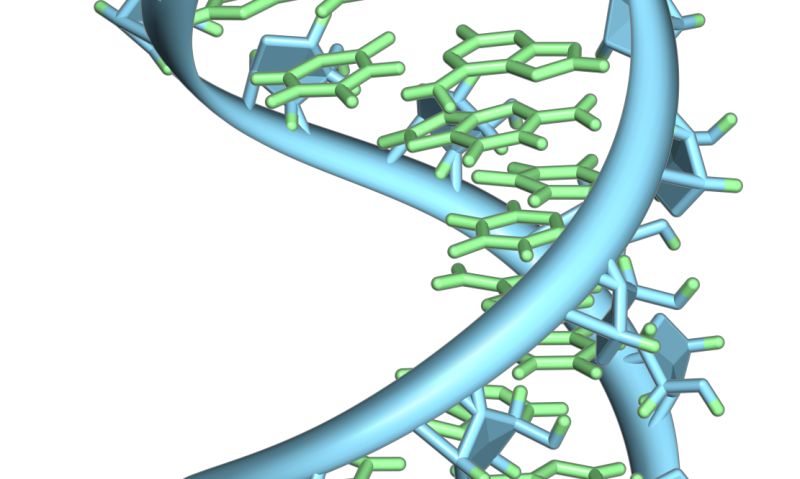
Imagine a world where life didn't need proteins to survive—where a single type of molecule could both store genetic instructions and fix itself when broken. That's the picture emerging from a new study by researchers at the University of Notre Dame, who have engineered an RNA-only enzyme capable of repairing damaged genetic material.
The discovery, published in the journal Nature Communications, offers a clue about how the very first life on Earth might have protected its genetic code nearly four billion years ago.
In today's cells, DNA holds the master blueprint for life, while proteins do the heavy lifting—copying, fixing, and building based on those instructions. But proteins themselves need DNA to be created, creating a chicken-and-egg problem for scientists studying how life began.
Saurja DasGupta, a biochemist at Notre Dame, thinks RNA may have come to the rescue. "Our results suggest that the molecular tools needed to preserve the RNA-based genetic code and pass it on to future generations could have been furnished by RNA alone—no proteins required," said DasGupta, an assistant professor in the Department of Chemistry and Biochemistry.
DasGupta and his team engineered a type of RNA enzyme called a ribozyme that can recognize and splice together broken pieces of RNA. The ribozyme works by hunting for a specific chemical signature: broken RNA strands end with a phosphate group (a phosphorus atom bonded to four oxygen atoms), while intact strands end differently. This chemical difference acts like a signal, telling the enzyme where repairs are needed.
DasGupta collaborated with Jack W. Szostak of the University of Chicago on the study.
The discovery also came with a dose of luck. The researchers initially set out to modify an existing class of ribozymes, but when the results didn't match their expectations, they followed the data in a new direction instead of abandoning the experiment. "What I'm most surprised about, actually, is that it wasn't found sooner," DasGupta admitted.
Beyond illuminating primordial life, the repair ribozyme could help modern medicine. Broken RNA appears in viral infections and certain cancers, but standard genetic sequencing can't detect it. DasGupta notes that these damaged strands are "essentially invisible in standard sequencing protocols." A tool that can spot broken RNA might eventually help doctors diagnose or understand these conditions better.
The findings support the "RNA World" hypothesis—the idea that early Earth hosted life forms powered entirely by RNA, billions of years before DNA or proteins took center stage. If those ancient organisms stored their genes in RNA, they would have needed some way to fix genetic damage, or genetic information would have been permanently lost when heat, pH changes, or other stressors broke the strands.
This new ribozyme suggests such repair mechanisms could have existed without requiring proteins at all.