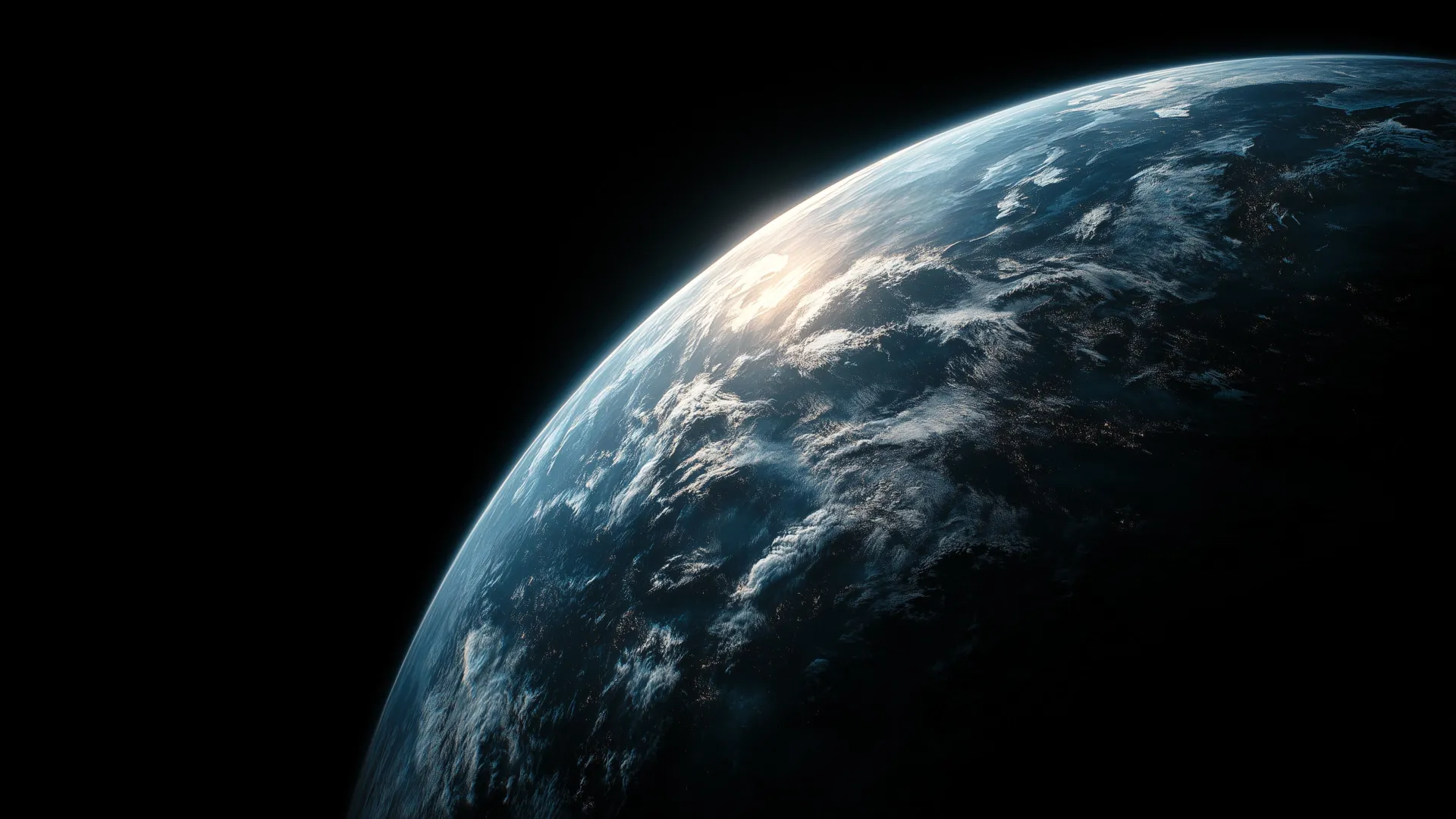
In the darkness of interstellar space, where no star provides warmth and no light reaches the surface, moons orbiting rogue planets could harbor liquid water oceans for up to 4.3 billion years. This startling discovery, made by scientists at Ludwig Maximilian University of Munich and the Max Planck Institute for Extraterrestrial Physics, fundamentally reshapes how we think about where life might exist in the universe.
For decades, astronomers have assumed that habitable worlds need one essential ingredient: proximity to a star. Life on Earth depends on the sun's warmth and energy. But new research suggests the cosmos harbors far more potential cradles for life than anyone imagined, hidden in places we once thought utterly barren and cold.
The story begins with planetary chaos. When giant planets form in crowded stellar nurseries, they sometimes drift dangerously close to one another. Gravitational encounters can sling these worlds completely out of their solar systems, casting them adrift as rogue planets with no star to orbit. Previous work by LMU physicist Dr. Giulia Roccetti showed that some of these expelled giants retain their moons despite being ejected into the void. But the moons' orbits change dramatically—from nearly circular paths into highly elongated trajectories that bring them alternately close to and far from their parent planet with each pass.
Here lies the key to survival: tidal heating. As a moon swings closer to and farther from its planet, powerful gravitational forces repeatedly stretch and squeeze the world. This relentless flexing generates internal heat through friction, the same process that keeps Jupiter's moon Europa warm beneath its icy crust. The researchers found this mechanism could work powerfully enough to maintain liquid surface oceans even in the crushing cold of interstellar space.
But keeping heat in is not automatic. An atmosphere matters enormously. On Earth, carbon dioxide traps heat as a greenhouse gas. Scientists once thought CO2-rich atmospheres might support rogue planet moons for up to 1.6 billion years. Yet in the extreme cold surrounding free-floating worlds, carbon dioxide would eventually condense into dry ice, losing its warming ability.
The breakthrough came with hydrogen. Under the immense atmospheric pressures that would exist on such worlds, hydrogen molecules collide with one another in ways that absorb and trap infrared radiation—a phenomenon called collision-induced absorption. Because hydrogen remains stable at extremely low temperatures, it could function as a planetary insulating blanket for billions of years, far outlasting carbon dioxide's usefulness.
David Dahlbüdding, the doctoral researcher and lead author of the study, points to an unexpected connection to our own planet's origins. The researchers found that high concentrations of hydrogen—which could have been delivered to early Earth by asteroid impacts—may have created the chemical conditions where life first emerged. On rogue planet moons, tidal forces could drive repeated wet-dry cycles where water evaporates and condenses in ongoing rhythms that may produce the complex molecules life requires.
The implications ripple across the galaxy. Astronomers estimate rogue planets may be as common as stars themselves—potentially billions throughout the Milky Way. If many harbor moons, the number of worlds capable of supporting life might dwarf the count of sun-orbiting planets. Habitable worlds may not cluster around stars at all. Instead, life could be thriving right now in the darkest regions of space, in places we never thought to look.