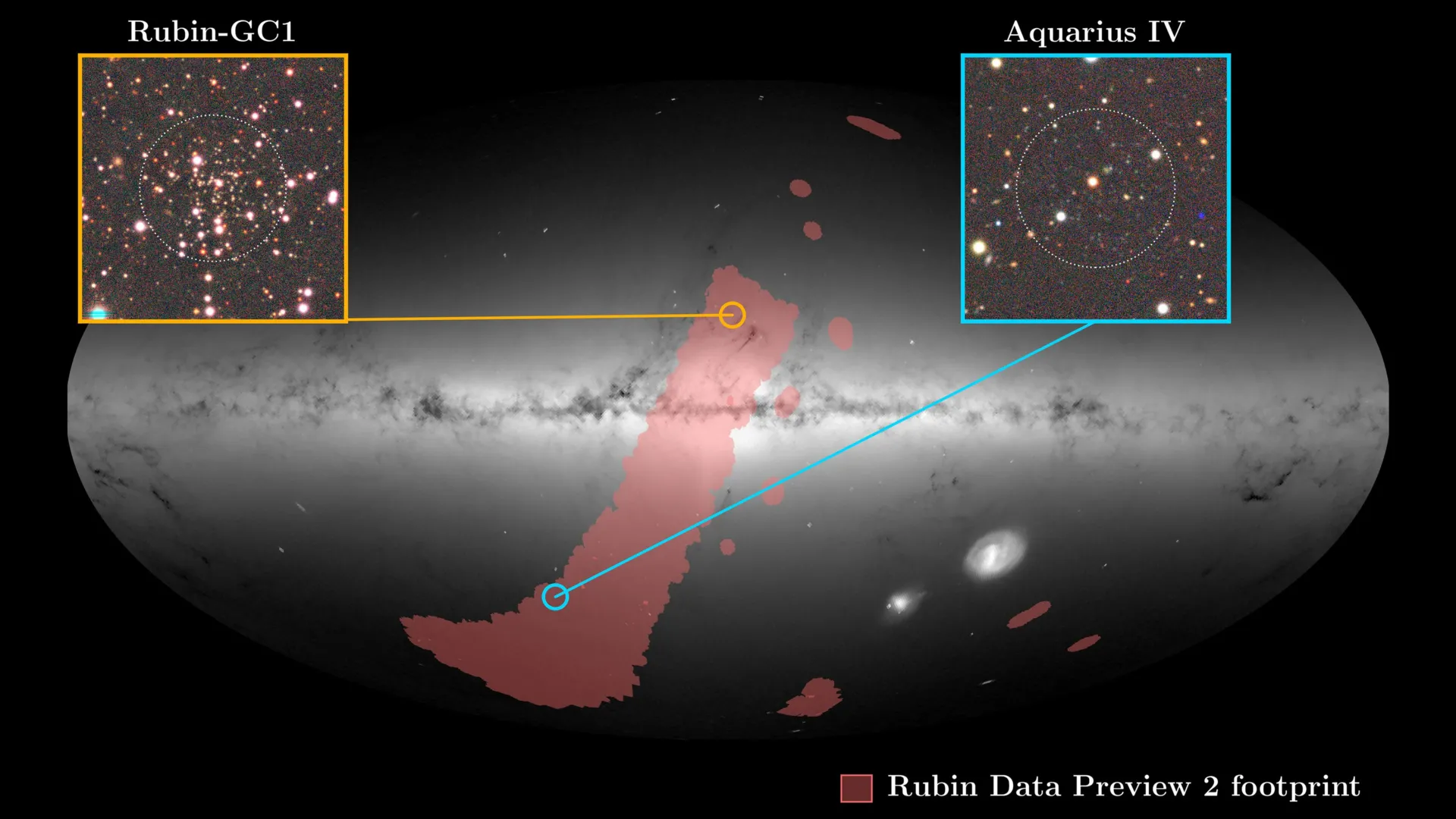
Aquarius IV was hiding 355,000 light-years from Earth, while a second newly found companion lay behind thick clouds of cosmic dust. Both came into view in early observations from the Vera C. Rubin Observatory in Chile, even though the images covered just 7% of the night sky.
The discoveries matter because astronomers have counted about 65 satellite galaxies around the Milky Way, but estimates suggest hundreds more may remain unseen. These small companions include dwarf galaxies and star clusters. Some hold so few stars, or sit in such difficult places to observe, that they have escaped earlier searches. Finding them can help scientists piece together how the Milky Way formed and learn more about dark matter, the unseen material thought to shape galaxies.
The two objects are different kinds of companions. Aquarius IV is a tiny galaxy in the distant outskirts of the Milky Way. Rubin-GC1 is a star cluster on the other side of our galaxy, tucked into a region where cosmic dust blocks much of the light. Researchers identified both using preview observations gathered between April 2025 and January 2026, before the observatory's official launch.
William Cerny, an astronomy student at Yale University and lead author of the Aquarius IV study, said the early finds are only a beginning. He also co-authored the Rubin-GC1 study. The research appeared in Research Notes of the AAS, while the Rubin-GC1 paper was accepted by The Astrophysical Journal Letters. Yale astronomy professor Marla Geha, a co-author of both studies, called it remarkable that the long-awaited search for new Milky Way satellites in Rubin data is now underway.
The observatory began its 10-year Legacy Survey of Space and Time in June. Based on Cerro Pachon in the Chilean Andes, it will repeatedly photograph large areas of the Southern Hemisphere sky, creating a detailed record of how the night sky changes. The survey aims to map the Milky Way's halo, the broad region around its central disk that contains stars, gas, dark matter and smaller structures.
Rubin's 8.4-meter Simonyi Survey Telescope works with the largest digital camera ever built, which can capture images at 3.2 gigapixels. The facility is jointly funded by the U.S. National Science Foundation and the Department of Energy's Office of Science. Its first discoveries show how even a small slice of its planned observations can reveal objects that were hard to spot.
As Rubin surveys more of the sky over the coming decade, astronomers will have a better chance of finding the Milky Way's faint, overlooked neighbors. Each new satellite could add a clue to the story of how our galaxy took shape—and help researchers test their ideas about the universe's hidden matter.