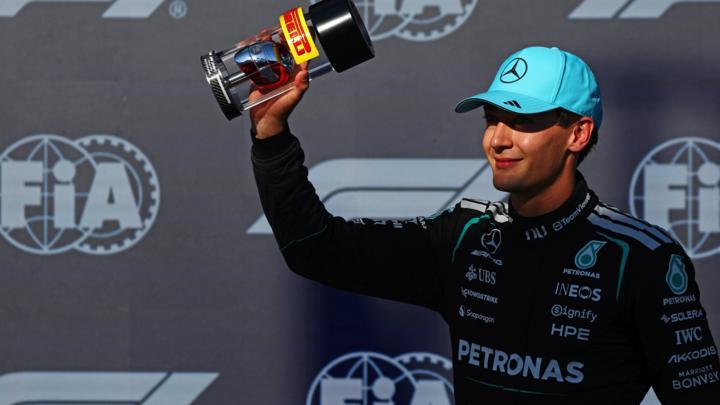
George Russell seized the moment in Montreal, piloting his Mercedes to sprint pole at the Canadian Grand Prix with a precision that announced, unmistakably, that the British driver's difficult season was finally taking a turn. He clocked a time just 0.068 seconds faster than his team-mate Kimi Antonelli, who has dominated the opening races of the year by winning three of four grands prix while Russell languished 20 points behind.
Russell's dominance felt earned. He was fastest on both runs in final qualifying—a rare clean sweep at a circuit known for its unforgiving grip and racing lineage. His redemption mattered because the past weeks had been what he called "turbulent," a season that began with him struggling to find his rhythm against a younger, sharper Antonelli. Coming to Montreal, Russell carried the weight of needing to prove something not just to his rivals but to himself. "It feels great after a tough Miami but I never doubted myself," he told reporters. "I always knew what I could do."
The margin of his comeback owes much to Mercedes' major car upgrade, brought to this track specifically for this weekend. Russell was candid about its impact. "The team have done a great job to bring this forward," he said. "It's definitely feeling great. Pleased to have it on the car and pleased to be back in P1. It's been a little while but still a big focus for tomorrow." The car felt like a proper grand prix machine on a high-grip circuit where Mercedes has historically struggled. That matters because it meant Russell wasn't just rediscovering his own talent—the machine beneath him was finally responding.
McLaren arrived with their own second upgrade in as many races, keeping Lando Norris within 0.315 seconds of pole and Oscar Piastri closer still at 0.019 seconds behind his team-mate. Yet even their innovation couldn't match Mercedes' advantage at this particular venue. The gap speaks to the quantum nature of Formula One development: upgrades are the difference between momentum and standstill.
The battle's periphery told other stories. Lewis Hamilton, chasing records on the circuit where he shares the most wins alongside Michael Schumacher, landed fourth, 0.361 seconds adrift. Max Verstappen, wrestling with a car he said was "jumping" at the rear, secured eighth place. There were casualties too: Liam Lawson and Alex Albon missed qualifying entirely after their teams couldn't repair their cars in time—Lawson after hydraulic failure, Albon after an encounter with a groundhog. Fernando Alonso's day ended against the barriers at Turn Three after he locked his front wheels with just under 90 seconds remaining in the session, an uncharacteristic mistake for the veteran Spaniard trying to prove Aston Martin could punch above its weight.
Russell's sprint pole wasn't just about fastest laps. It was permission to believe that the season could recalibrate. Montreal had delivered the reset his confidence needed, and tomorrow would show whether he could translate that single extraordinary lap into sustained performance across the sprint and the main race ahead.