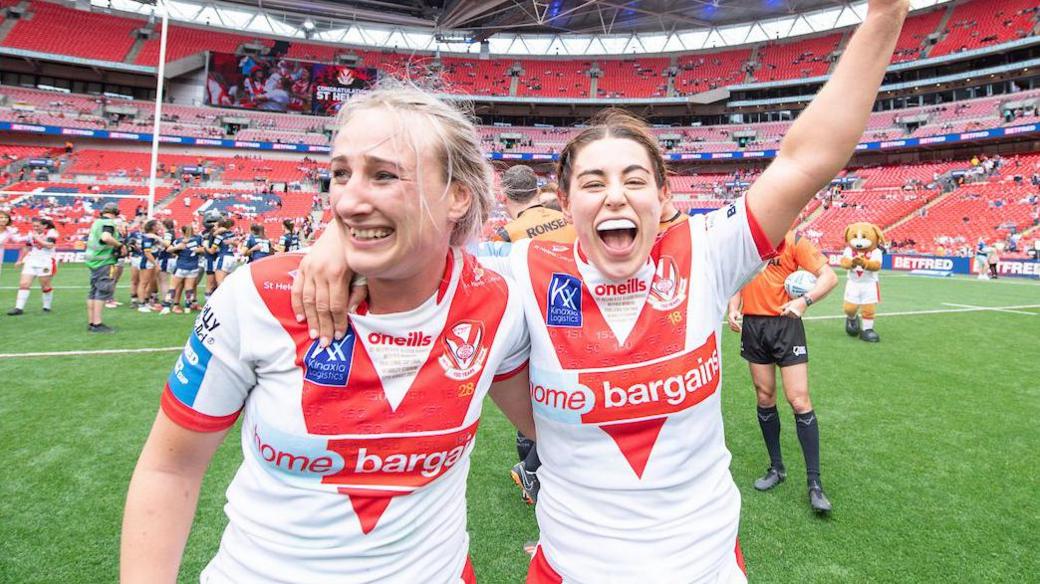
Jodie Cunningham pulled on a St Helens shirt eight years ago when the women's rugby league program didn't yet exist, and on the final day of this season, she will hang it up as England's most-capped international player in the sport—a journey that has fundamentally reshaped women's rugby league in Britain. Alongside her lifelong friend Emily Rudge, who holds 34 England caps of her own, Cunningham is stepping back from the game at its highest point, after a partnership that has defined the women's sport for the past eight years.
The significance of their retirement cannot be separated from what they have built. When both players joined St Helens at the club's women's side formation in 2016, women's rugby league was still finding its footing in the professional sphere. Cunningham, the current England and St Helens captain with 34 international caps, and Rudge, the former England captain who held the position from 2018 to 2023, didn't just play the game—they pioneered it. Between them, they have made 197 appearances for St Helens, turning the club into a powerhouse that has claimed a league title, two League Leaders' Shields, and four consecutive Women's Challenge Cups between 2021 and 2024. Cunningham herself earned the 2021 Woman of Steel award, cementing her status as the sport's leading figure during its most expansive period.
"Rugby league has given me everything in life and I am so grateful for the opportunities and experiences I have had playing the sport I love," Cunningham said in a statement that captures the depth of what these two players have sacrificed and gained. Even as she announces her departure, she remains focused on the work ahead: a Challenge Cup final, the Women's Super League season, and potentially a World Cup in Australia in October 2026—a tournament both players still hope to represent England in, offering a poignant finale to their international careers.
Rudge's individual accomplishments tell a parallel story. She has scored 48 tries across 102 appearances for Saints, making her only the second woman ever to reach that century mark for the club, following Channy Crowl. Yet what strikes her most as she contemplates retirement is not the numbers but the partnership. "I think Jodie and I always knew that we would finish together," she reflected. "We've had a long career side by side and, honestly, I don't think either of us wanted to play without the other." That sentiment speaks to a bond forged in the earliest days of women's professional rugby league, when every match mattered, not just as sport but as proof of concept.
St Helens chairman Eamonn McManus placed their legacy in historical context by comparing the two players to Christabel, Sylvia, and Adela Pankhurst—the daughters of suffragette leader Emmeline Pankhurst. "They have driven the pioneering spirit for the women's game, and it is future generations who will really bear the fruit of their incredible efforts," he said. Cunningham has already begun her next chapter, having taken on the role of St Helens' head of women's pathways and performance in 2024, ensuring that the infrastructure they built will continue to develop long after they step away from the field.
For Rudge, the decision to retire now feels bittersweet but right. "I probably do feel like I could carry on for another couple of years, but I'm certain that this is the right decision. I'm excited for other opportunities and being able to experience some new things." As these two pioneers leave the game, they leave behind a transformed sport—one that wouldn't exist in its current form without them.