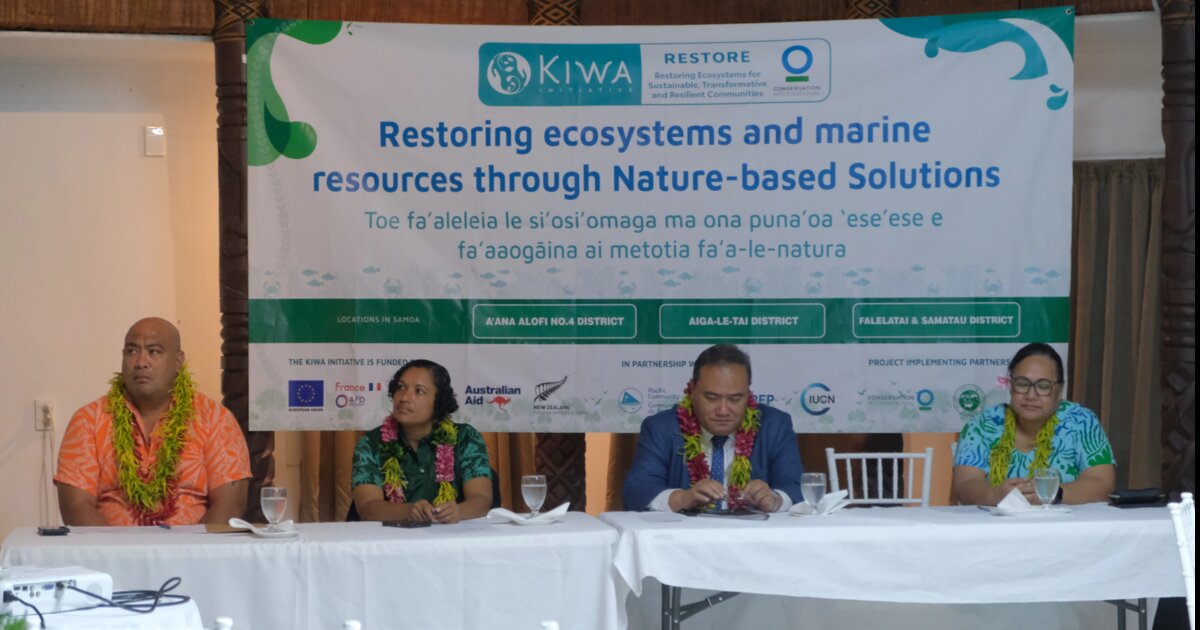
More than 12,600 coral fragments are now taking root across Samoa's reefs, the result of a training program that has mobilized communities to become guardians of their own coastal ecosystems. The Kiwa RESTORE Project, funded by the Kiwa Initiative and implemented by Conservation International, recently completed its first phase with a closing ceremony at Samoa Beach Resort in Mulifanua, marking not just the end of two weeks of intensive training but a decisive shift toward locally-led reef recovery.
The initiative brought together government representatives and selected communities across seven pilot sites—Faleatiu, Lalovi, Fuailolo'o, Salua-uta, Apai-uta, Samatau and Matautu Falelatai—equipping them with the skills to conduct coral restoration, deploy reef stars, understand coral ecology, and monitor their work over time. What makes this effort distinctive is its investment in capacity-building rather than top-down intervention. During the practical phase, participants at each site installed 100 reef stars, with approximately 1,800 coral fragments attached per location, totalling 700 reef stars across all seven communities.
This work arrives at a critical moment. Samoa's coral reefs, like those across the Pacific, face mounting pressure from climate change, ocean acidification, and fishing pressure. Conservation International Samoa Director Le'ausālilō Leilani Duffy emphasized that the program represents "a significant step toward restoring degraded reef areas and strengthening the resilience of coastal ecosystems and communities." The completion of these first seven sites opens a pathway for expansion to additional villages, with technical support and knowledge-sharing flowing across the region through Conservation International's network in Fiji and Timor-Leste.
The ceremony itself reflected the program's emphasis on partnership and shared stewardship. Bishop Mulipola Oliva of Salua-Uta opened proceedings with a devotion that grounded the work in spiritual responsibility—the care of marine resources and creation for future generations. This framing proved meaningful to participants like Tanuvasa Joyita, who described the training as a valuable first experience and expressed her intention to share what she learned with her village and family to promote marine conservation awareness.
Government support underscores the initiative's significance. Tologatā Tamaleaoa Leilua, Acting Assistant Chief Executive Officer of the Fisheries Division at the Ministry of Agriculture and Fisheries, welcomed the program as strengthening partnerships in addressing climate change impacts and supporting community-based fisheries management. In a region where fishing remains central to food security and livelihoods, building reef resilience directly protects the communities that depend on healthy fisheries.
Yet Duffy's closing words captured the truest measure of the work ahead: "Coral restoration is not a one-time activity. It requires continuous care, monitoring, learning and collaboration. The small coral fragments planted today represent hope for healthier reefs, stronger fisheries, resilient communities and a sustainable future for Samoa." The 12,600 fragments now settling into Samoa's waters are far too young to predict survival rates or eventual reef coverage. But what this initiative plants is something equally vital—a foundation of local knowledge, community ownership, and cross-country collaboration that allows restoration to become not an external project but a commitment woven into the fabric of each village's relationship with its ocean.