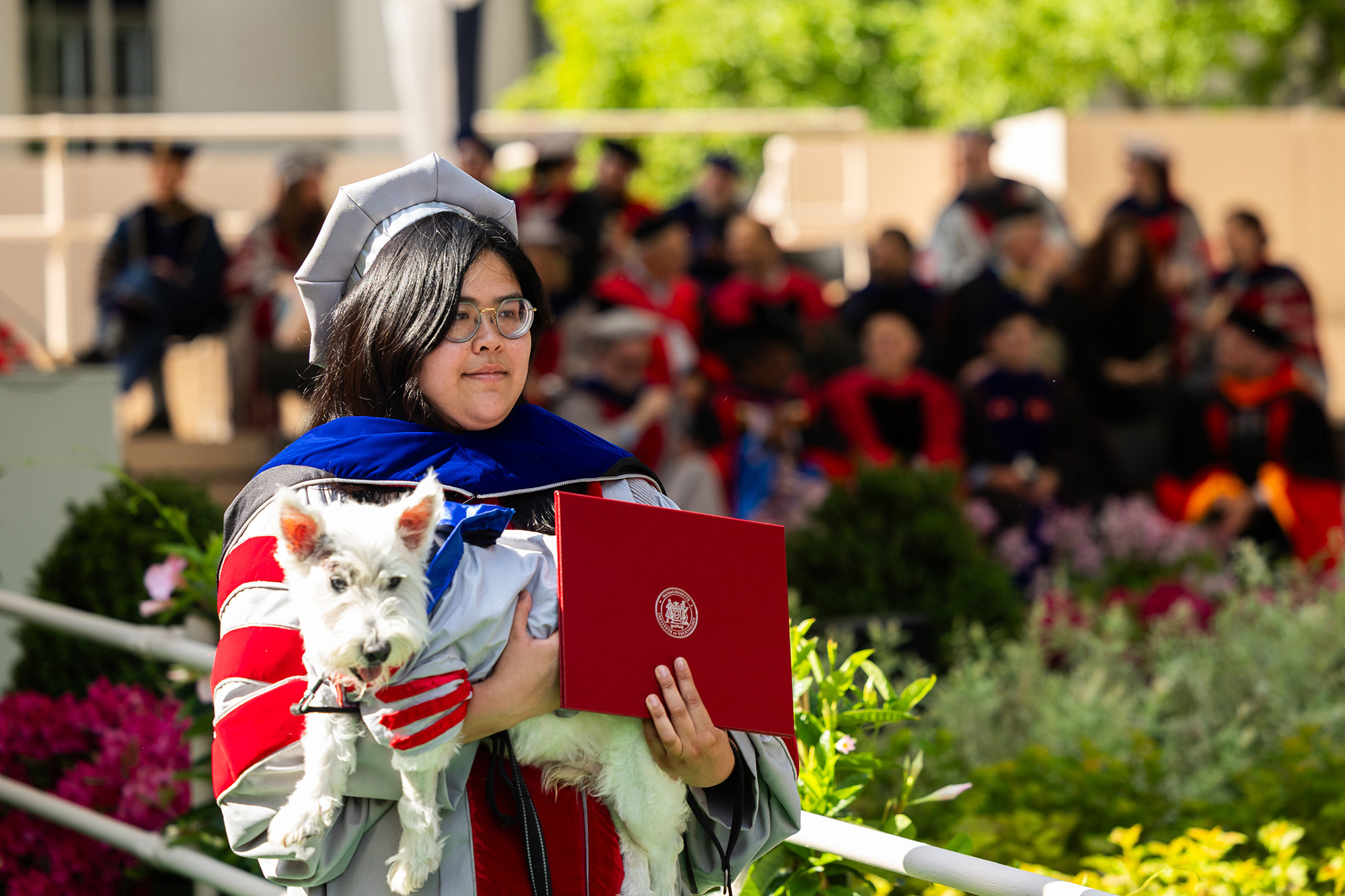
Michelle Quien walked across the MIT graduation stage with a golden retriever in a custom-sewn doctoral gown at her side, a four-year partnership made tangible in hand-stitched fabric. Vinny, her dog and self-proclaimed "pivotal member of my research group," wore the academic regalia as proudly as his human, who had just earned her PhD in chemical engineering from MIT's prestigious Department of Chemical Engineering.
The moment was more than a sentimental flourish. For Quien, Vinny's presence at her doctoral ceremony symbolized something essential about how she had approached her entire PhD journey: the integration of care, creativity, and scientific ambition. While pursuing groundbreaking work in her field, she had deliberately made space for the relationships and practices that grounded her.
Quien, originally from Moorestown, New Jersey, spent her doctorate in Michael Strano's lab developing a novel nanomaterial called 2DPA-1. The material represents a conceptual breakthrough—combining the strength and electrical conductivity of graphene with the durability of Kevlar, the polymer used in bulletproof vests. Her thesis work has been instrumental in establishing characterization tools that will allow future researchers to optimize this material's properties for applications yet to be imagined. It is the kind of foundational science that opens doors for an entire field.
Yet Quien was equally committed to her own creativity outside the lab. Unable to find any vendor selling doctoral gowns for dogs, she decided to make one herself. Using tutorials and sewing machines at Metropolis, a campus maker space, she hand-stitched the finishing touches by hand. Her approach—learning through documentation, perfectionism tempered by pragmatism—mirrors her scientific practice. She has also taught herself crochet, knitting, embroidery, bookbinding, and pottery, creating everything from her own clothes and journals to the physical binding of her thesis.
"I always knew that I wanted my dog, Vinny, to have a doctoral gown for graduation," Quien said. "He's been with me throughout my entire PhD and has been a pivotal member of my research group, helping everyone by being cute and reducing their stress."
This is not frivolous. The mental and emotional labor of a doctoral program is real, and Vinny's role as a stress reliever for the entire lab speaks to the human dimension of research that institutions are increasingly recognizing. What Quien chose to celebrate at her graduation was not just her own achievement, but the web of relationships—human and animal—that had sustained her through five years of rigorous work.
Her next chapter is already underway. Quien has accepted a position at a startup developing portable nuclear reactors designed for regions without reliable grid electricity. She will tackle materials science challenges central to making this technology viable. It is the kind of high-impact work she has been pursuing since her undergraduate days at Cornell, when exposure to polymers and nanotechnology first showed her the potential of innovative materials to solve real-world problems.
As she leaves MIT, Quien carries forward both the technical rigor of her dissertation and the creative resourcefulness she brought to every challenge, from characterizing novel nanomaterials to sewing a doctoral gown for her best companion. In that, she embodies what education at its best can be: not the suppression of personality in service of specialization, but the deepening of both.