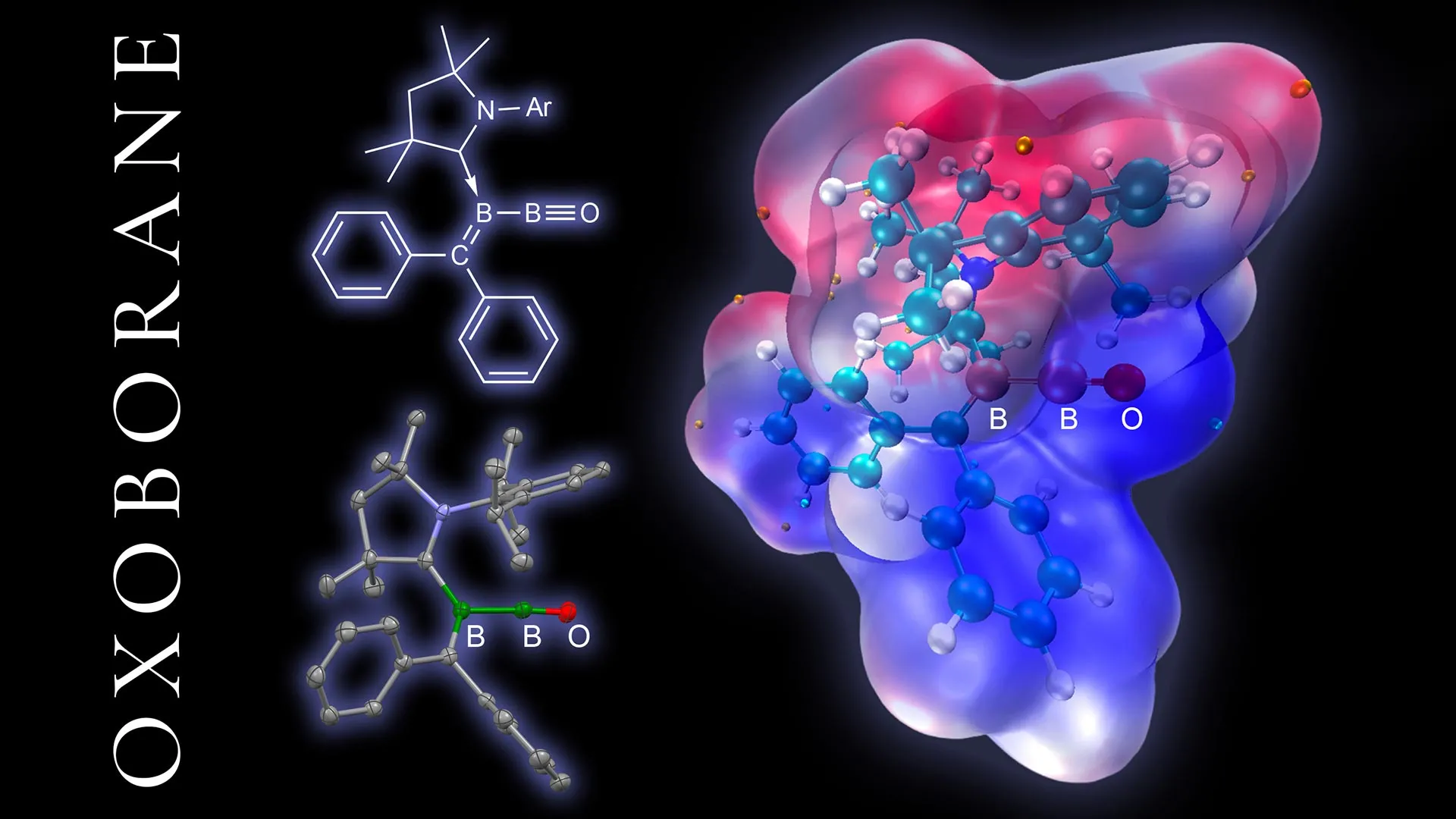
Three orange and yellow solids in a University of Würzburg lab turned out to be the answer to a chemistry puzzle that had lasted more than 60 years. They contained oxoboranes: rare molecules with a triple bond between boron and oxygen that scientists had struggled to make, isolate and study.
Boron, an element used in materials such as glass and ceramics, rarely forms triple bonds. These bonds involve three shared pairs of electrons between two atoms. For decades, chemists had detected oxoboranes or trapped them under extreme conditions, but stable examples that could be separated and examined in an ordinary laboratory had remained out of reach. That made it difficult to learn how the molecules behave and what other chemistry they might make possible.
The breakthrough came from reactions that were not originally designed to produce oxoboranes. Two doctoral students, Lukas Lubczyk and Christian Markl, were separately studying how a compound called a diboracumulene reacts with ketones, common starting materials in organic chemistry. Both noticed unusual orange or yellow solids forming. Further study showed that oxoboranes were the main products.
The result surprised even researchers familiar with the long search. “Nearly everybody in the field had given up on oxoboranes, as they were thought to be just too unstable to be isolated,” said Professor Holger Braunschweig, who led the University of Würzburg team. “So we were stunned to see them spontaneously form in these reactions and stick around long enough that we could study them.”
The team used the method to prepare three different oxoboranes. Making more than one suggests the reaction may work beyond a single special case, though researchers are still testing how widely it can be applied. The work was published in Nature Chemistry, with computational research led by Professor Ashwini K. Phukan at Tezpur University in India helping the team interpret its findings.
The discovery adds to a series of advances from Braunschweig’s laboratory. In 2012, his team reported the first molecule with a triple bond between two boron atoms. In 2025, researchers produced the first neutral molecule with a boron-carbon triple bond. The new oxoboranes address another difficult bond combination among the light elements in the periodic table.
For now, the researchers are looking for ways to make additional oxoboranes and exploring whether similar reactions could help create other hard-to-isolate compounds involving different elements. The work does not mean every unstable molecule is suddenly within reach. But it shows that a useful route can emerge from an unexpected result—and that compounds long thought too fleeting to study may sometimes be made in a surprisingly direct way. The research received support from the German Research Foundation, the German Academic Exchange Service and India’s Department of Science & Technology.