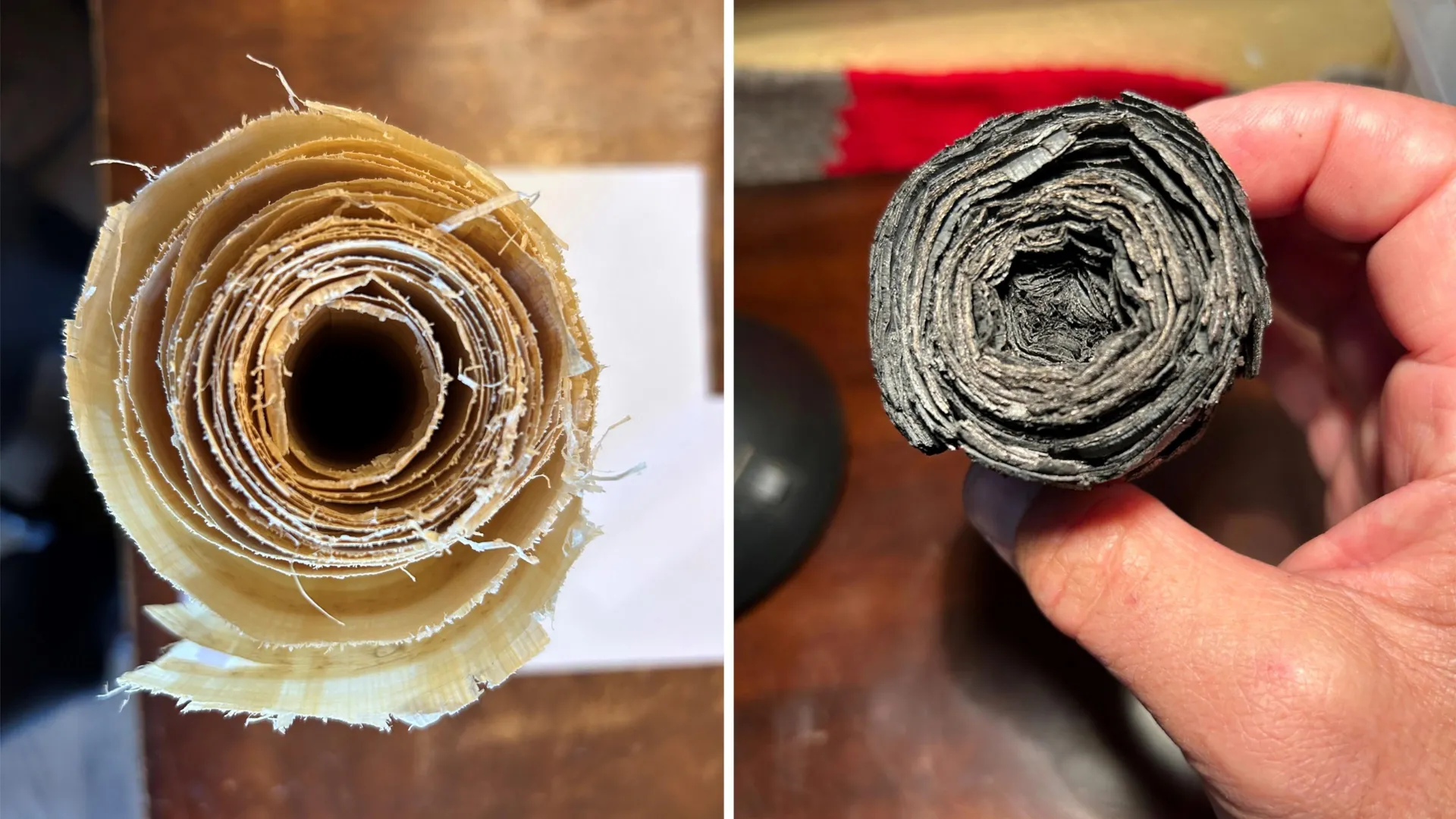
Douglas Seiler burned a scroll inscribed with lines from 'Star Wars' and the Bible to solve a 2,000-year-old mystery.
In Herculaneum, Italy, the eruption of Mount Vesuvius in 79 C.E. didn’t just destroy—it preserved. Buried under volcanic ash, more than 1,800 papyrus scrolls were carbonized, turning into fragile black cylinders. These scrolls, from the only surviving ancient library of its kind, could hold lost works of philosophy, poetry, and science—voices from the Roman world frozen in time.
But reading them has been nearly impossible. Unrolling the brittle scrolls often turns them to dust. So Seiler, a researcher with Berkeley SETI, tested a new way: don’t unroll them at all. Instead, scan them with X-rays. His idea? If ancient ink contained lead, it would absorb X-rays much more strongly than the carbonized papyrus, making the writing visible without touching the scroll.
To test this, Seiler recreated ancient conditions. He used real papyrus from Egypt, reed pens, and traditional Japanese lampblack ink. High school students copied texts—including a quote from 'The Outer Limits'—onto the scrolls. Then, he burned them in a furnace until they were as brittle and black as those from Herculaneum.
The results, published in PLOS ONE, were striking. Even tiny amounts of lead in the ink absorbed up to 25 times more X-rays than the surrounding material, making the text stand out clearly in scans. Better yet, a handheld X-ray scanner could detect lead in the ink—offering a quick, low-cost way to find which scrolls are worth deeper study.
This could change everything. So far, only a few of the 1,800 scrolls have been virtually unrolled, and none were first tested for lead. But one fragment from early, destructive attempts to open a scroll did show traces of lead—hinting that more might be out there.
"The value in this project is practically unquantifiable," said Leah Packard-Grams, a UC Berkeley papyrologist who advised the team. "The stakes are the largest in the history of Greek literature."
For centuries, scholars have dreamed of unlocking these texts. Some may contain unknown works by famous thinkers, or lost writings from ancient intellectual circles. Now, with a method that’s non-invasive and precise, that dream is closer than ever. The next step? Scanning the real Herculaneum scrolls—not for ash, but for answers.