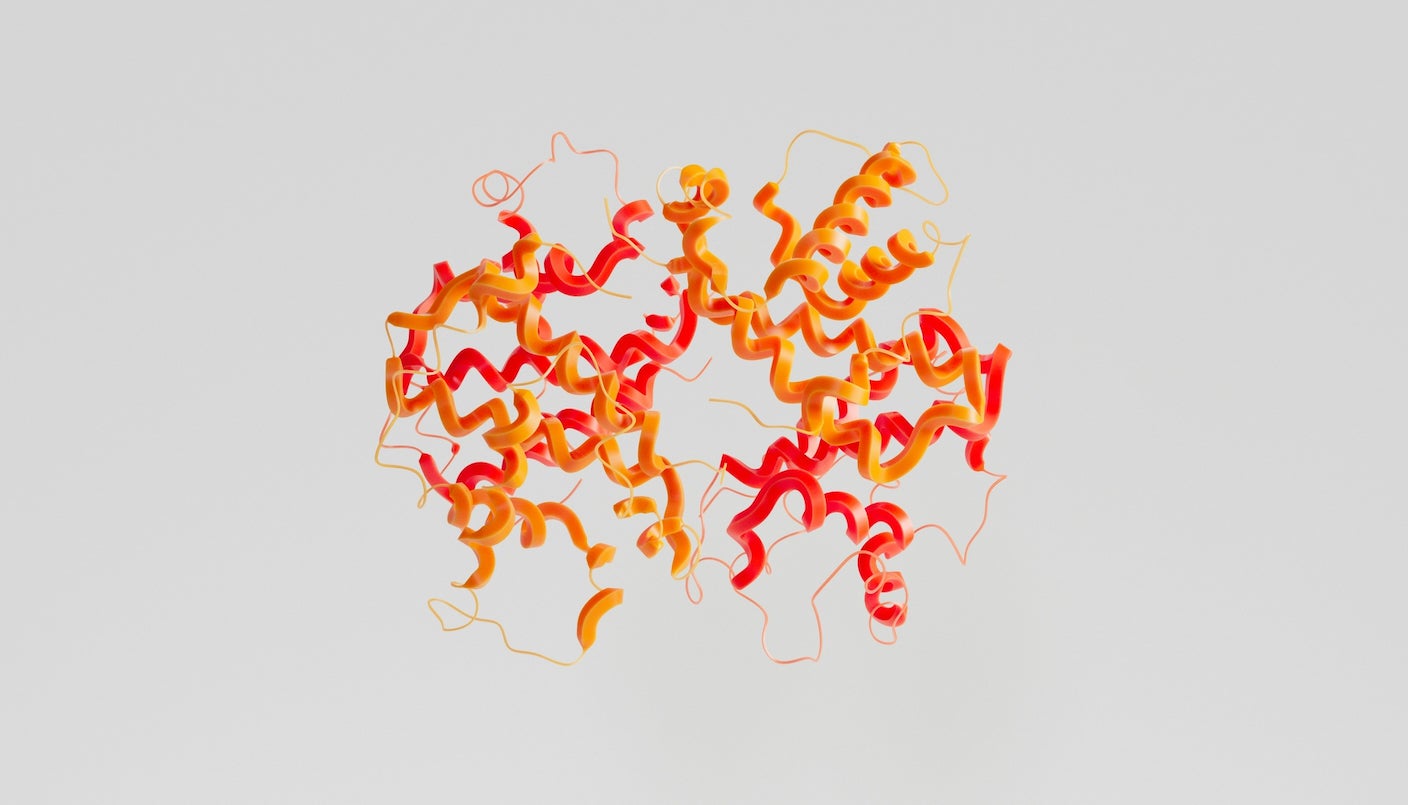
A request as simple as “make a protein that glows green” can now set off a long chain of design work at Westlake University in China. Researchers there built Pinal, an AI system that turns plain-language descriptions of a protein’s job into proposed amino-acid sequences for testing in a lab.
Protein design has often been a task for specialists. To create a new enzyme or imaging marker, scientists typically need to describe its structure or sequence in technical terms and use specialized software. Newer AI systems have opened ways to design proteins that do not exist in nature, but they have not removed that barrier. Pinal’s approach, described in research published in Nature, is to let a user start with the function they want instead.
The system works in two stages. First, it turns a written request into a structural blueprint. Then a second module uses that blueprint and the original request to choose the amino acids that make up the protein. Users do not have to specify a molecular structure or sequence. Pinal also generates several possible designs, scores each structure-and-sequence combination, and selects a candidate. That matters because a useful protein may not have the shape a designer would guess first.
To train the system, the Westlake team assembled about 135 million protein sequences. Large language models helped write descriptions of what those proteins do, producing around 1.7 billion protein-and-text pairs. The researchers used AlphaFold, an AI system that predicts protein structures, to estimate structures for the sequences. They trained Pinal’s two modules separately: one to map a text prompt to a structural plan, and the other to choose amino acids using both the plan and the prompt.
The team tested Pinal on four goals: a protein that glows green, an enzyme that breaks down PET plastic, an enzyme that processes alcohols, and a shuttle protein that carries chemicals between enzymes in a metabolic pathway. The results varied. For the glowing-protein task, Pinal produced 50,000 sequences. Researchers narrowed those to 29 for lab tests, and just one fluoresced. The shuttle task had a stronger result: five of 20 candidates worked. The best boosted the output of a multi-enzyme pathway for fixing carbon dioxide to 1.7 times the output of its natural version.
Those numbers show both the promise and the work still required. Pinal can produce a design that meets a goal, but finding one may mean generating and testing many candidates. Its developers also warn that the rules used to screen designs may keep the system from exploring some possibilities. Every sequence still needs to be checked by experienced scientists in a properly equipped lab.
Even so, Pinal changes who can take the first step. A biologist may be able to describe a function before knowing how to translate it into structural constraints, then use the system to generate candidates for expert review and experiments. The next challenge is making more of those candidates work on the first try. For now, Pinal’s clearest contribution is turning an idea stated in ordinary words into a protein design that researchers can put to the test.