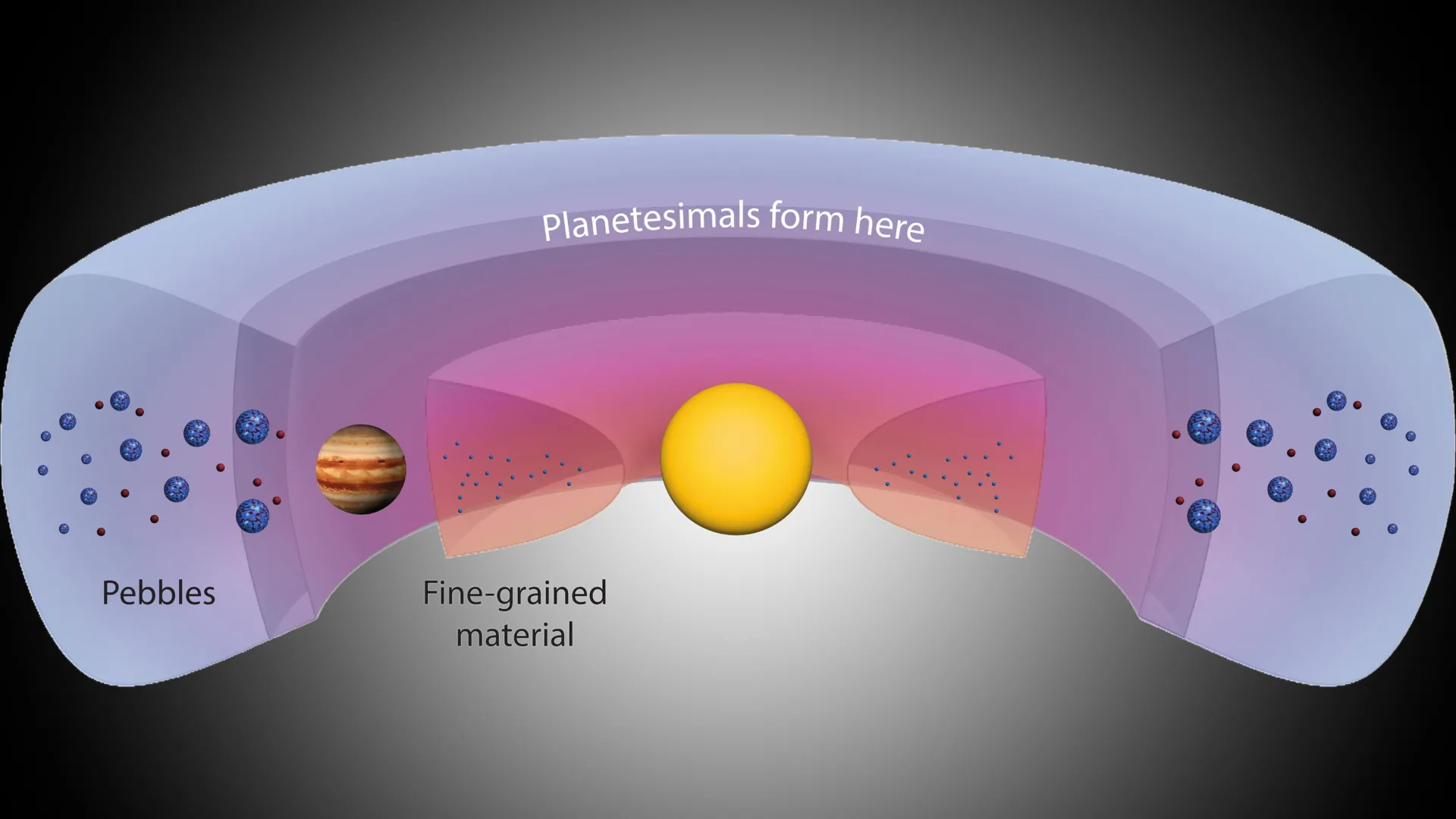
Just beyond Jupiter's orbit in the young Solar System, a ring of dust and gas was quietly building worlds. Four and a half billion years ago, scientists now believe, this zone functioned as what researchers call a "planetesimal factory"—a remarkably efficient and versatile region that churned out rocky planetary building blocks with wildly different compositions over roughly two million years.
The discovery, made by researchers at the Max Planck Institute for Solar System Research in Germany and published in The Astrophysical Journal, offers a crucial window into how our Solar System assembled itself. It answers a long-standing puzzle: could dust traps—regions where Jupiter's gravitational pull concentrated material—actually produce the variety of space rocks we see embedded in meteorites today? Using detailed computer simulations that tracked both microscopic particle collisions and large-scale disk movement, the team led by Joanna Drążkowska found the answer is yes.
The simulations focused on the period between two and four million years after the Solar System's birth, when Jupiter had already cleared much of the nearby material and created a gap in the surrounding disk. This gap generated a ring of higher gas pressure just beyond Jupiter's orbit—a cosmic traffic jam that trapped vast amounts of dust and allowed small clumps called pebbles to accumulate. Previous research had suggested such dust traps existed, but remained unclear whether they could maintain their planet-building productivity for extended periods while generating diverse bodies. The new work shows they absolutely could.
What makes this discovery particularly elegant is how it bridges theory and evidence. The researchers connected their simulated planetesimals directly to actual meteorites that have survived on Earth since the Solar System's infancy. They focused especially on carbonaceous chondrites, carbon-rich meteorites believed to have formed beyond Jupiter during the exact period the simulations modeled. Laboratory analysis divides these meteorites into six groups based on composition, with some fragile and fine-grained while others are stronger and contain embedded inclusions. The simulations revealed that these two meteorite types corresponded to two distinct materials in the early disk: fragile, dusty matter and sturdier clumps that formed earlier in hotter regions before spreading outward.
The models revealed something unexpected about how these materials evolved. During the first 500,000 years, the proportion of crumbly material dropped, then rose again over the following million years. This shifting balance eventually produced distinct generations of planetesimals—one dominated by fragile material, another by sturdier matter. Jupiter itself played a crucial gating role, acting as a stronger barrier for larger, heavier particles while allowing smaller dust grains to pass through more readily.
"For the first time, we have succeeded in accurately reproducing the results of laboratory studies of meteorites using computer simulations of the early Solar System," said MPS Director Thorsten Kleine, capturing the significance of matching real-world evidence to simulation. The work suggests that this single region, just beyond Jupiter's orbit, may explain the origins of multiple meteorite families—and by extension, much of the rocky material that would eventually assemble into planets and asteroids throughout our corner of space.