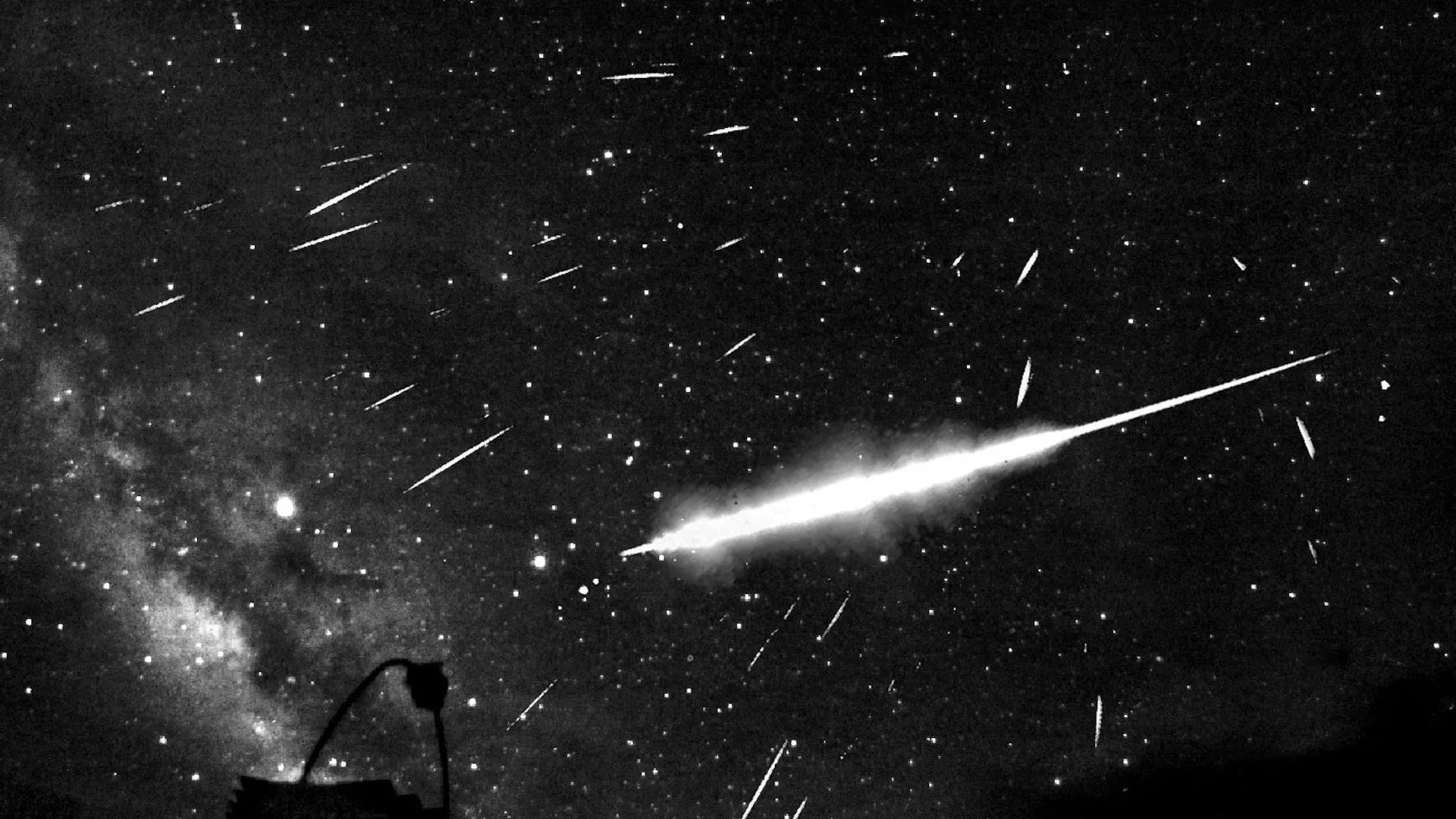
On a routine night scanning automated sky cameras across Canada, Japan, California and Europe, a scientist noticed something remarkable: 282 meteors tracing back to a single asteroid in the process of falling apart near the Sun. The discovery, published in the Astrophysical Journal in March 2026, reveals an asteroid caught in the act of disintegration—a rare glimpse into how rocky bodies in our solar system physically evolve and ultimately collapse under extreme conditions.
Every night, thousands of automated cameras watch the sky for meteors, those brief flashes of light created when tiny fragments from space burn up in Earth's atmosphere. While popular culture fixates on giant asteroids that might threaten Earth, planetary scientists know that the much smaller particles constantly raining down on our planet tell equally fascinating stories about the cosmos. These meteors form when rock grains from space—traveling at speeds exceeding 15 miles per second—rapidly heat up in the atmosphere, causing their outer layers to vaporize into electrically charged gas that glows brilliantly across the night sky. For tiny particles, the entire event lasts only a split second before the material burns completely away.
The challenge for scientists has always been connecting these fleeting streaks of light to their sources in space. Comets, those "dirty snowballs" of ice and dust, regularly create visible meteor showers as they approach the Sun and release debris into space. Asteroids, however, are trickier. These dry, rocky bodies formed in the warm inner solar system and typically remain quiet. When they do become "active"—releasing dust, gas or larger fragments—the causes vary widely: intense heat from the Sun, collisions with other objects, or rapid spin that tears them apart. One famous example, the asteroid 3200 Phaethon, produces December's reliable Geminid meteor shower, but most active asteroids remain hidden unless astronomers happen to observe their activity directly.
That's where meteor streams become detective tools. When an asteroid or comet first sheds fragments, those pieces stay tightly bunched together, like food coloring just dropped into water. Over time, gravitational pulls from planets gradually spread the fragments across the sky, eventually blending them into the background cosmic dust. By studying fresh meteor clusters, scientists can uncover asteroids in the act of breaking down.
The 282 meteors identified in the March 2026 study represent exactly this kind of discovery: fragments still tightly grouped enough to reveal their source, yet spread out enough to be tracked across multiple sky-camera networks spanning an entire hemisphere. The asteroid's orbit carries it dangerously close to the Sun—nearly five times closer than Earth's distance from it—subjecting the rock to scorching temperatures that likely triggered its breakup. The meteor stream's extreme orbit and the freshness of the debris suggest this disintegration happened relatively recently in cosmic terms.
The finding matters because it offers scientists a front-row seat to asteroid destruction in real time. These observations help researchers understand the physical limits of rocky bodies orbiting near the Sun, the timescales over which they fragment, and the forces that shape planetary systems. As automated sky cameras continue their nightly vigil, more hidden asteroids may emerge from the data, revealing a much more active and dynamic solar system than previously suspected—one where quiet rocks are constantly being reshaped by the intense dance between celestial bodies and solar heat.