In a specially equipped lab at Okinawa Institute of Science and Technology, chemists have finally spotted something that has eluded researchers for decades: a fleetingly stable intermediate in the formation of metallocene molecules, those peculiar compounds with a metal atom cradled between two carbon rings like a filling in a molecular sandwich.
The discovery matters because metallocenes have quietly transformed entire fields. Since the 1950s, they've become the backbone of catalysts that drive industrial chemistry, materials that store energy, sensors that detect change, and drug delivery systems that promise to revolutionize medicine. Yet for all their usefulness, scientists have struggled to understand how they actually assemble—key moments in their formation happen so fast they vanish almost instantaneously, leaving researchers blind to the process.
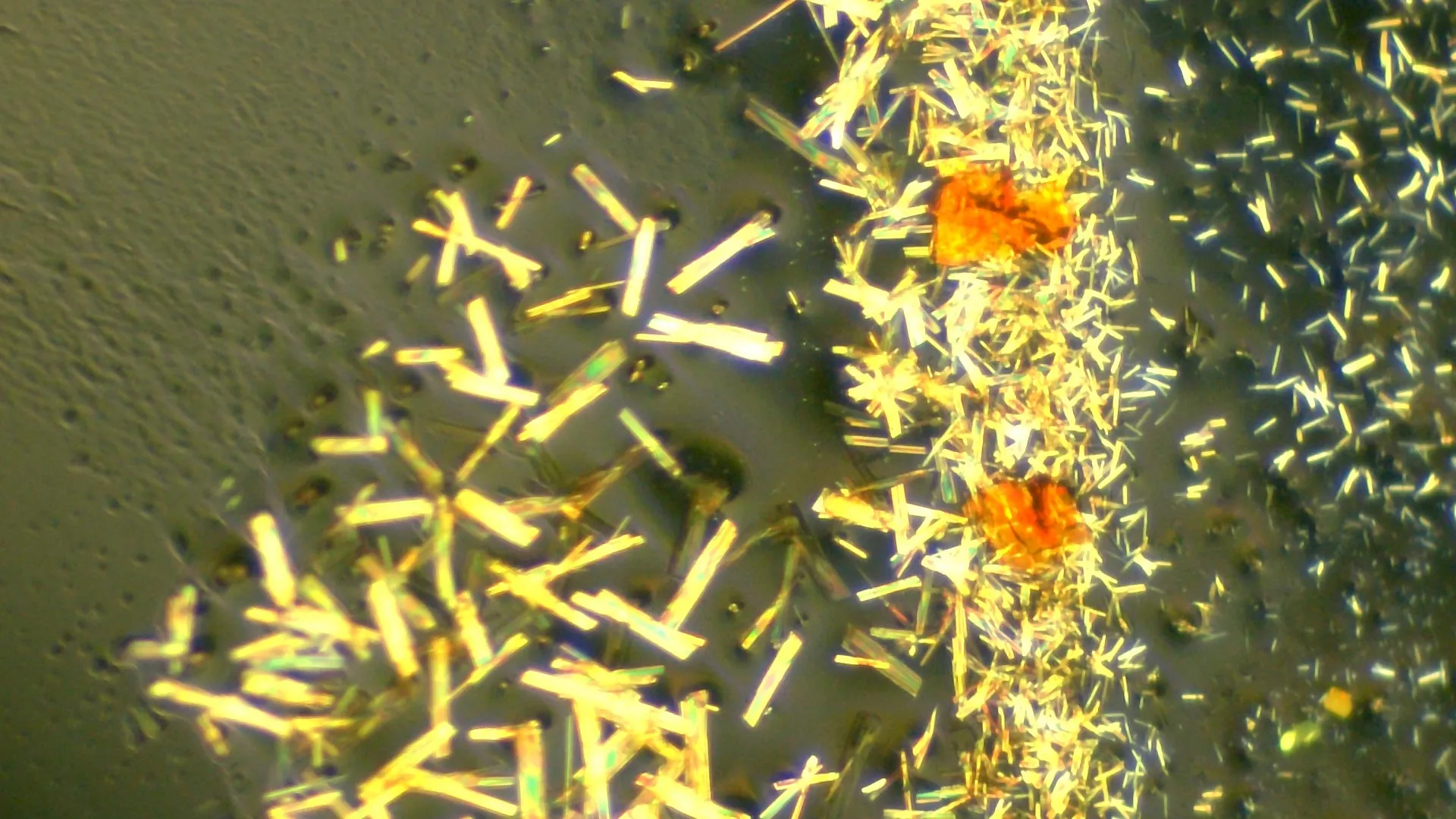
Now, Dr. Satoshi Takebayashi and his Organometallic Chemistry Group at OIST have captured and fully mapped a doubly ring-slipped intermediate, publishing their findings in the Journal of the American Chemical Society. This isn't merely an incremental advance. It's the first time researchers have used single-crystal X-ray diffraction to observe and characterize this particular configuration at the molecular level, filling a profound gap in how chemists understand these materials.
The story began with ambition. Takebayashi's team was deliberately pushing metallocenes beyond a chemistry principle established for decades—that stable transition metal complexes should contain exactly 18 electrons in their outer shell. Last year, they succeeded in creating unusual 20-electron ferrocene derivatives, challenging that old rule. But when they ran similar experiments with ruthenium, something unexpected happened: the reactions produced standard 18-electron products instead. That puzzling result became the thread that led to the breakthrough.
When the researchers isolated and analyzed one of these intermediate structures, they discovered something remarkable. Ring-slippage—when the bonds between a carbon ring and its metal atom shift—had occurred, but unusually. Instead of the carbon rings bonding through all five atoms, each ring had slipped back to bond through just one atom. Double ring-slippage had never been fully characterized before.
The team didn't stop there. They layered analytical techniques—NMR spectroscopy, mass spectrometry, and computational modeling—to map the entire reaction pathway with precision. Their work revealed another unstable stage: a single ring-slipped intermediate that emerges from the doubly ring-slipped structure. Together, these findings paint the clearest picture yet of how metallocenes form and reshape themselves during reactions.
The implications ripple outward. Takebayashi notes that there's renewed momentum in incorporating metallocenes into new materials designed to respond to stimuli or shift properties on demand. Understanding how these compounds deform and react—the precise knowledge OIST researchers now possess—opens the door to deliberately engineering metallocene-based systems. Drug delivery vehicles that release cargo on command. Catalysts fine-tuned for specific reactions. Sensors that change response in predictable ways. Materials that adapt to their environment.
For a field that has relied on these molecules for decades without fully understanding their secrets, this glimpse into the hidden stages of their formation might prove transformative. Chemistry, materials science, and medicine are all positioned to benefit when scientists can finally see what happens in those vanishing moments.