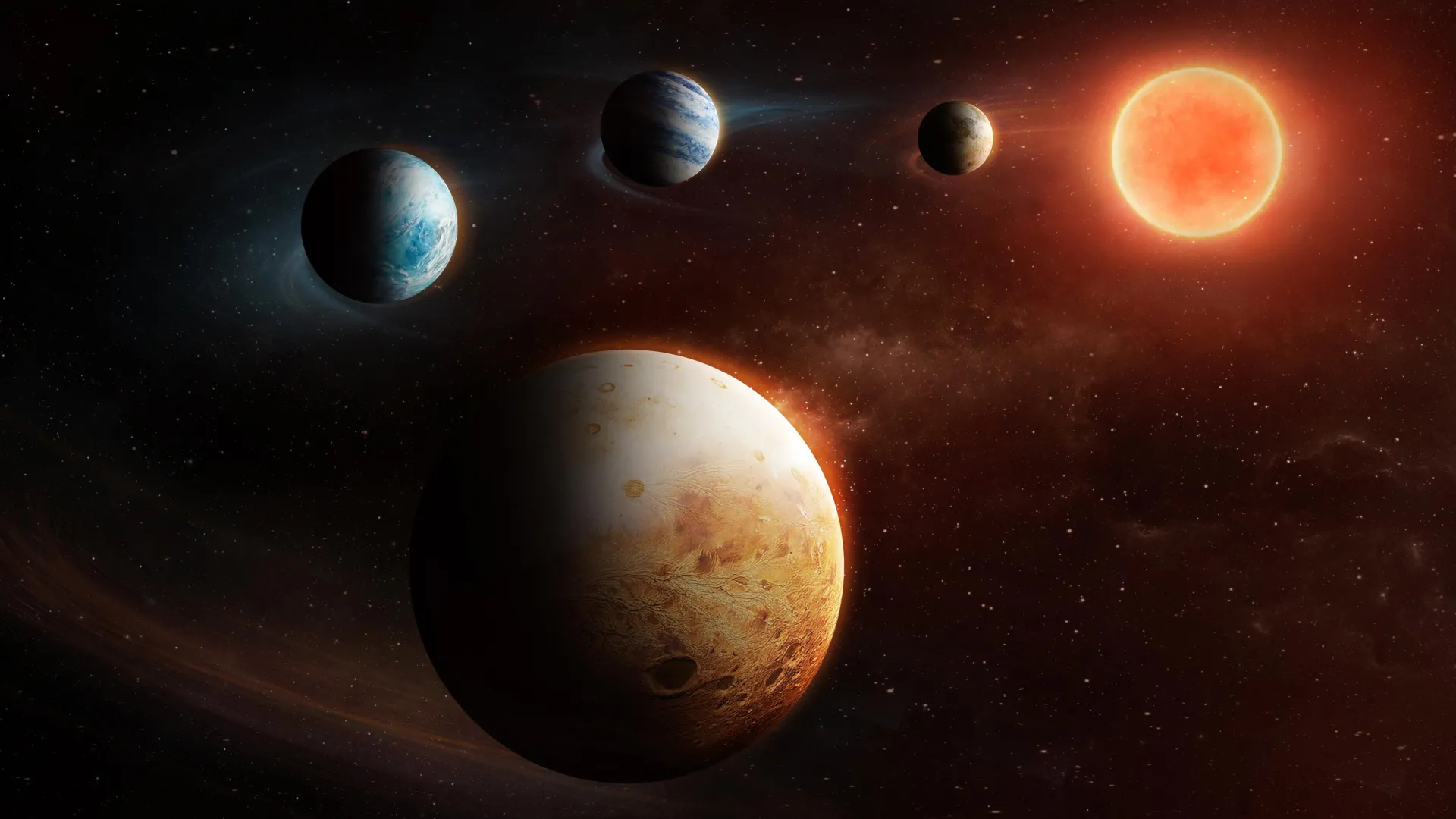
When Thomas Wilson and his team at the University of Warwick examined the star system LHS 1903, they expected to find the same planetary order that has organized our own Solar System for billions of years: rocky worlds huddled close to the star, and gas giants spinning lazily in the frigid outer reaches. Instead, they discovered something that shouldn't exist — a planetary system arranged completely backwards.
This upending of conventional wisdom matters because it forces astronomers to fundamentally rethink how planets form across the Universe. For decades, scientists have assumed that the architecture of our Solar System — with Mercury, Venus, Earth, and Mars as rocky inner planets and Jupiter, Saturn, Uranus, and Neptune as distant gas giants — reflects a universal pattern. Leading formation theories explain why: near a star's intense heat and radiation, only dense rocky cores can survive; farther out, where temperatures plummet, gas accumulates into thick atmospheres that become giant planets. Observations of countless exoplanetary systems have largely supported this model.
But LHS 1903, a small cool red dwarf star dimmer than our Sun, reveals a radically different arrangement. Using data from the European Space Agency's CHaracterising ExOPlanet Satellite (Cheops) and other space- and ground-based telescopes, Wilson's team identified four planets orbiting the star. The first three matched expectations: a rocky planet closest to the star, followed by two gas giants farther out. Then came the shock. A fourth planet, orbiting even farther from the star than the gas giants, turned out to be rocky. "That makes this an inside-out system, with a planet order of rocky-gaseous-gaseous-and then rocky again," Wilson explained. "Rocky planets don't usually form so far away from their home star."
The team initially considered straightforward explanations. Perhaps the outer rocky planet had once had a thick atmosphere that was stripped away by a catastrophic collision with an asteroid or comet. Or maybe the planets migrated over time, shuffling their positions. But simulations and orbital calculations ruled both out. Instead, their investigation pointed toward a far more intriguing possibility: the planets around LHS 1903 may not have formed all at once.
Standard theory holds that planets develop simultaneously within giant discs of gas and dust called protoplanetary discs, multiple embryos emerging and evolving together over millions of years. But researchers now believe this star system produced its planets sequentially, one after another — a concept called inside-out planet formation that was theorized about a decade ago but has lacked strong observational evidence until now.
What makes the outer rocky planet even more remarkable is that it likely formed in conditions that violate everything astronomers thought possible. "By the time this outer planet formed, the system may have already run out of gas, which is considered vital for planet formation. Yet here is a small, rocky world, defying expectations," Wilson noted. "It seems that we have found first evidence for a planet which formed in what we call a gas-depleted environment."
As telescopes grow more powerful, astronomers are discovering increasingly exotic planetary systems that challenge assumptions rooted in our own cosmic backyard. ESA scientist Maximilian Günther acknowledges the deeper significance: "Much about how planets form and evolve is still a mystery. Finding clues like this one for solving this puzzle is precisely what Cheops set out to do." The discovery suggests that our Solar System may not be the universal blueprint scientists assumed, but rather one variation among countless possibilities yet to be understood.