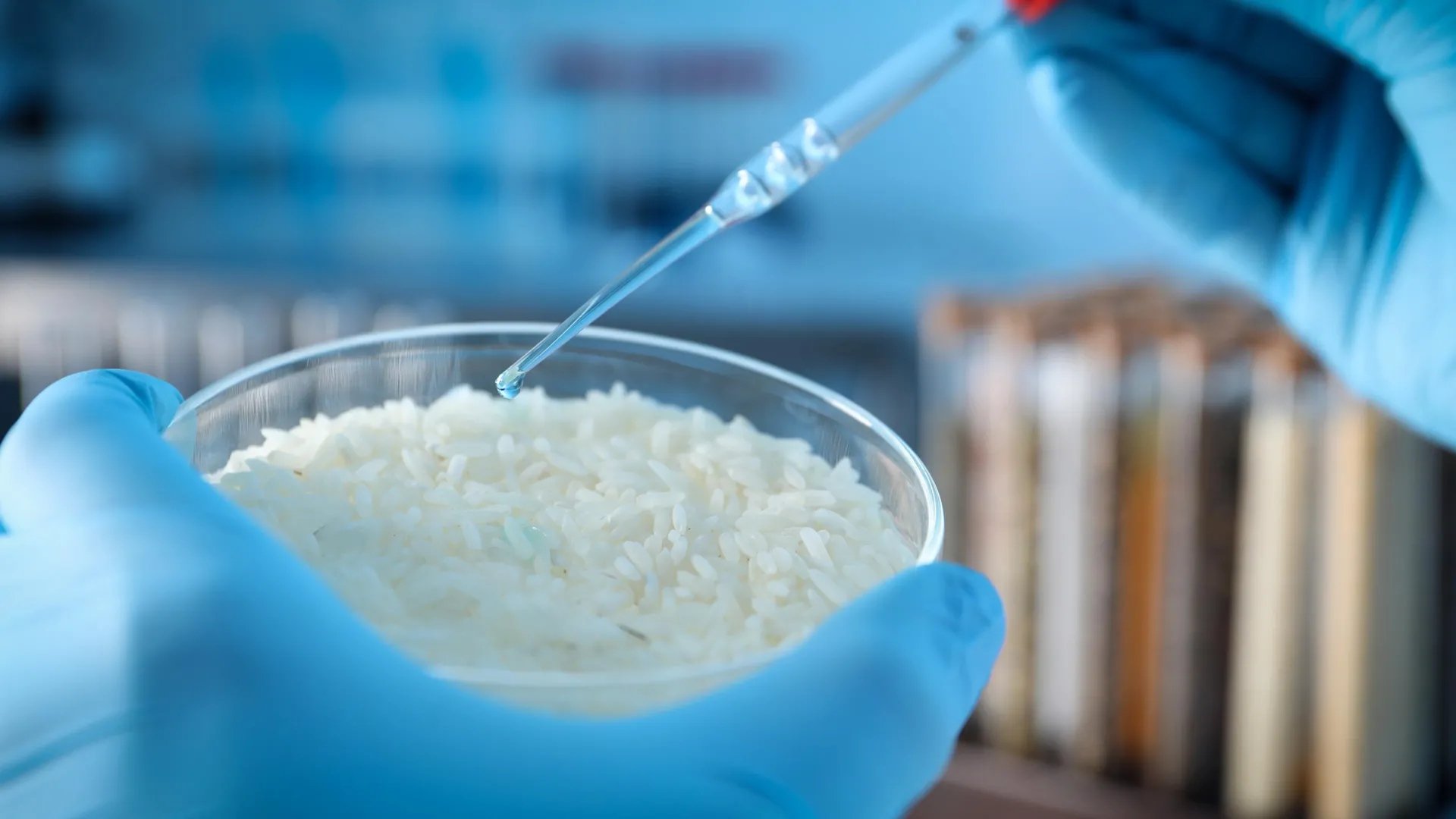
At the University of Birmingham, scientists have discovered something unexpected in one of the world's humblest foods: rice grains, when packed together, grow weaker under fast pressure but stronger under slow compression—a rare property they're now using to engineer a new generation of adaptive materials.
For most materials, strength is predictable. But rice defies this logic. When researchers compressed tightly packed rice grains slowly, they behaved as expected, holding firm. Yet when the same force was applied rapidly, the grains grew substantially weaker. This phenomenon, called "rate softening," occurs because friction between individual rice grains drops sharply during rapid loading, destabilizing the internal force networks that normally support the load. It's uncommon enough that scientists rarely see it outside laboratory settings.
Rather than treat this oddity as a curiosity, Dr. Mingchao Liu and his international team at Birmingham saw a design opportunity. They combined rice-based granular units with other materials like sand—which, helpfully, become stronger under rapid loading—to create a metamaterial that does something remarkable: it adjusts its own stiffness automatically based on the speed of applied force, with no electronics, sensors, or active control required.
The results, published in the journal Matter, show a material that can bend, buckle, or stiffen on its own depending on whether forces come slowly or suddenly. A slow push produces one mechanical response; a sudden impact triggers a completely different one. Physics itself becomes the control system.
"Rather than treating this phenomenon as curiosity, we turned it into a design principle," Liu explains. "Instead of telling a structure how to respond, we let physics decide: fast loads trigger one behavior, slow loads another."
The implications are far-reaching. In soft robotics, where safety alongside humans is paramount, this material opens possibilities that rigid, metal-based systems cannot match. Future robots built with these adaptive granulars could be lighter, safer, and genuinely responsive to their environment—ideal for delicate tasks like surgical assistance or work in unpredictable settings. Because the material adapts without external power or computation, it remains functional even if electronics fail.
The same self-adapting quality makes it valuable for protective equipment. Impact protection gear could absorb energy or deform in controlled ways during collisions, reducing injury risk. A helmet or body armor built from this metamaterial would respond differently to a hard blow than to sustained pressure, optimizing protection across various scenarios without requiring the wearer to activate anything.
What makes this work particularly elegant is its simplicity. Rice is abundantly available, inexpensive, and already familiar to materials science. The researchers have demonstrated that common granular materials—substances we see every day—can be transformed into engineered systems that respond intelligently through their own mechanical properties alone.
The discovery signals something broader: that nature and everyday objects often hold clues for advanced engineering solutions. A staple grain consumed by billions becomes the blueprint for materials that could soon protect us, assist in surgery, or enable robots to work safely beside us—all because researchers asked the right question about what happens when you squeeze rice very, very fast.