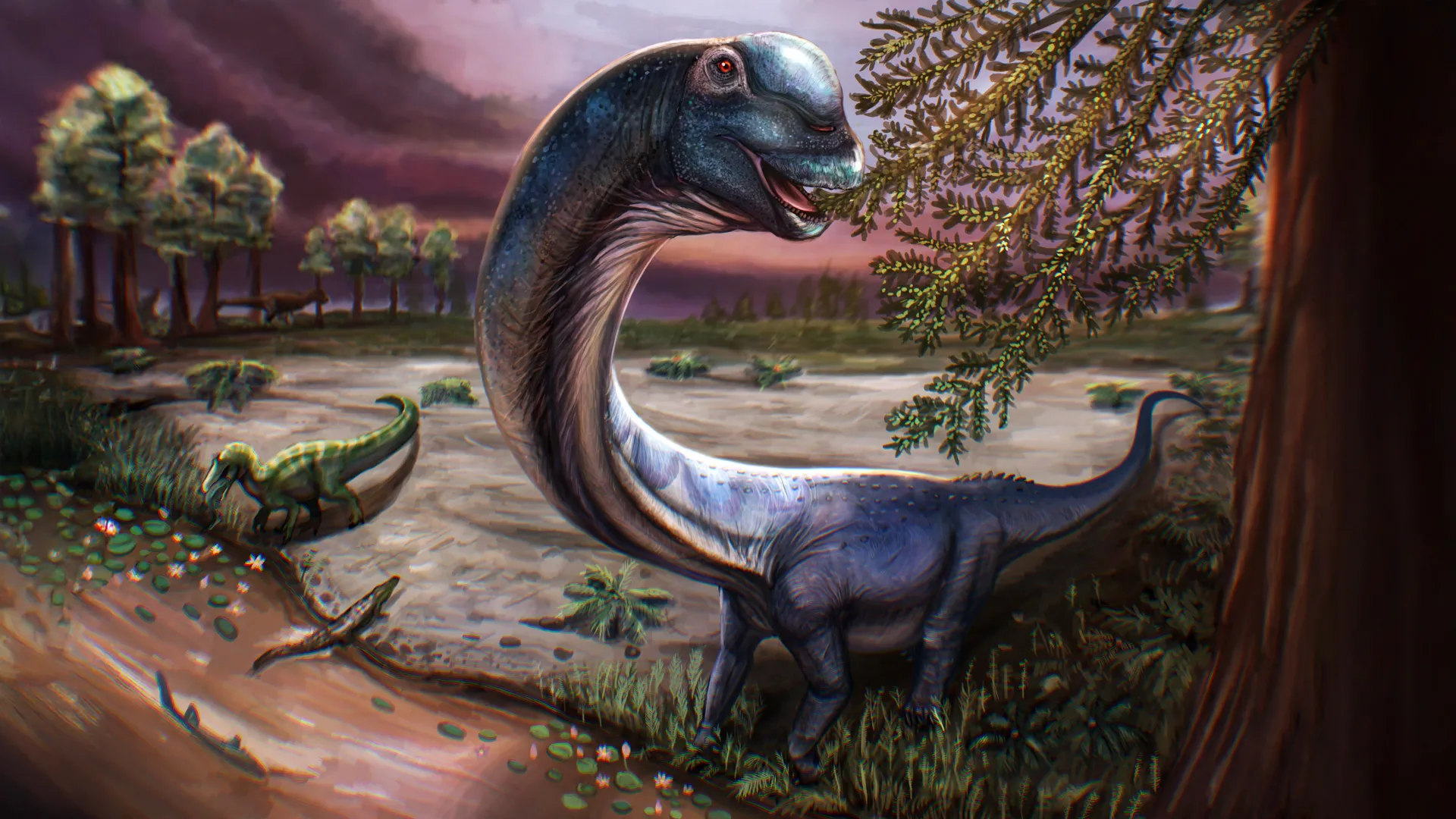
A lifesize replica of a 27-meter-long dinosaur now greets visitors at the Thainosaur Museum in Bangkok, a towering monument to a discovery that has rewritten Southeast Asia's paleontological record. Scientists have identified Nagatitan chaiyaphumensis, the largest dinosaur ever found in the region, whose fossils lay hidden near a pond in Chaiyaphum Province for roughly a decade before researchers fully recognized its extraordinary significance.
The name itself is a bridge between worlds: "Naga," drawn from legendary Southeast Asian and Thai mythology, paired with "Titan" from Greek myth, and completed with a nod to the province where the bones emerged from rocks 100 to 120 million years old. It is the 14th dinosaur species officially named in Thailand, marking another milestone in a region that is rapidly becoming central to our understanding of Early Cretaceous ecosystems.
What makes Nagatitan remarkable is not just its size—though that matters. At roughly 27 tonnes, the herbivore weighed as much as nine adult Asian elephants, with a front leg bone alone stretching 1.78 meters, longer than a human is tall. A collaboration involving researchers from University College London, Mahasarakham University, Suranaree University of Technology, and Thailand's Sirindhorn Museum examined vertebrae, ribs, pelvis bones, and leg bones to reach that calculation. The team determined Nagatitan was indeed massive, though not the heaviest sauropod ever discovered—it weighed at least 10 tonnes more than Dippy the famous Diplodocus, but less than giants like Patagotitan or Ruyangosaurus.
What makes it truly special is the window it opens onto Southeast Asian prehistory. Thitiwoot Sethapanichsakul, the Thai PhD student at UCL Earth Sciences leading the study published in Scientific Reports, calls Nagatitan "the last titan" of Thailand. The dinosaur was discovered in Thailand's youngest dinosaur-bearing rock formation; younger geological layers from the end of the dinosaur age are unlikely to preserve remains because the region became a shallow sea. This may be the most recent large sauropod Southeast Asia will ever yield to science.
Nagatitan belonged to the somphospondylan sauropods, a branch that flourished around 120 million years ago, and more specifically to the Euhelopodidae family known only from Asia. Its spine, pelvis, and leg bones bore distinctive features that set it apart from relatives. The ancient landscape was dry to semi-arid—conditions that sauropods appear to have preferred—and scientists theorize the animals may have used their long necks and tails to release heat and regulate body temperature. Around them flowed a river system teeming with fish, freshwater sharks, and crocodiles, alongside smaller herbivores like iguanodontians and early relatives of Triceratops, plus giant predators and pterosaurs swooping overhead.
The discovery points to something larger than a single species. Sethapanichsakul emphasized that Thailand holds a substantial collection of sauropod fossils waiting formal scientific description—fossils that may hide multiple new species within them. The collaboration between UCL and Thai institutions, made possible by 3D scanning and printing that eliminated the need for constant international travel, signals a shift in how paleontology can work globally and sustainably. For Sethapanichsakul, it represents something personal too: fulfilling a childhood promise to name a dinosaur, and pushing Southeast Asian fossils into the international spotlight where they belong.