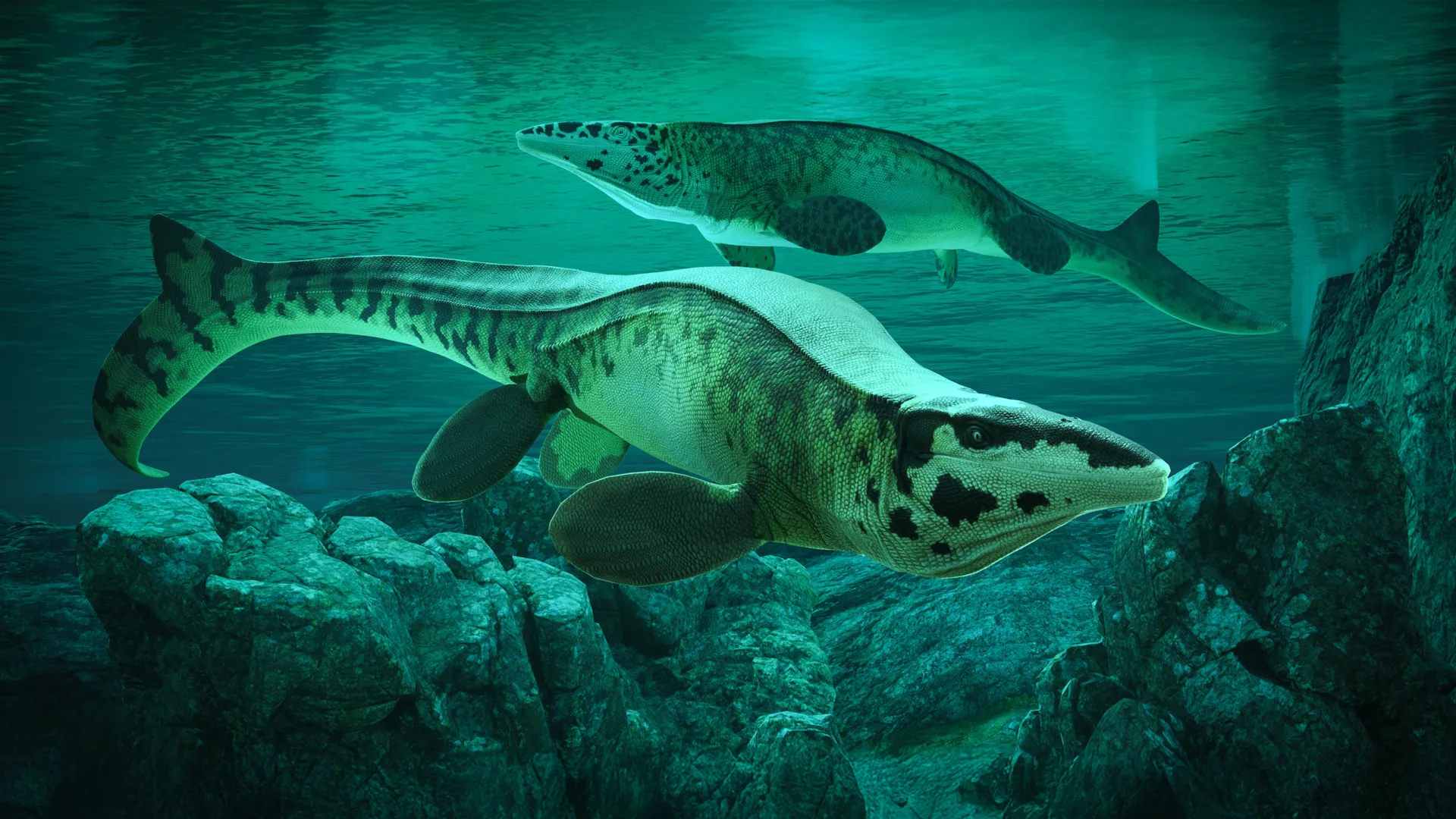
When paleontologist Amelia Zietlow noticed that a fossil in the American Museum of Natural History's collection didn't quite match where it belonged, she set off a discovery that would rewrite the story of prehistoric ocean terror. Tucked among the museum's holdings was the remains of a creature far more fearsome than scientists had realized — a 43-foot mosasaur that dominated ancient Texas seas 80 million years ago, now formally named Tylosaurus rex.
The identification process was painstaking detective work. Zietlow, then a Ph.D. student at the American Museum of Natural History's Richard Gilder Graduate School, suspected the specimen had been misidentified as Tylosaurus proriger, a related species. When researchers compared the Texas fossils with the original T. proriger specimen housed at Harvard University's Museum of Comparative Zoology, the differences became unmistakable. What emerged was not just a new species, but evidence of a predator built for raw power and aggression unlike anything previously understood in the mosasaur family.
The research, led by scientists at the American Museum of Natural History, the Perot Museum of Nature and Science in Dallas, and Southern Methodist University, revealed that T. rex was substantially larger than T. proriger and possessed finely serrated teeth rarely seen in mosasaurs — dental weapons honed for tearing flesh. While T. proriger fossils cluster around Kansas and date to roughly 84 million years ago, T. rex ruled Texas waters approximately 4 million years later, occupying a distinct evolutionary space and time. Over a dozen similar fossils scattered across museum collections worldwide now belong to this newly recognized predator.
The researchers chose the name Tylosaurus rex as a tribute to paleontologist John Thurmond, who recognized in the late 1960s that giant tylosaurs from northeast Texas seemed unusually large and potentially distinct. His informal name for them — "Tylosaurus thalassotyrannus," meaning "sea tyrant" — captures something essential about what the fossil record now confirms. The holotype specimen, discovered near an artificial reservoir outside Dallas in 1979, is currently displayed at the Perot Museum.
The evidence of T. rex's temperament is written in broken bones. The most striking specimen, nicknamed "The Black Knight," shows a missing snout tip and fractured lower jaw — injuries researchers believe came from violent encounters with another T. rex. This level of intraspecific violence had not been previously documented in other Tylosaurus specimens, suggesting a species prone to brutal territorial or competitive battles. "Besides being huge, roughly twice the length of the largest great white sharks, T. rex appeared to be a much meaner animal than other mosasaurs," said Ron Tykoski, vice-president of science and curator of vertebrate paleontology at the Perot Museum.
The discovery extends beyond a single species designation. The team created a revised dataset and new evolutionary framework for tylosaurs that challenges assumptions held for three decades. Famous specimens previously cataloged under different names — including "Bunker" at the University of Kansas and "Sophie" at Yale's Peabody Museum — are now being reassigned to T. rex. Zietlow emphasized that the work signals a broader reckoning: "This discovery is not just about naming a new species. It highlights the need to revisit long-standing assumptions about mosasaur evolution and to modernize the tools we use to study these iconic marine reptiles." As researchers continue examining the fossil record of Texas's ancient seas, the story of ocean dominance 80 million years ago grows sharper, more violent, and more remarkable.