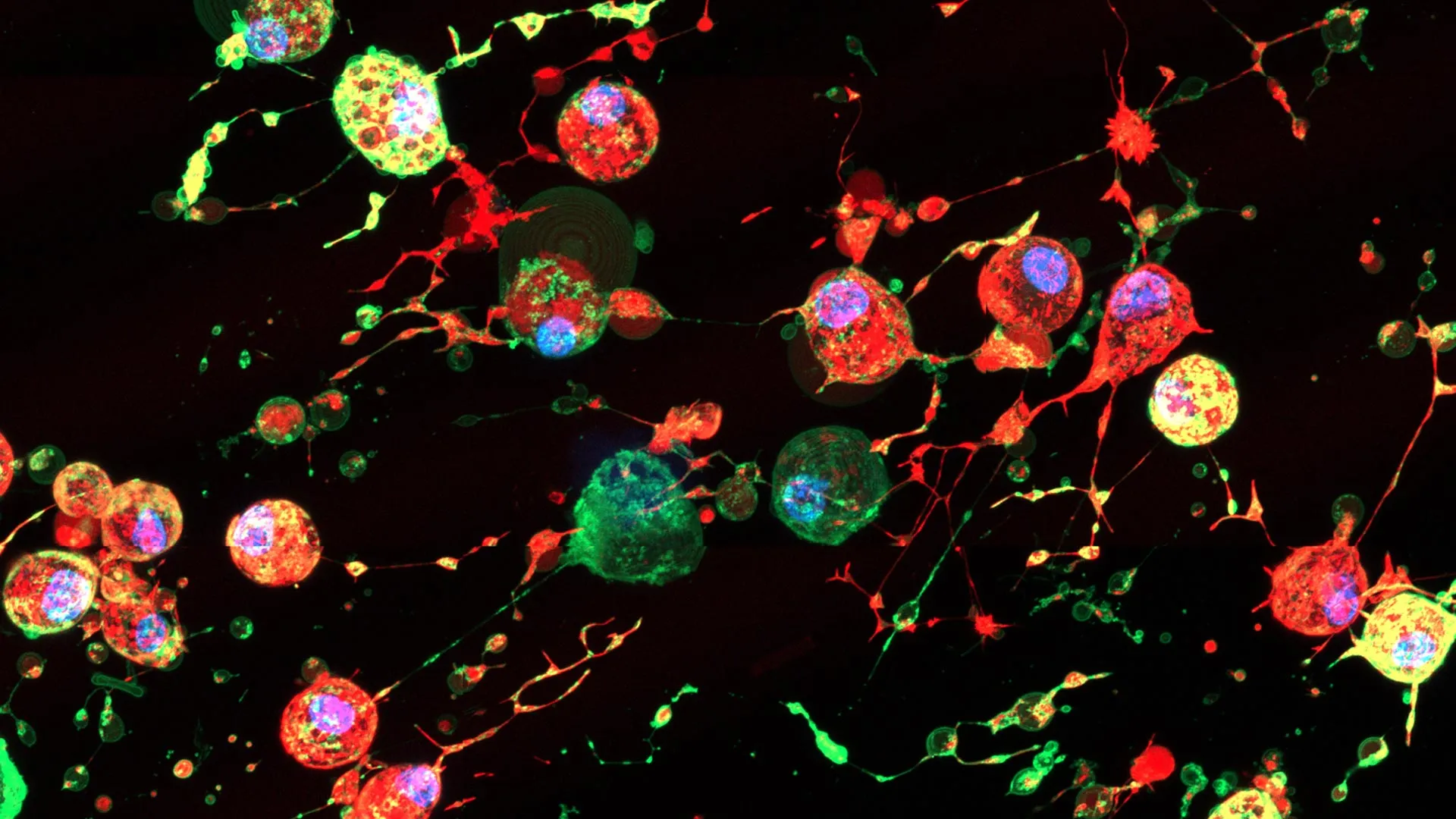
Stephanie Rutter was peering into the microscopic aftermath of a cell’s death when she noticed something no one had seen before—a faint, lingering trail left behind like ghostly footprints on a battlefield. At La Trobe University’s Institute for Molecular Science in Melbourne, Rutter and her team have uncovered a hidden biological choreography: dying cells don’t just vanish—they leave behind structured signals that guide the immune system in cleanup operations. Published in Nature Communications, this discovery reshapes our understanding of how the body manages cell death, a process that occurs billions of times a day in humans. The team identified a new type of extracellular vesicle, dubbed F-ApoEVs (‘footprint’ apoptotic extracellular vesicles), which remain precisely where a cell died, acting as molecular signposts that help immune cells locate and remove debris—preventing dangerous inflammation and autoimmune reactions.
This meticulous cleanup process, once thought to be random and passive, is now revealed as a highly organized system. But the researchers found a disturbing twist: viruses like influenza may be hijacking it. In lab studies, viral particles were observed hiding inside F-ApoEVs, using the body’s own sanitation system as a stealth vehicle to spread infection without detection. It’s a biological Trojan horse—one that could explain how some viruses evade immune surveillance and propagate efficiently through tissues.
Professor Ivan Poon, director of the Research Centre for Extracellular Vesicles and Rutter’s supervisor, emphasized the broader implications: “Billions of cells are programmed to die each day as a part of normal turnover and disease progression, and until now, it was believed that the cell fragmentation process during cell death was random and fairly simple.” His team’s work proves otherwise. The discovery not only illuminates a fundamental biological mechanism but also opens new pathways for treating infectious and autoimmune diseases, including Systemic Lupus Erythematosus (SLE), where failed debris clearance leads to chronic inflammation.
Dr. Georgia Atkin-Smith of WEHI, a co-leader of the study, noted that dying cells “can continue to communicate from the grave,” influencing immune responses long after their demise. This afterlife of cellular communication underscores the complexity of the human body’s maintenance systems—and how finely tuned they must be to stay healthy. The research was a collaborative effort between La Trobe’s RCEV, LIMS, the School of Agriculture, Biomedicine and Environment, WEHI, and Toronto Metropolitan University, blending expertise across immunology, cell biology, and virology.
As scientists begin to map these hidden signals, new therapies could emerge—ones that boost the body’s natural cleanup crews or block viruses from exploiting them. For now, the discovery stands as a reminder: even in death, cells have a message to send.