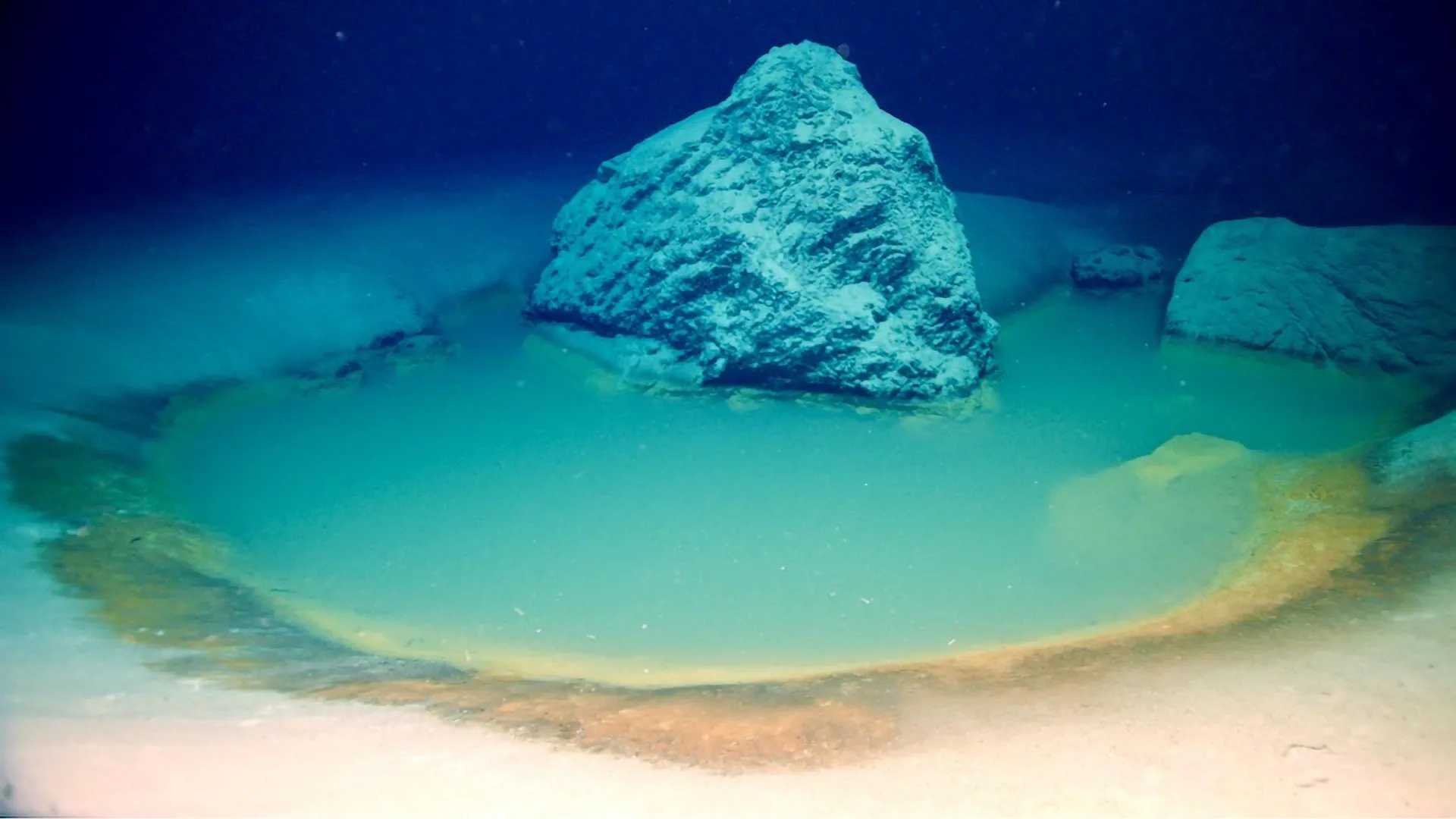
In the final five minutes of a ten-hour dive, a remotely operated vehicle found something unexpected more than a mile beneath the Gulf of Aqaba: deep-sea lakes so salty that they contain no oxygen, yet teem with microscopic life.
The pools are the first brine pools documented in this northern extension of the Red Sea. Their discovery may help scientists understand how ancient oceans formed and where life can survive. That question also matters beyond Earth: knowing the limits of life here can help researchers assess whether other worlds might support living things.
Sam Purkis, a professor and chair of marine geosciences at the University of Miami’s Rosenstiel School, led the work with colleagues and OceanX. They found the pools at a depth of 1,770 meters, or more than one mile, using a remotely operated underwater vehicle launched from the research vessel OceanXplorer. The ship carried equipment designed to explore hard-to-reach places beneath the sea.
Brine pools are among the most extreme habitats on Earth. Their water has an unusually high concentration of salt, unusual chemistry and no oxygen. Still, the newly found pools support a rich community of microbes. Earlier studies of microbes in Red Sea brine pools have found biologically active molecules with possible anticancer properties, though the new discovery itself does not establish a medical treatment.
“Until we understand the limits of life on Earth, it will be difficult to determine if alien planets can host any living beings,” Purkis said. He added that studying microbes in extreme environments can help researchers trace those limits and guide the search for life elsewhere in the solar system and beyond.
The pools may also hold clues to the Gulf’s geological past. Because they lie relatively close to shore, their salty, oxygen-free waters can preserve traces of events such as tsunamis, flash floods and earthquakes. The seabed in this region is crossed by faults and fractures formed by tectonic activity, the movement of Earth’s crust.
That record could matter for communities along the coast. In 2022, Purkis and colleagues reported evidence of an underwater landslide about 500 years old that may have caused a large tsunami. Learning more about past hazards could help inform coastal development in Egypt and Saudi Arabia.
The findings were published June 27, 2022, in Communications Earth & Environment, in a study titled “Discovery of the deep-sea NEOM Brine Pools in the Gulf of Aqaba, Red Sea.” The four-week OceanXplorer expedition received funding from NEOM, a company developing the Saudi Arabian coastline. The research brought together scientists from the University of Miami, King Abdullah University of Science and Technology, the University of Bari Aldo Moro, OceanX, MARUM in Germany and NEOM.
Purkis said the team was lucky to find the pools at the very end of its allotted dive time. Their discovery gives researchers a new place to investigate both the toughness of microscopic life and the history recorded beneath the Red Sea.