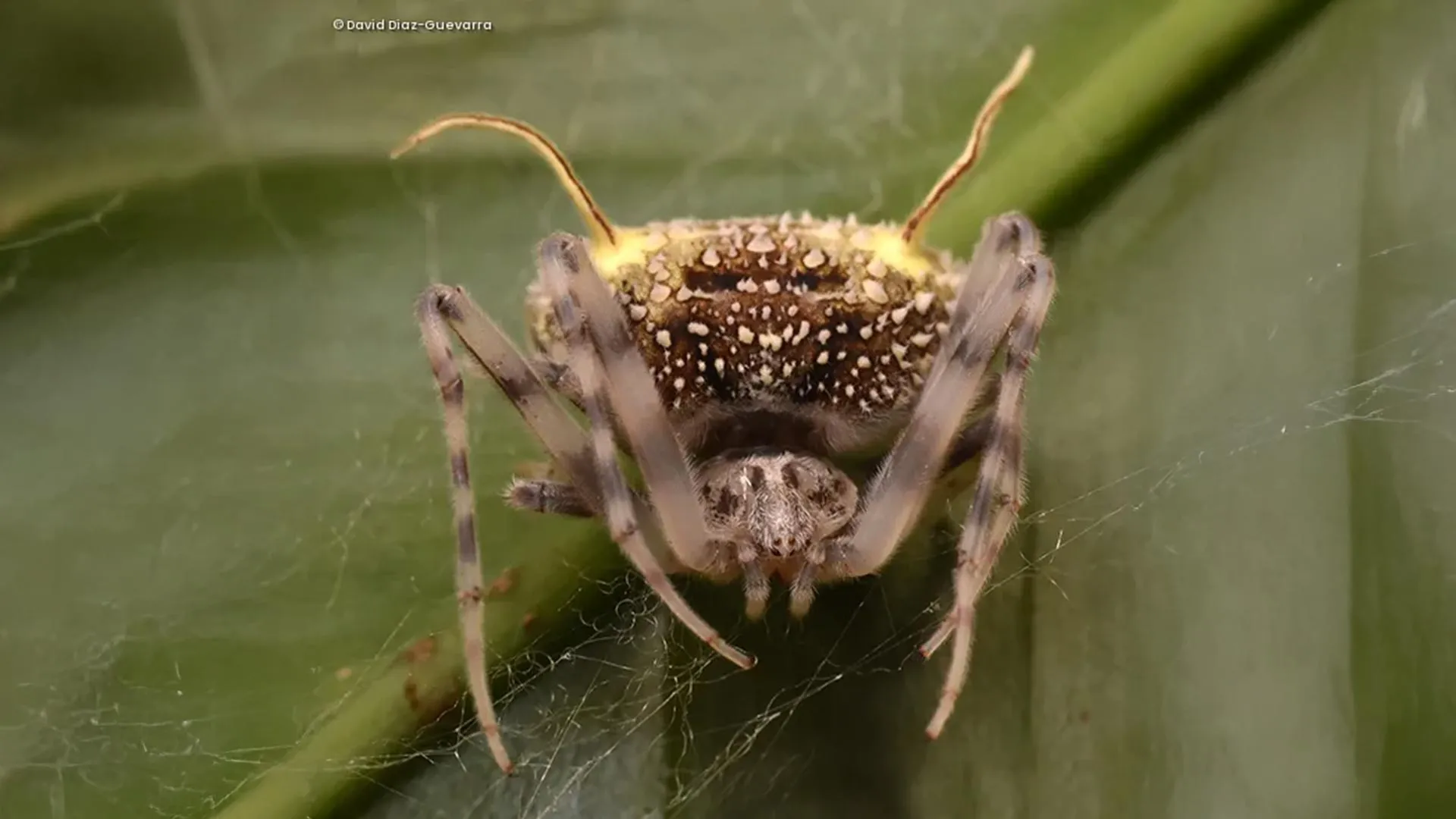
Under the dim glow of headlamps in the Llanganates-Sangay Corridor of Ecuador’s Amazon, biologist Diego Peñafiel reached for what he thought was a pale, stalked mushroom clinging to a leaf—only to watch it scuttle away. The creature, later named Taczanowskia waska, is no fungus, but a spider so perfectly disguised as the parasitic Gibellula fungi that even seasoned researchers were fooled. This extraordinary mimicry, documented by an international team including scientists from the Leibniz Institute for the Analysis of Biodiversity Change (LIB), marks the first known case of a spider imitating a fungus that infects its own kind—a discovery that rewrites the playbook on evolutionary deception.
In ecosystems teeming with life, survival often hinges on invisibility. The Amazon rainforest, one of Earth’s most biodiverse regions, is a theater of endless adaptation. Taczanowskia waska plays its part with uncanny precision: it sports elongated, stalk-like structures from its abdomen and a ghostly hue that mirrors the fruiting bodies of Gibellula fungi, which grow on dead or dying spiders. It positions itself motionless on the undersides of leaves—the exact habitat where these fungi thrive—making it nearly indistinguishable from its fungal doppelgänger. This dual strategy of visual and behavioral mimicry likely serves a dual purpose: avoiding predators that avoid infected prey and lying in wait for unsuspecting insects that never see the ambush coming.
The discovery began not in a lab, but online. A photograph posted to iNaturalist, initially labeled as a mushroom, caught the eye of sharp-eyed naturalists who suspected a spider. That digital clue led to a targeted field investigation, where the living specimen was finally collected and studied. Nadine Dupérré of the Museum of Nature Hamburg at LIB played a key role in confirming the find, comparing the spider to preserved specimens in scientific collections. Her work underscored a vital truth: new discoveries often rest on the shoulders of old data. “Finds like these demonstrate the value of scientific collections,” she says. “They enable us to classify new species and compare them with historical specimens.”
Though the genus Taczanowskia is rare and poorly understood, this discovery opens a window into the hidden complexity of tropical ecosystems. With so many species still unknown, each new find like Taczanowskia waska is a reminder of nature’s inventiveness—and the importance of collaboration, curiosity, and technology in uncovering it. As rainforests face mounting threats, such revelations also deepen the urgency to protect these irreplaceable landscapes, where even a mushroom might turn out to be a spider with a very clever secret.