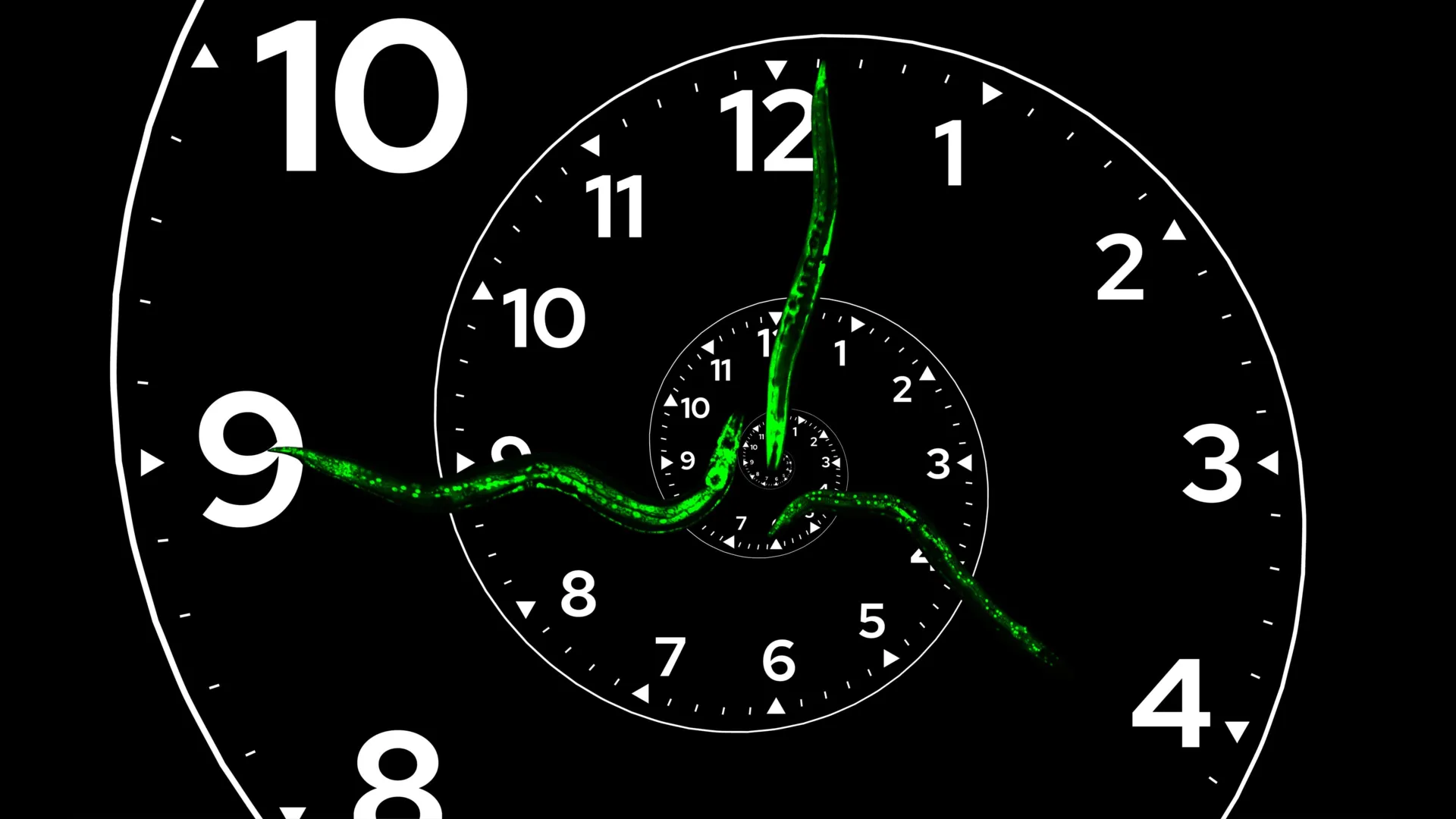
Deep inside the cells of a tiny worm, two proteins work in perfect tandem—flipping genes on and off like a conductor keeping time with an orchestra, ensuring that growth never skips a beat and development never stalls. Researchers at Cold Spring Harbor Laboratory have identified what they call a master developmental clock, a biological timer that keeps the worm C. elegans progressing through its life stages in precise, orderly sequence. The discovery, led by CSHL Professor Christopher Hammell and Director of Research Leemor Joshua-Tor, reveals a mechanism so elegant and essential that when it breaks down, development hits a complete wall.
For years, Hammell's team had observed something remarkable: development in C. elegans unfolds as a series of carefully timed bursts of gene activity, each one triggering the next in a choreographed progression. But the critical question remained unanswered—how does the cell know when to start each pulse, and when to stop? What keeps the timing so precise?
The answer lies in two proteins working in concert: MYRF-1 and LIN-42. Together, they form a feedback circuit that functions as the central clock governing development in every single cell of the worm. MYRF-1 acts as the trigger, initiating each developmental stage and marking when that stage is complete. Once activated, it then triggers LIN-42, which fine-tunes the intensity and duration of the genetic pulse. Between them, they ensure development marches forward in the correct sequence and at the proper pace. Hammell calls it "a ratchet"—a system that turns genes on and off multiple times but only moves in one direction, never backward, never repeating.
What makes this discovery extraordinary is that this is the first known example of a non-repeating biological clock of its kind. Most biological clocks studied by scientists—circadian rhythms that govern sleep and wakefulness—cycle repeatedly, day after day. The MYRF-1/LIN-42 clock is fundamentally different: it orchestrates a finite series of events that must happen only once and in perfect order. When researchers blocked MYRF-1 in their experiments, the entire developmental program collapsed. Without it, Hammell explains, "development hits a wall and can't progress."
To uncover this clock's workings, the team deployed an impressive arsenal of modern science—traditional molecular biology combined with DNA sequencing, protein sequencing, and AlphaFold, the artificial intelligence tool that predicts protein structures. The synthesis of all these approaches revealed not just that MYRF-1 and LIN-42 control development, but exactly how they do it.
Yet the discovery raises tantalizing new questions. The MYRF-1/LIN-42 circuit runs independently in every cell, yet somehow all these cellular clocks stay perfectly synchronized during normal development. Do the clocks communicate with one another? Hammell says his team has never deeply explored that question before. Moving forward, the researchers aim to understand how MYRF-1 and LIN-42 physically interact and whether this developmental timing system works similarly across different types of organisms.
The implications extend far beyond a worm barely visible to the naked eye. Understanding how developmental clocks operate could illuminate what goes wrong in developmental disorders and genetic diseases—conditions in which the body's internal timing system falters. Like a train finally receiving the signal to depart the station, this newly discovered clock ensures that growth and development move steadily forward, stage by stage, on time, every time.