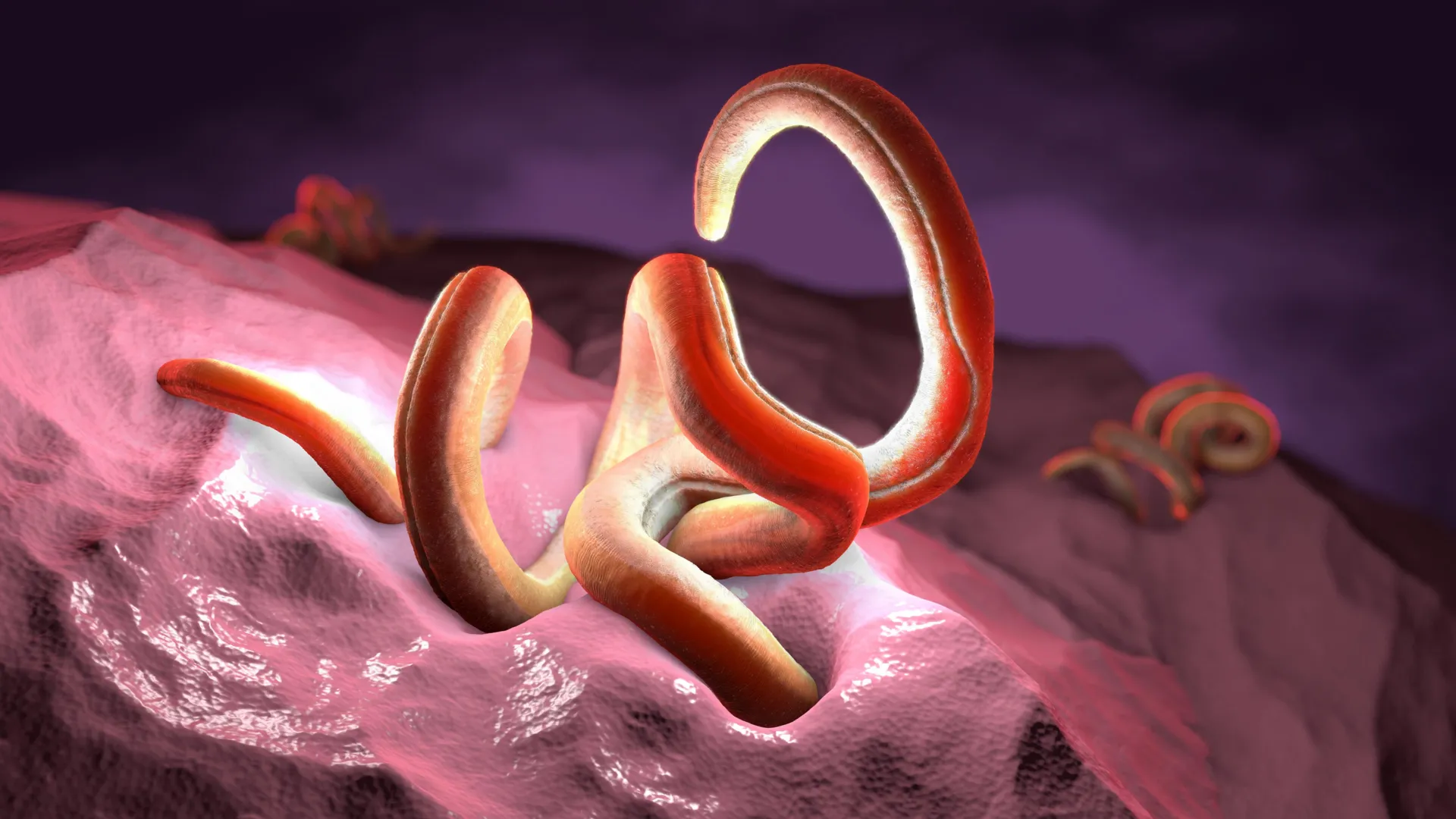
Scientists have long wondered why a controversial treatment using tiny intestinal worms sometimes helps reduce inflammation in humans — and sometimes does nothing at all. Now, researchers in Prague think they have found the answer, and it comes down to something many people already know they should eat more of: fiber.
Kateřina Jirků and her team at the Biology Centre of the Czech Academy of Sciences discovered that friendly intestinal worms can only fight inflammation when they have enough dietary fiber to thrive. Without it, the worms essentially fall into a deep sleep, losing their ability to help.
For most of human history, tiny parasites living in the gut were completely normal. But in wealthy countries, cleaner living conditions and modern medicine have made these worms far less common. Around the same time, autoimmune disorders and inflammatory bowel diseases have become more common. About twenty years ago, scientists began exploring whether reintroducing certain harmless worms could treat these conditions — an approach called helminth therapy. Early results were promising, but inconsistent.
"Sometimes the worms suppress inflammation, sometimes they do not," Jirků explained. "That's why we focused on factors that may influence their effects in the gut."
To solve the puzzle, the team studied tapeworms in rats. They fed some rodents a diet high in fiber and others a low-fiber diet similar to typical Western eating patterns. The difference was striking. When fiber was abundant, tapeworms grew healthy and strong, and the rats showed reduced inflammation. When fiber was lacking, the worms shrank to a fraction of their normal size, never reached adulthood, and failed to produce eggs. The parasites essentially entered an energy-saving state resembling hibernation.
"When fiber is lacking, the worm enters an energy-saving state resembling hibernation in mammals, and its anti-inflammatory effect disappears," Jirků said.
The findings, published in the journal Nature Communications, also revealed that fiber reshaped the entire gut environment. A fiber-rich diet encouraged beneficial bacteria, while a Western-style diet reduced microbial variety and allowed potentially harmful bacteria to flourish. These changes in gut microbes matched the differences in inflammation levels.
The researchers noted that health organizations recommend adults consume about 25 to 30 grams of fiber daily. Yet average intake across many Western countries falls below that level. Traditional populations, by contrast, are estimated to consume between 80 and 120 grams of fiber each day.
The study suggests that simply taking worm pills may not be enough for helminth therapy to work. The host's diet — particularly fiber intake — appears to be essential. Future treatments may need to account for what patients are eating, not just what microscopic creatures they're swallowing.