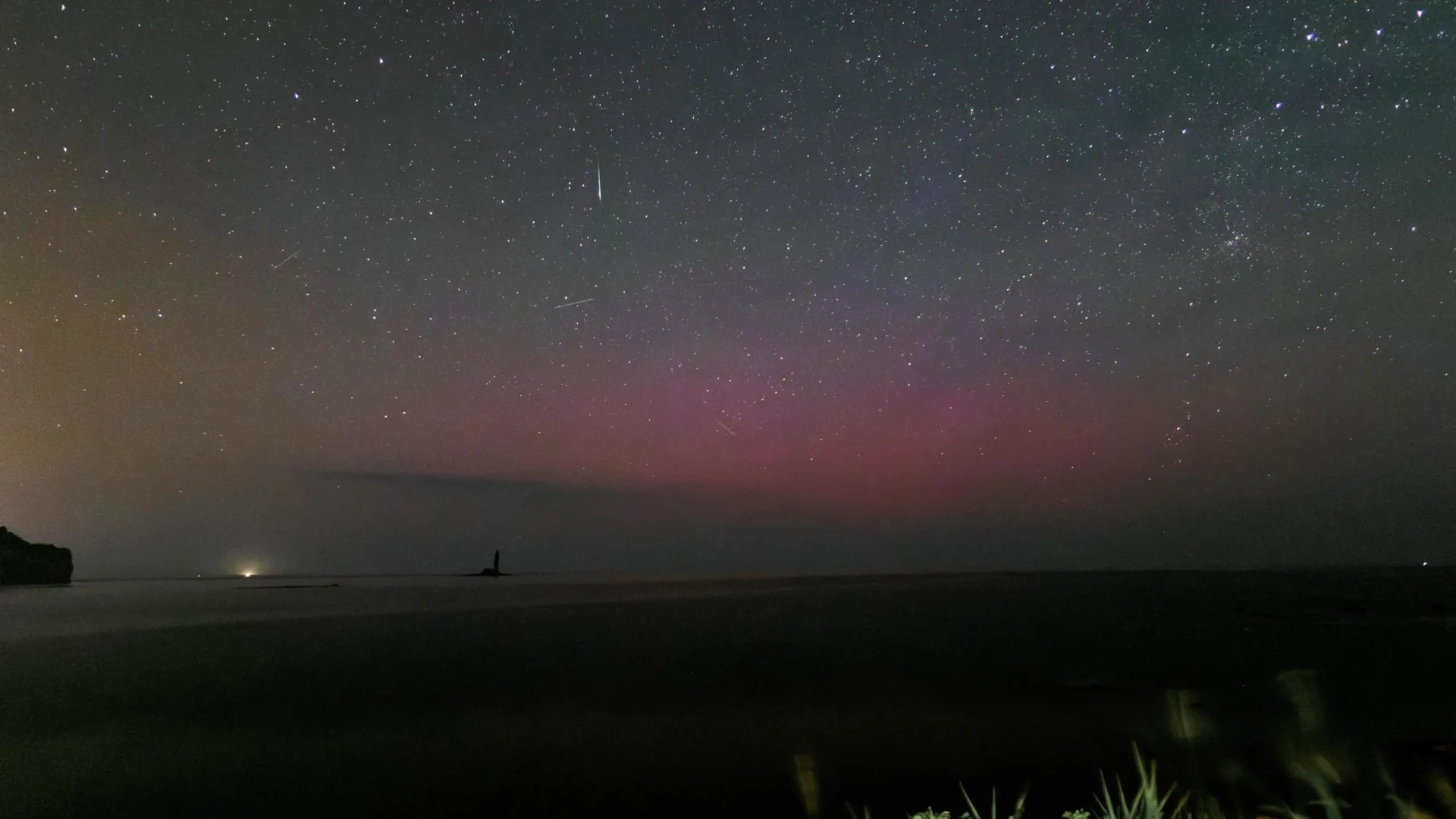
On certain nights above Japan, a faint red glow spreads across the horizon—a gentle crimson haze that most people overlook, yet harbors a discovery that is rewriting what scientists thought they knew about Earth's magnetic realm. When streams of charged particles from the Sun collide with oxygen atoms high in the atmosphere, they release energy as soft red light, creating rare auroras that are usually visible only near the polar regions. But a team of researchers from Hokkaido University and the Okinawa Institute of Science and Technology has found something unexpected: these red auroras above Japan are reaching heights of 500 to 800 kilometers—nearly double the 200 to 400 kilometer range scientists had long anticipated.
The discovery matters because it suggests that space weather is more powerful, and less predictable, than our conventional measurement tools have indicated. When powerful geomagnetic storms strike Earth, they compress the planet's magnetosphere—the invisible magnetic shield surrounding us—and heat the upper atmosphere. But the five auroral events that researchers studied in Hokkaido between June 2024 and March 2025 revealed something that standard measurements missed: even moderately intense storms can push auroras to extreme altitudes. Lead author Tomohiro M. Nakayama captured the surprise in his own words: "I was really surprised because I didn't expect such tall auroras to appear even during moderately intense storms."
The research team's approach was ingenious. Rather than relying solely on satellite data, they partnered with citizen scientists across Japan who photographed the auroras from multiple locations. By studying the angles of those images and mapping them along Earth's magnetic field lines, the researchers estimated how high the glowing structures actually reached. This crowdsourced network proved invaluable for investigating rare phenomena that conventional monitoring systems alone could not capture in sufficient detail.
The mechanism at work appears elegant: dense streams of solar wind compressed Earth's magnetic field so forcefully that the upper atmosphere heated and expanded upward, pushing the region where red auroras form to altitudes far higher than expected. At the same time, the movement of charged particles during these events may have masked the true intensity of the storms, making them appear weaker according to traditional space weather measurements. In other words, Earth's magnetic shield may be responding more violently to solar activity than our instruments suggest.
These findings carry practical implications that extend beyond the beauty of the night sky. When Earth's upper atmosphere heats up and expands, satellites orbiting in low Earth orbit experience greater atmospheric drag—extra resistance that gradually alters their trajectories and causes them to lose altitude faster than anticipated. As the number of satellites in low Earth orbit grows exponentially, understanding these effects has become critical to maintaining reliable global communications and Earth observation systems. Nakayama emphasizes this point: "Our results could help improve space weather forecasting and support safer satellite operations." The red auroras dancing above Japan are not merely a visual spectacle, then, but a window into the dynamic forces that shape the space environment where humanity's growing fleet of satellites depends on to function.