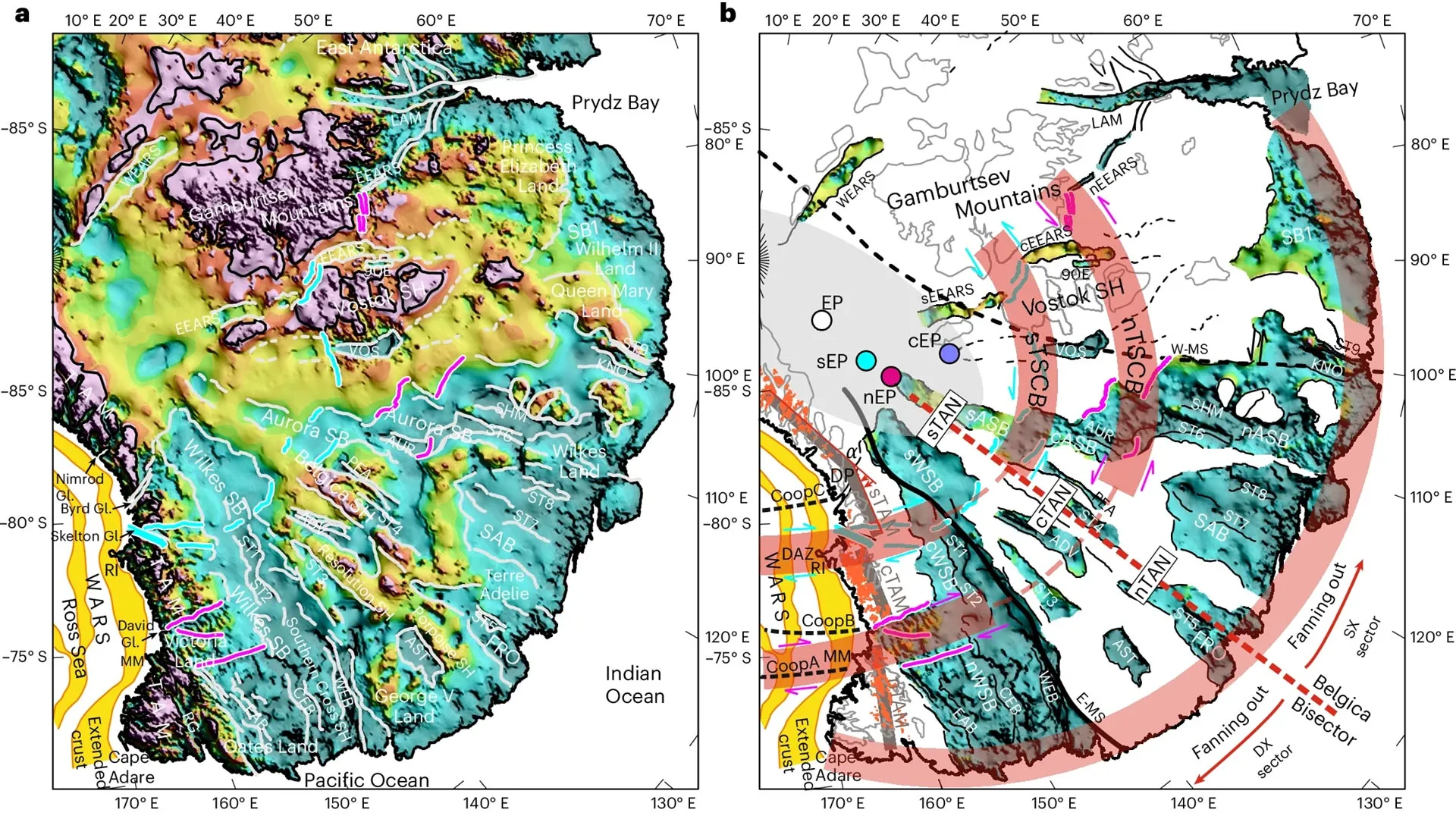
Beneath the frozen stillness of East Antarctica, where ice towers three kilometers high, a hidden world of immense geological architecture has come into view — one that reshapes how scientists understand the continent’s deep past. Dr. Guy Paxman and an international team, led by Dr. Egidio Armadillo of the University of Genoa, have discovered that scattered subglacial basins — long studied in isolation — are actually parts of a single, fan-shaped province stretching across the Antarctic interior. Named the East Antarctic Fan-shaped Basin Province, this structure links the Wilkes and Aurora basins with the basin holding Lake Vostok, Earth’s largest known subglacial lake, into a unified geological story.
This revelation matters not just for geology, but for the future of Antarctica’s ice. The shape of the bedrock beneath the ice sheet governs how ice flows, where water pools, and which regions may be more vulnerable to collapse under climate change. By uncovering this vast, interconnected system, scientists gain a clearer picture of the forces that have shaped — and continue to shape — one of Earth’s most remote and consequential landscapes. The province likely formed through a process called distributed rotational extension, where the continental crust stretched outward like fingers spreading from a fixed thumb base. This pattern, one of the largest of its kind ever observed in continental crust, may have played a role in the breakup of the ancient supercontinent Gondwana and the separation of Antarctica from Australia.
To unveil this hidden structure, researchers synthesized gravity readings, magnetic data, seismic records, and models of the lithosphere. A key innovation came from Paxman’s work reconstructing what East Antarctica would look like without its ice: a landscape rebounding up to one kilometer higher due to the removal of the ice’s weight. This “rebounded topography” revealed the true scale and orientation of the basins, confirming their alignment into a single tectonic fan. The study was supported by the Italian National Antarctic Research Program, underscoring the importance of long-term international collaboration in polar science.
The discovery opens new questions: When exactly did this structure form? What geodynamic forces drove its evolution? And how might it influence ice stability in a warming world? As climate change accelerates ice loss in vulnerable regions, understanding the bedrock’s role becomes ever more urgent. This hidden province, buried under miles of ice, is no longer just a curiosity — it’s a key piece in predicting Antarctica’s response to global change. With new data and fresh eyes, the frozen continent continues to yield secrets that reshape our understanding of Earth’s dynamic story.