At the National Laboratory of the Rockies in Colorado, scientists have cracked open a puzzle that has long frustrated renewable energy researchers: how to capture the sunlight that both plants and solar panels leave behind. Nathan Neale and his team discovered that a silicon semiconductor bonded to a molecular catalyst can harness this wasted high-energy sunlight and use it to drive chemical reactions—potentially turning carbon dioxide and water into fuel, or nitrogen gas into fertilizer.
The breakthrough hinges on a deceptively simple insight: the sun delivers far more energy than we currently convert. Solar panels capture only about 20 percent of the incident light's energy. Plants manage just 1 percent. The rest radiates away as heat because high-energy electrons lose their power almost instantaneously, cooling in mere femtoseconds. Until now, that rapid energy loss seemed inevitable.
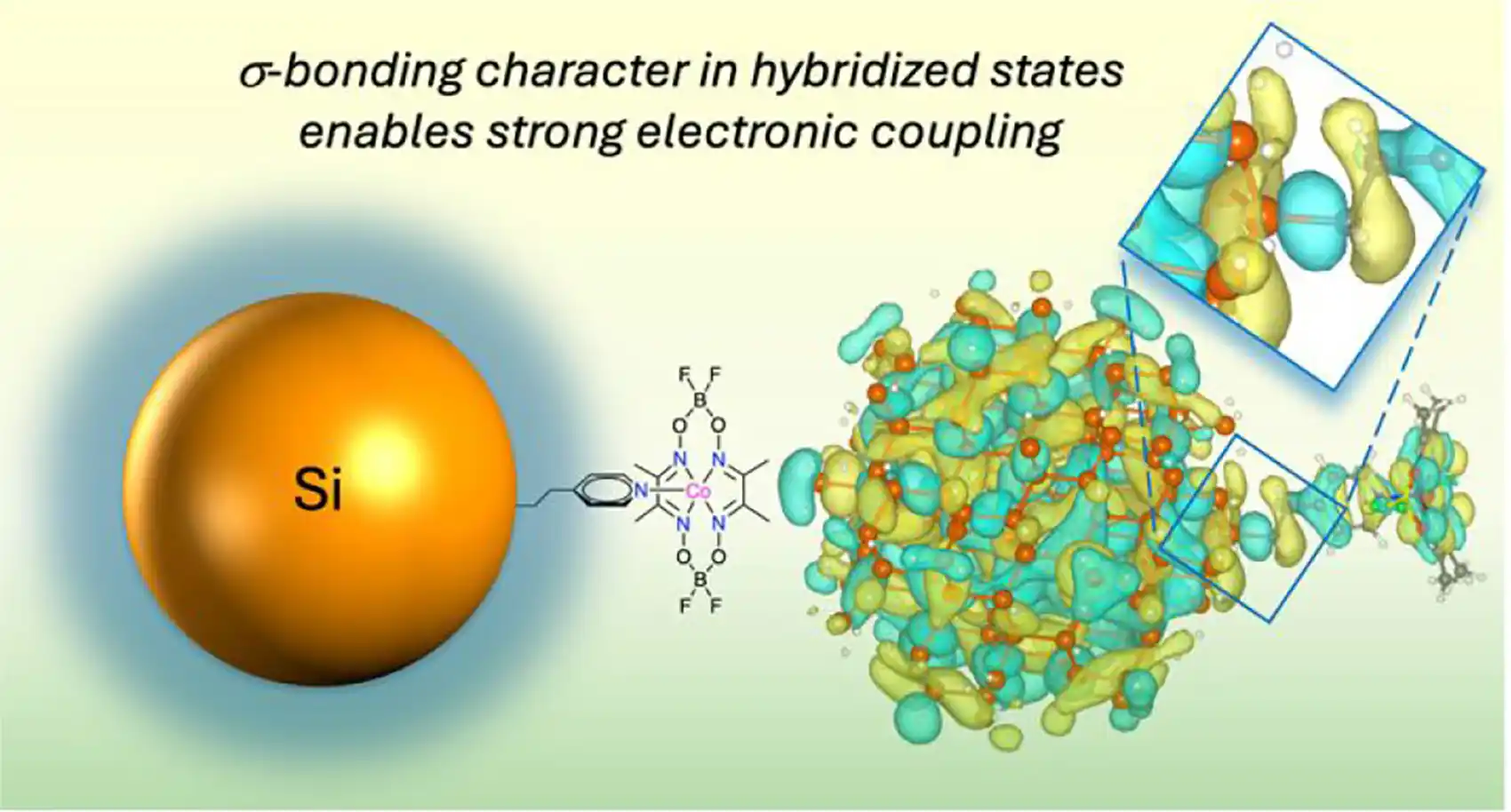
Neale's team engineered their way around this problem by fusing a silicon nanocrystal to a molecular catalyst called cobaloxime using a linking molecule called ethylenepyridine. This seemingly modest chemical adjustment created a hybrid electronic state with a remarkable property: the electrons stayed "hot"—energetic enough to drive reactions—for at least five nanoseconds. That may sound impossibly brief, but it represents an astonishing leap: the high-energy electrons persisted roughly 25,000 times longer than they typically do in silicon alone.
The team confirmed their mechanism using multiple spectroscopy methods to study how the semiconductor and catalyst behaved together, then ran quantum mechanical calculations to model the exact photoelectronics. What they found was elegant: the blended electronic states allowed hot electrons to spread across both the silicon and the catalyst simultaneously, extending their productive lifetime. The role of the ethylenepyridine linker proved critical. "It is insufficient to simply provide spatial proximity between a semiconductor and a surface-bound catalyst to achieve efficient photoinduced processes," the researchers noted in their conclusions published in the Journal of the American Chemical Society. The specific chemistry of that molecular bridge made all the difference.
This work belongs to the fields of artificial photosynthesis and photocatalysis, areas where researchers worldwide are racing to translate biology's ancient efficiency into human-made systems. The immediate applications are tantalizing: splitting water to produce hydrogen, converting carbon dioxide into hydrocarbons, or synthesizing ammonia-based fertilizers from atmospheric nitrogen—a gas that comprises one-fifth of our air yet remains locked away from most biological processes without human intervention.
The research was funded by the U.S. Department of Energy's Office of Science Basic Energy Sciences program. While direct sun-to-fuel semiconductors remain far from commercial reality, this discovery demonstrates that the underlying physics is sound. The team's insight about electron lifetimes and hybrid electronic states opens a pathway toward solar technologies that could eventually rival or exceed nature's own photosynthetic efficiency. In a world searching for ways to wean itself from fossil fuels, that possibility—hidden in the ultraviolet light that shines equally on every rooftop and forest—matters more with each passing year.