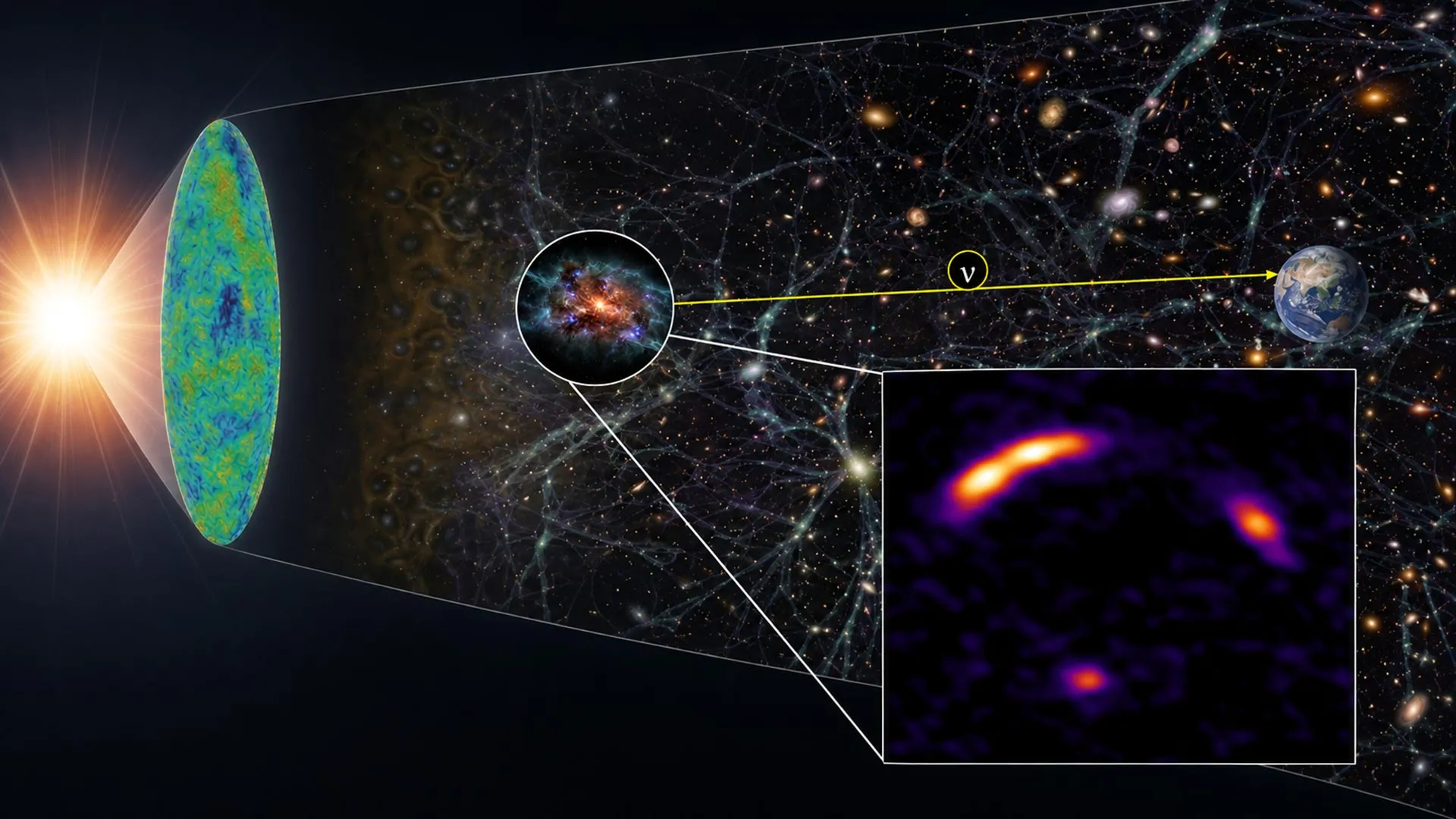
When the neutrino known as IC 210922A pierced through the IceCube Observatory buried deep in Antarctic ice, it carried with it a whisper from a galaxy 11 billion light-years away—a signal that would ultimately upend what scientists thought they knew about the origins of high-energy neutrinos. The source, a blazingly bright but dust-shrouded galaxy nicknamed 'Shadow Blaster,' was expected to be powered by a ravenous supermassive black hole. Instead, astronomers using the Atacama Large Millimeter/submillimeter Array (ALMA) found something far more surprising: a stellar powerhouse where new stars are born at a furious pace, lighting up the cosmos from within a core just 1,500 light-years across.
Neutrinos are among the most elusive particles in the universe—trillions pass through our bodies every second without a trace. Yet, when one of these ghostly particles arrives with high energy, it points back to something extraordinary. For years, scientists believed such signals mostly came from active galactic nuclei, where black holes devour matter and spew out energy. But Shadow Blaster, officially known as JCMT0402−0424, defied that script. Hidden behind a veil of dust, it remained invisible to optical telescopes—yet glowed intensely in submillimeter wavelengths, earning its dramatic nickname.
The breakthrough came thanks to a cosmic stroke of luck: a foreground galaxy aligned perfectly between Earth and Shadow Blaster, bending and magnifying its light through gravitational lensing. This natural telescope allowed ALMA to resolve the galaxy’s core with unprecedented clarity. What emerged was not the signature of a black hole, but the intense glow of heated gas and dust—clear evidence of rampant star formation. The compact core, packed with stellar nurseries, is now believed to be a neutrino factory, where cosmic rays from massive young stars collide with dense material to produce these mysterious particles.
This discovery, led by an international team from institutions including MITOS Science Co., LTD., National Central University, and the National Astronomical Observatory of Japan, suggests that starburst galaxies like Shadow Blaster could be responsible for up to 20% of the high-energy neutrinos flooding the universe. That’s a staggering contribution from a source long overlooked. It reshapes the map of cosmic particle physics, revealing that the violent birth of stars—not just the death throes of matter near black holes—can launch neutrinos across space and time.
As astronomers continue to trace these ghost particles to their origins, Shadow Blaster stands as a beacon of a new understanding: the universe’s most elusive signals may come not from darkness, but from the blinding fury of creation.