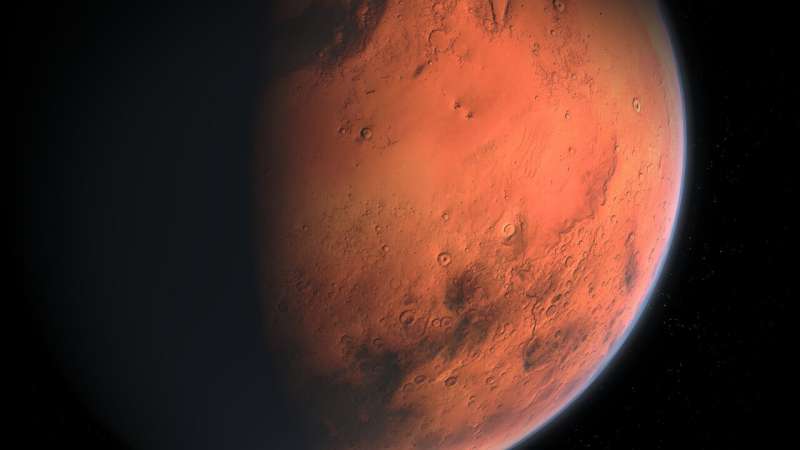
A hidden layer of crystallized rock, buried some 24 kilometers beneath the rust-red plains of Mars, is rewriting what we thought we knew about where life might take root in the cosmos. Researchers at the University of Oxford have uncovered evidence that the red planet once harbored enormous, Earth-like magmatic systems deep in its interior—vast networks where molten rock pooled, evolved, and reprocessed itself through the crust over hundreds of millions of years.
The findings, published in Nature Astronomy, emerged from an unlikely source: During the NASA InSight mission, a spacecraft parked on Martian soil recorded seismic waves rippling through the planet from meteoroid impacts and marsquakes—the planetary equivalent of earthquakes. Dr. Tobermory Mackay-Champion, then at Oxford's Department of Earth Sciences, and his colleagues turned that data into something like an ultrasound of Mars' interior, revealing a mysterious boundary no previous study had fully understood.
The team compared hundreds of possible rock compositions against the seismic recordings, using thermodynamic modeling and statistical techniques. They found that only ultramafic rocks—rich in iron and magnesium, low in silica—matched the properties below that own The layer above it, however, bore the signature of mafic rocks with higher silica content. This chemical stratification, they argue, likely formed where magma pooled deep underground and gradually separated into distinct materials: dense crystals sinking to the base of the crust, while lighter, more evolved melts drifted upward.
On Earth, similar processes beneath volcanic mountain chains helped build our continents and drive the geological recycling that regulates our climate. Scientists had long assumed such complexity required plate tectonics—yet Mars, a "stagnant lid" planet with no moving plates, appears to have achieved something remarkably similar.
The implications stretch far beyond Martian geology. "One of the big questions in planetary science is whether Earth is unique," said co-author Professor Jon Wade, also of Oxford's Department of Earth Sciences. "If Mars could develop this kind of complex crust without plate tectonics, then maybe the conditions needed for habitability could emerge on more planets than we realized, including those previously dismissed based on size or their apparent lack of tectonic activity."
The boundary layer appears to extend hundreds—or perhaps even thousands—of kilometers around Mars' northern hemisphere, suggesting the planet once hosted interconnected magmatic systems rather than mere isolated volcanoes.phenomena the team calls "transcrustal magmatism," previously thought to be uniquely terrestrial.
These processes are tightly wound with how planets grow oceans, atmospheres, and the stable conditions life requires. By showing such systems can arise without plate tectonics, the research quietly expands the map of worlds that might be more than barren rock.ones where, somewhere in their deep interiors, the seeds of habitability might still be waiting.