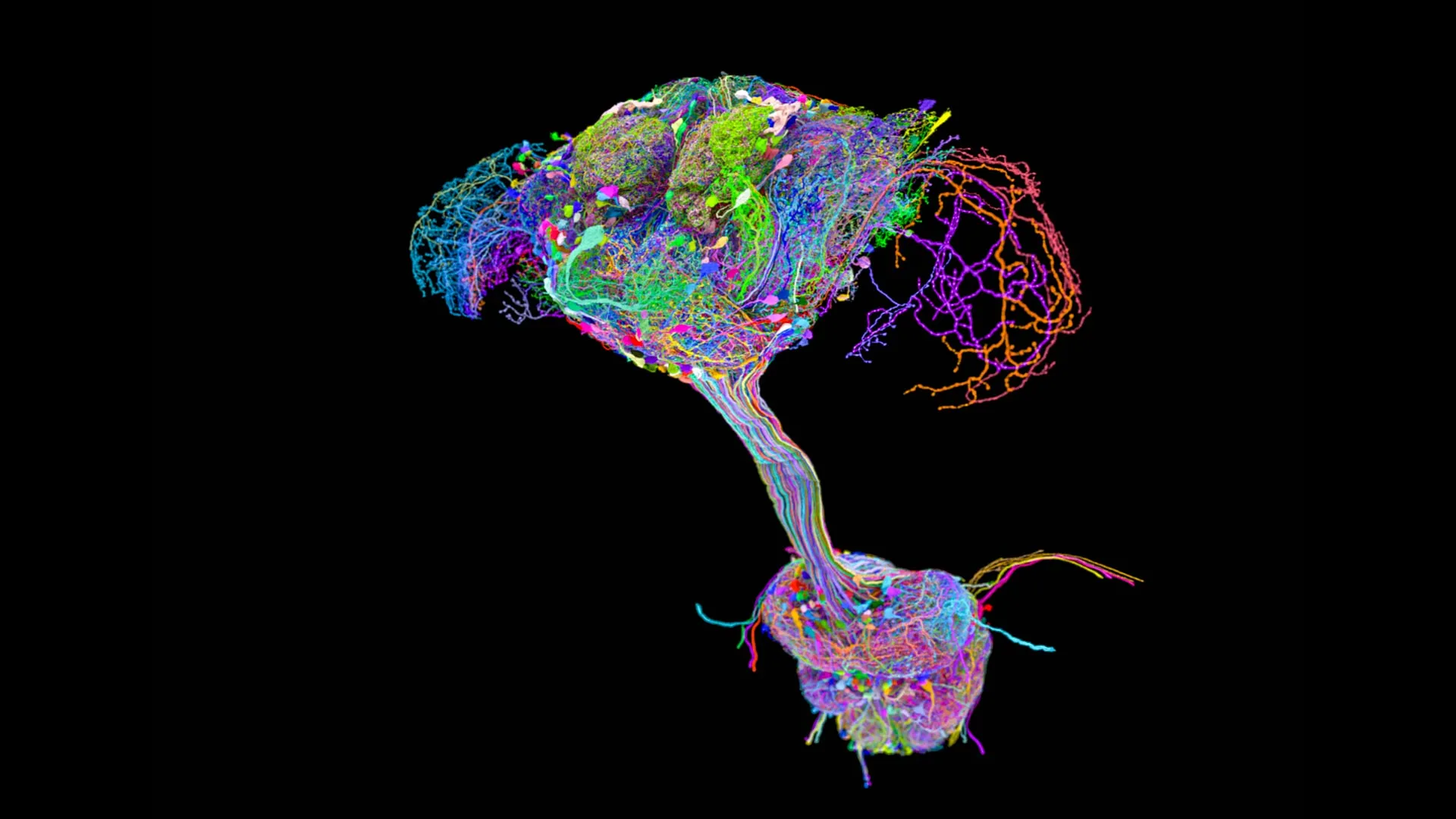
When researchers at Harvard Medical School and Princeton University sliced a single fruit fly into thousands of impossibly thin sections and photographed each one, they set out to answer a question that has haunted neuroscience for decades: how does the brain actually tell the body what to do?
The answer, published in Nature on June 8, turned out to be far more surprising than a simple chain of command. A complete map of every neural connection in a fruit fly's central nervous system—the first connectome to bridge both brain and nerve cord—reveals that behavior isn't orchestrated from a single control center. Instead, distributed local circuits embedded directly in the body do much of the work themselves, deciding how legs should move, wings should beat, and sensory signals should be processed without waiting for orders from above.
"We can see all of the neurons and their connections as a complete unit for the first time and ask, 'What do we learn from that?'" said Rachel Wilson, a neurobiologist at Harvard's Blavatnik Institute and co-senior author of the study. For the first time, scientists working together globally can actually follow information as it flows from sensation to action across an entire nervous system—a breakthrough that opens new doors to understanding how brains and bodies work together to produce movement, learning, and behavior.
Building this connectome was a feat of both biology and engineering. The team, led by groups at Harvard and Princeton including Mala Murthy and Sebastian Seung at the Princeton Neuroscience Institute, started with a single fruit fly. They sliced it into thousands of ultra-thin serial sections, then used electron microscopy to capture millions of images showing every neuron and synapse. Artificial intelligence tools then aligned these millions of images and assembled them into a unified 3D map of stunning detail—showing how each neuron connects to others at the level of individual synapses.
Why fruit flies? Their nervous systems contain only about 160,000 neurons, making them infinitely simpler than humans with our roughly 86 billion. Yet despite that simplicity, fruit flies navigate complex environments, interact socially, learn from experience, and react to sensory signals with sophistication. They're also easy to breed and keep in laboratories, and their genetic toolkit is, as co-author Wei-Chung Allen Lee puts it, "incredibly sophisticated," allowing scientists to access, control, and record activity from single neurons. In essence, they're the Rosetta Stone of neuroscience—simple enough to map completely, complex enough to matter.
The connectome itself is now freely available online to researchers worldwide, funded in part by the U.S. National Institutes of Health, the National Science Foundation, and the BRAIN Initiative. This is no locked vault of data. It's a shared resource that could reshape how scientists understand the nervous system's most fundamental design principles.
What makes this particular map special is that it doesn't just show the brain—it bridges the gap between brain and nerve cord, the fly's spinal equivalent. Previous maps had either shown the brain alone or the nerve cord alone. Connecting them reveals something essential: information doesn't just flow downward from brain to body. The nerve cord contains some of the most functionally important neurons, those tied to sensation and movement, and these circuits can operate with remarkable independence. The brain receives feedback from the body, and the body makes local decisions. Behavior emerges from this conversation between parts, not from the barking of orders from headquarters.