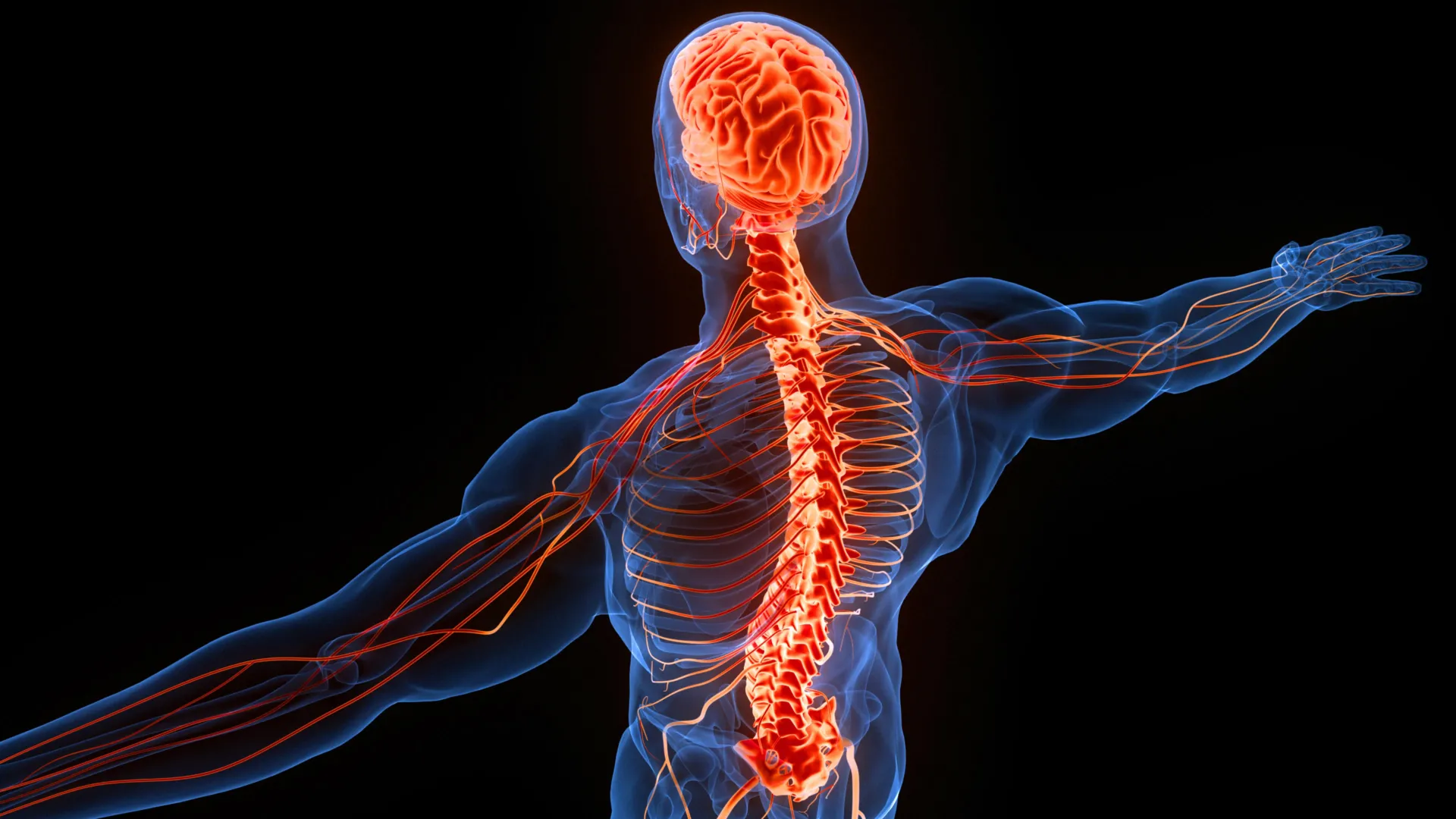
A flash of movement at the edge of your vision can make you turn before you have time to think. That quick response depends on a nervous system built with a striking twist: the left side of the brain often handles signals from the right side of the body, and the right side handles signals from the left.
Scientists have long asked why so many brain and spinal cord pathways cross the body’s midline. In a study published in Frontiers in Neuroanatomy, University of Minnesota researchers Dr. Martin Wessendorf and Daniel Wang offer an evolutionary explanation. They suggest that later brain circuits may have developed around an ancient visual system whose connections already crossed sides.
The idea starts with how eyes form images. A lens projects a reversed image onto the retina: something on your right appears on the left side of the retina. At the optic chiasm, nerve fibers sort visual information so that the right visual field reaches the left side of the brain, and the left visual field reaches the right.
Some of those signals go to the optic tectum, an old midbrain structure found in every vertebrate species. In mammals, it is called the superior colliculus. It helps the brain react quickly to events, such as noticing nearby motion. The researchers point out that the tectum also receives sound and body-sensation signals, which are organized into maps that match its map of the opposite visual field. This may have offered evolution an existing crossed layout for other circuits to build on.
Wessendorf, a neuroscientist and associate professor emeritus, studies how the brainstem regulates spinal cord neurons. Wang specializes in cognitive neuroscience and neurodegenerative diseases. In their paper, they examine crossed pathways in four-limbed animals, or tetrapods, including mammals, birds, reptiles, and amphibians.
Two pathways carry sensations from the body toward the brain. The dorsal column pathway sends information about gentle touch, vibration, and body position up the spinal cord; it crosses in the brainstem. It is found in amphibians, reptiles, birds, and mammals, but not fish. The spinothalamic tract carries pain, itching, and some kinds of touch. It crosses within the spinal cord before sending signals toward the thalamus, a brain region involved in sensory and movement processing. This pathway appears in birds, mammals, and reptiles, as well as some cartilaginous fish, including sharks and rays.
The crossed pattern also appears in movement pathways linking the brain to the opposite side of the spinal cord. One example named by the researchers is the tectospinal pathway, which helps the body respond quickly to information from the surroundings. Together, these examples show that crossing is not limited to vision or to one type of signal.
The researchers’ proposal is an evolutionary hypothesis, not a settled answer. But the broad spread of these pathways across animal groups gives scientists clues about when the arrangement may have taken shape. If the optic tectum provided an early map of the world on the opposite side, the brain’s cross-wiring may be a very old inheritance—one that newer systems adapted rather than replaced.