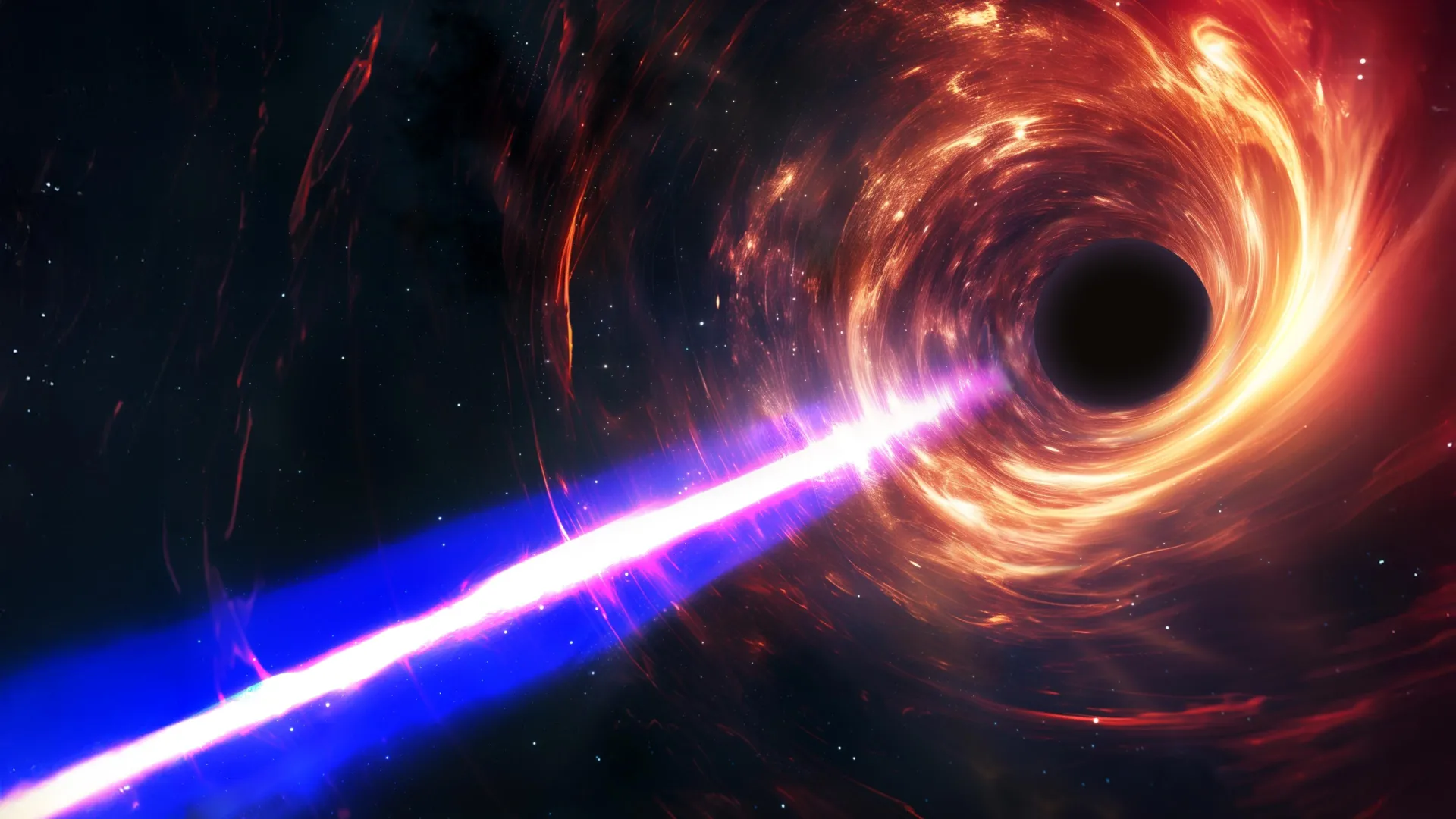
Three hundred meters beneath the Mediterranean Sea off the coast of Sicily, a neutrino detector captured something no scientist had ever seen before: a ghost particle carrying 220 petaelectronvolts of energy, more than ten times more powerful than any cosmic neutrino previously observed. The particle arrived on February 13, 2023, arriving like a messenger from the edge of the universe—but its origin remained a mystery. Now, research published in the Journal of Cosmology and Astroparticle Physics offers a compelling answer: the particle likely came from blazars, some of the cosmos's most violent objects, where supermassive black holes hurl jets of plasma toward Earth.
The detection itself was remarkable for another reason. The KM3NeT/ARCA observatory, nestled deep off Sicily's coast, was still under construction when it made the discovery. Only 21 detection lines—roughly 10 percent of the observatory's final planned capacity—were operational. Even operating at a fraction of its full power, the instrument caught this unprecedented event.
The mystery began immediately. Typically, when scientists detect a neutrino from space, they search for an electromagnetic counterpart—radio waves, visible light, X-rays, or gamma rays arriving from the same region of sky at the same moment. No matching signal appeared. This absence of a conventional cosmic calling card forced researchers to think differently about where the neutrino came from.
Meriem Bendahman, a researcher at INFN Naples and member of the KM3NeT collaboration, and her team approached the problem like forensic investigators examining clues at a crime scene. They considered several possibilities: the neutrino could have been born when ultra-high-energy cosmic rays collided with the cosmic microwave background, that ancient light left over from the early universe. But the lack of any electromagnetic signal suggested something else: the particle likely emerged not from a single dramatic event, but from a diffuse background—a flux of neutrinos contributed by many sources across the sky.
This reasoning pointed them toward blazars. These are active galactic nuclei powered by supermassive black holes, among the most extreme accelerators in the universe. Rather than one blazar producing the detected neutrino, the team hypothesized that a large population of blazars, working in concert across space, could generate the particle the detector observed.
To test this idea, the researchers used a simulation tool called AM3 to model realistic blazar populations, grounding their parameters in measurements already gathered from other observations. They adjusted two critical factors: baryonic loading, which determines how much energy protons carry and affects neutrino production, and the proton spectral index, which influences whether protons can reach the extreme energies needed. For each simulation, they calculated both neutrino production and gamma-ray emission, then compared the results with observations from multiple major observatories—KM3NeT/ARCA, the IceCube Neutrino Observatory, and NASA's Fermi Gamma-ray Space Telescope.
The model proved elegant. A realistic population of blazars could plausibly explain the extraordinary detection. Importantly, it also accounted for what had not been observed: the striking rarity of such ultra-high-energy events, with no comparable detections elsewhere. The blazar population model remained consistent with known gamma-ray observations from Fermi as well. "We modeled a realistic population of blazars with physically motivated parameters, and we found that this population of blazars could explain the origin of this ultra-high-energy event, while also being consistent with the constraints that we have regarding the gamma-ray and neutrino observations," Bendahman explained.
As KM3NeT continues its construction and grows closer to full operational capacity, the observatory will become increasingly sensitive to rare cosmic messengers—opening new windows onto the universe's most violent engines.