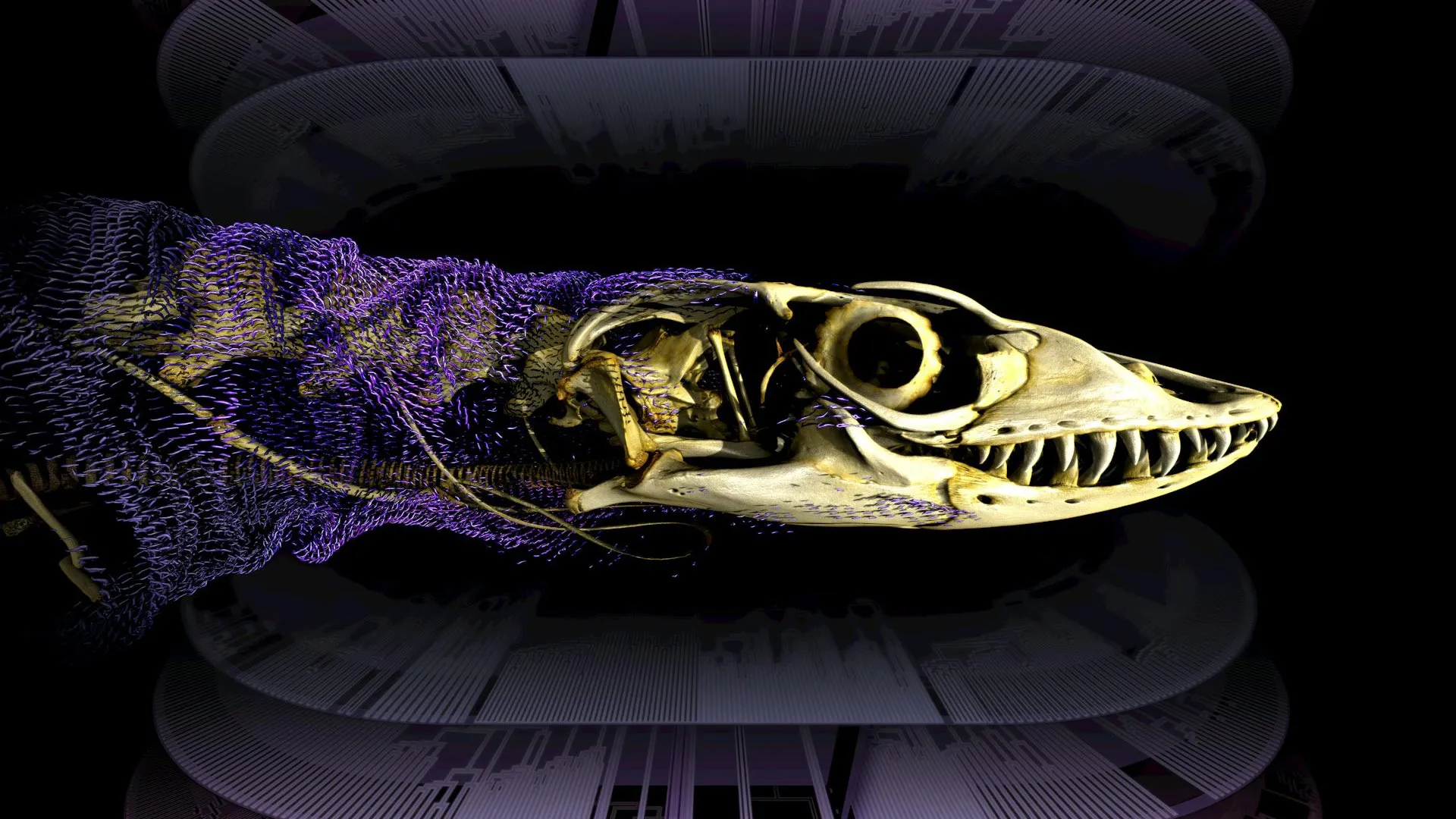
In the Miocene epoch, when Australia's vast interior turned dry and unforgiving, goannas did something that shouldn't have been possible: they grew back armor their ancestors had deliberately shed millions of years earlier. That evolutionary comeback—the only known case of a complex trait re-evolving after being lost—has just overturned a cornerstone principle of biology that scientists had treated as law for nearly a century.
The rediscovery comes from a sweeping analysis that finally settles a 320-million-year mystery: where do the bony plates embedded in reptile skin come from, and why do they keep reappearing across wildly different lineages—turtles, crocodiles, snakes, dinosaurs—as if evolution keeps reinventing the same solution to survival?
Researchers analyzed 643 living and extinct reptile species, combining fossil evidence with modern computational tools to reconstruct the entire evolutionary timeline of these skin bones, or osteoderms. What they found, published in the Biological Journal of the Linnean Society, rewrites our understanding of how evolution works. The evidence is unambiguous: osteoderms independently evolved multiple times across different lizard lineages, contradicting a 20th-century assumption that all living reptiles inherited them from a common ancestor.
The oldest skin bones in the fossil record stretch back 475 million years, when some of the earliest vertebrates evolved elaborate bony exoskeletons before they even had internal backbones. Throughout evolutionary history, this trait has surfaced again and again—fish developed scales, and land animals evolved osteoderms, possibly to cope with harsh terrestrial environments. Yet for the most part, these skin bones vanished from most lineages, making the pattern deeply puzzling.
By examining the evolutionary relationships of 643 species, the researchers traced when osteoderms first appeared in most lizards: during the Late Jurassic and Early Cretaceous periods, more than 100 million years ago, when iconic dinosaurs like Brachiosaurus and Stegosaurus roamed the Earth. That early burst of osteoderm evolution slowed over time, with most groups holding onto their skin bones ever since.
Except for one remarkable group. Monitor lizards—known as goannas in Australia—had completely lost their osteoderms, likely because their active, efficient bodies functioned better without the extra weight. But when their descendants reached Australia roughly 20 million years ago, they re-evolved the armor during the drier Miocene period. Scientists believe the skin bones returned to reduce water loss and provide protection in open, arid landscapes. Goannas are the only known lizard lineage to reacquire osteoderms after losing them, a finding that directly challenges Dollo's law—a principle stating that once a complex trait disappears, it can never re-evolve.
The discovery settles debates that had raged since the early 20th century, when researchers first assumed lizards shared a common ancestor with skin bones. By the late 1900s, scientists shifted to proposing independent evolution, but without a clear evolutionary timeline, the discussion remained fragmented. Modern computing, combined with fossil evidence, finally made it possible to narrow thousands of potential evolutionary scenarios into a single coherent story. The work represents a synthesis of past and present—Darwin's journal of publication and contemporary technology working together to illuminate 320 million years of biological history that no single line of evidence could have revealed alone.