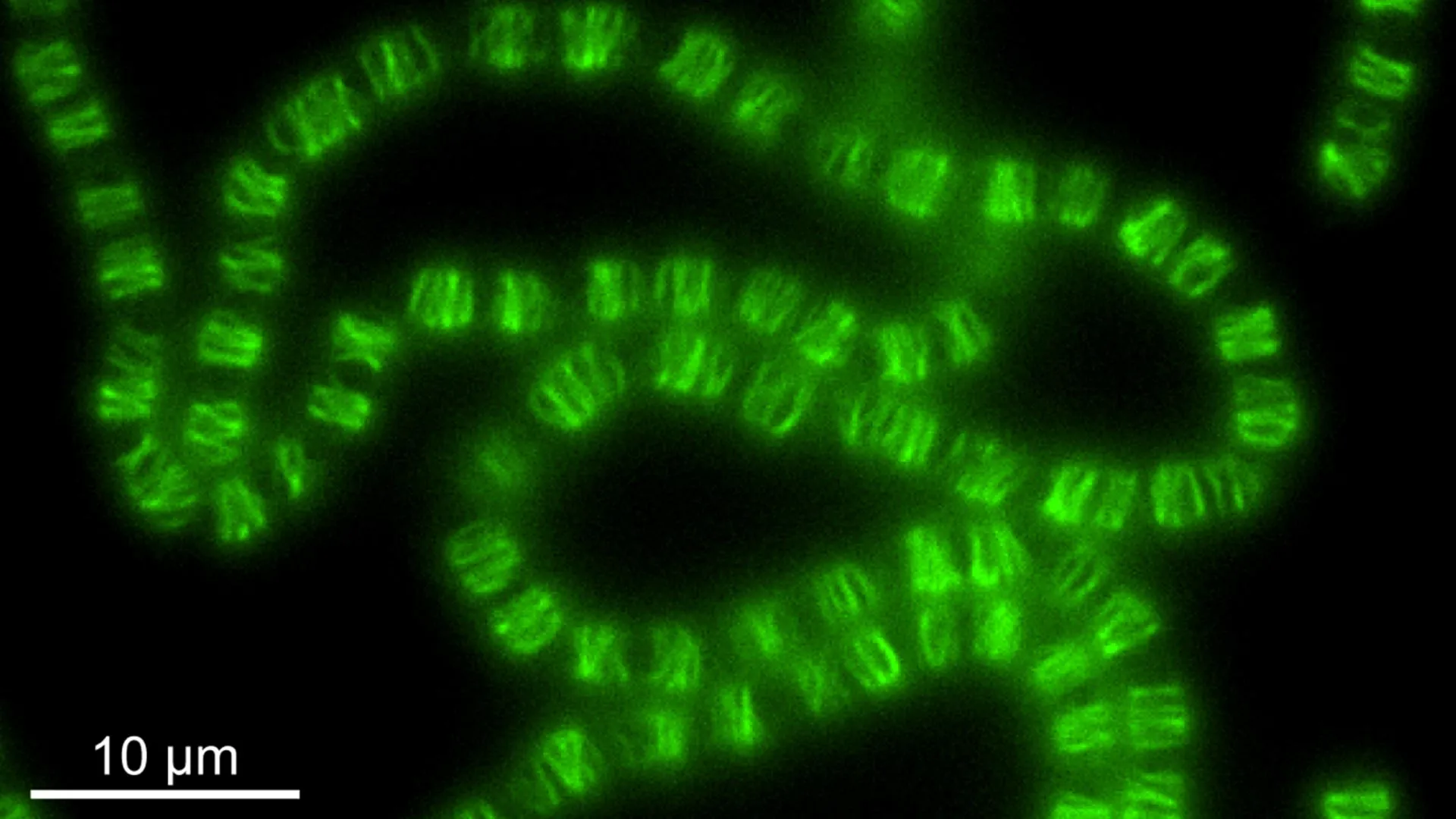
For billions of years, cyanobacteria quietly shaped the planet. These photosynthetic microorganisms filled Earth's early atmosphere with oxygen, making complex life possible. Now, scientists at the Institute of Science and Technology Austria have discovered something equally remarkable: an ancient bacterial system once used to separate DNA has been repurposed to build the very architecture of the cell itself.
The findings, published in Science, center on Anabaena sp. PCC 7120, a species that has served as a model for understanding multicellular cyanobacteria for over three decades. "Cyanobacteria are essentially pioneers of oxygenic photosynthesis," says Benjamin Springstein, a postdoc in Professor Martin Loose's group at ISTA. "They are responsible for the Great Oxygenation Event about 2.5 billion years ago. Without them, it's safe to say that none of us would be here today."
The discovery itself came almost by accident. During the COVID-19 pandemic, while lab work was paused, Springstein was reviewing scientific literature when he noticed something unexpected: Anabaena and related cyanobacteria contained a system called ParMR encoded within their chromosomes. Traditionally, ParMR is found only on plasmids—mobile genetic elements—and functions to distribute DNA during cell division. Its presence on chromosomes was highly unusual.
Springstein initially suspected the system might have adapted to separate chromosomes instead. But experiments revealed something far more surprising. One component, called ParR, no longer binds to DNA at all. Instead, it attaches directly to the cell's inner membrane. The other component, ParM, does not form structures in the cytoplasm to move genetic material. Instead, it creates filament networks just beneath the membrane, forming a polymer layer that resembles a cellular skeleton—or cortex.
"I made a serendipitous observation," Springstein recalls.
To understand how this works, the team collaborated with Professor Florian Schur and his PhD student Manjunath Javoor at ISTA, using cryo-electron microscopy to examine the filaments in detail. They discovered that unlike similar systems in other bacteria—which form polar filaments growing from one end—these filaments are bipolar, growing and shrinking from both ends. When removed from the organism and studied in isolation with purified components, the filaments displayed dynamic instability: they grow, then rapidly collapse, behavior strikingly similar to microtubules in more complex cells.
This research involved collaboration across four institutions: ISTA in Austria, Institut Pasteur de Montevideo in Uruguay, Kiel University in Germany, and the University of Zürich in Switzerland.
The work offers new insight into how protein systems evolve over time and how multicellular life may have developed in these ecologically important bacteria. Even today, cyanobacteria remain essential to life on Earth, contributing heavily to global biomass and playing central roles in carbon and nitrogen cycles, thriving everywhere from hot springs to Arctic waters.