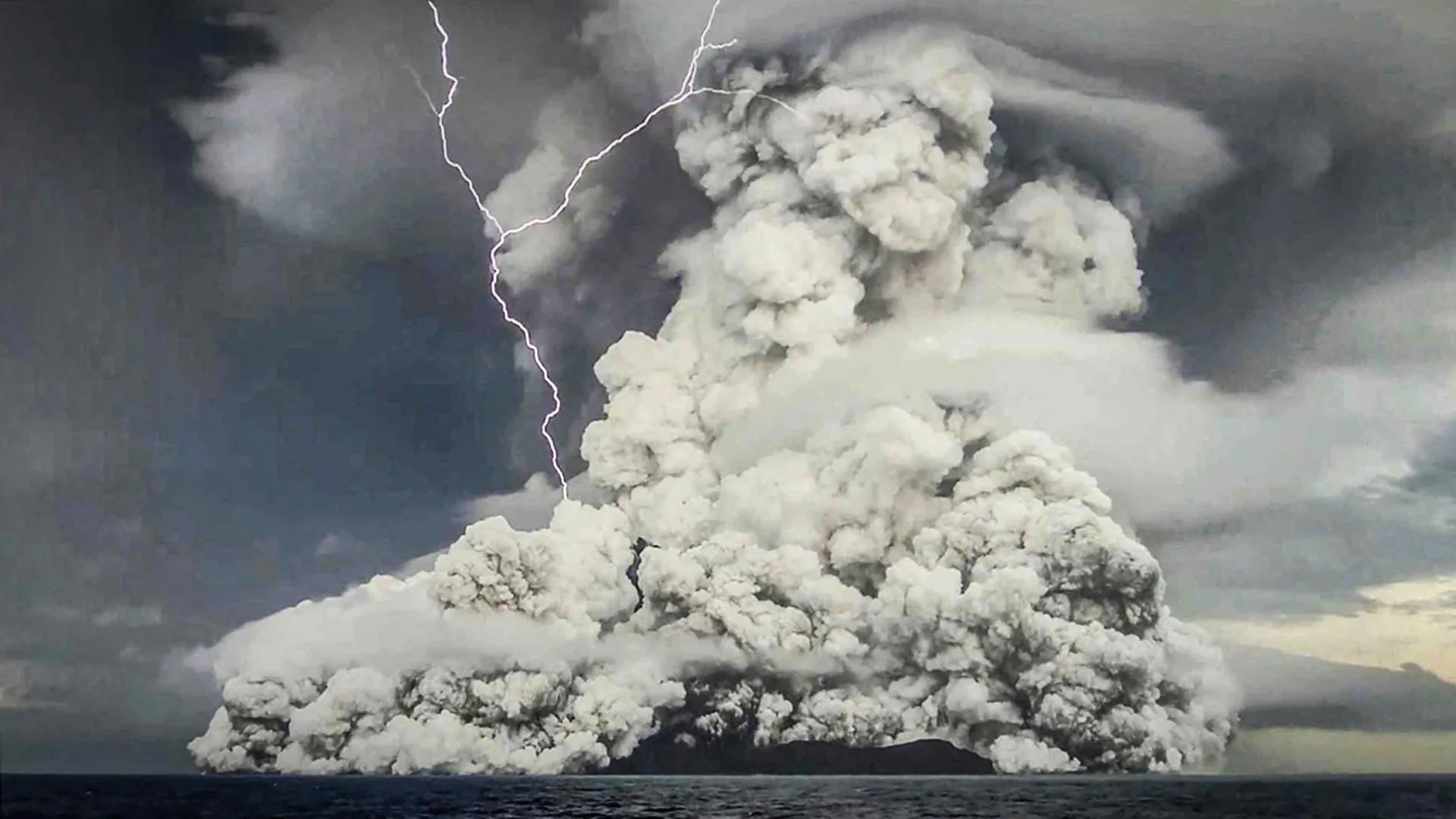
When Hunga Tonga-Hunga Ha'apai erupted beneath the South Pacific in January 2022, it was one of the most powerful volcanic explosions of modern times. But scientists digging through satellite images have stumbled onto something completely unexpected: the volcano's own giant cloud appears to have helped destroy some of the methane pollution the eruption created.
The surprise shows up as a strange chemical fingerprint. Researchers spotted record-high levels of formaldehyde floating inside the plume, and that is a big clue. Formaldehyde only lives for a few hours, but it forms briefly whenever methane breaks apart in the air. Seeing so much of it meant methane was being actively destroyed, over and over.
"We were surprised to see a cloud with a record-high concentration of formaldehyde. We were able to track the cloud for 10 days, all the way to South America. Because formaldehyde only exists for a few hours, this showed that the cloud must have been destroying methane continuously for more than a week," says Dr. Maarten van Herpen from Acacia Impact Innovation BV, first author of the study published in Nature Communications.
The numbers are startling. The eruption released about 300 gigagrams of methane — roughly the annual methane output of more than two million cows. Yet the plume also removed about 900 megagrams of methane per day, an amount comparable to the daily emissions of two million cows. The volcano was partly cleaning up its own mess.
How? The researchers point to a strange recipe of volcanic ash, seawater and sunlight. In 2023, a team found that Saharan dust blown across the Atlantic can mix with sea salt from breaking waves. Together they form tiny particles called iron salt aerosols. When sunlight hits these microscopic particles, they release chlorine atoms, which are aggressive enough to attack and break apart methane molecules.
"What is new — and completely surprising — is that the same mechanism appears to occur in a volcanic plume high up in the stratosphere, where the physical conditions are entirely different," says Professor Matthew Johnson from the University of Copenhagen, who worked on both discoveries.
The Hunga Tonga blast was special because it happened underwater, hurling huge amounts of salty seawater up into the stratosphere along with the ash. There, sunlight turned that salty mix into reactive chlorine that gobbled up methane.
This matters because methane now causes about one third of global warming. It's far less plentiful than carbon dioxide, but over a 20-year period it is roughly 80 times as potent. The good news: methane only lingers in the air for about a decade, unlike CO₂, which can influence climate for far longer. That short lifetime makes methane a prize target for quick climate action — and nature just showed us a trick that might one day inspire new ways to speed up its removal.