Chunlei Guo spends his days shooting metal with lasers that fire in pulses lasting one quadrillionth of a second — fast enough to do something remarkable: turn seawater into fresh water without dumping a salty poison back into the ocean.
Guo, a professor of optics and physics at the University of Rochester in New York, leads a team that built a solar-powered desalination system designed to fix two of the biggest problems with how we get drinking water from the sea today. The work was published in the journal Light: Science & Applications.
Here's why it matters: around the world, 2.2 billion people don't have reliable access to safe drinking water, according to the United Nations. As places from California to the Middle East face droughts, more and more of them are turning to desalination plants that remove salt from ocean water. But the two most common methods have serious downsides. Reverse osmosis forces water through special membranes, while thermal distillation uses heat to separate fresh water from seawater. Both guzzle energy, often need water to be treated before and after, and generate a thick, salty waste called brine. When that brine is dumped back into the sea, it raises local salt levels and lowers oxygen — conditions that can harm marine life.
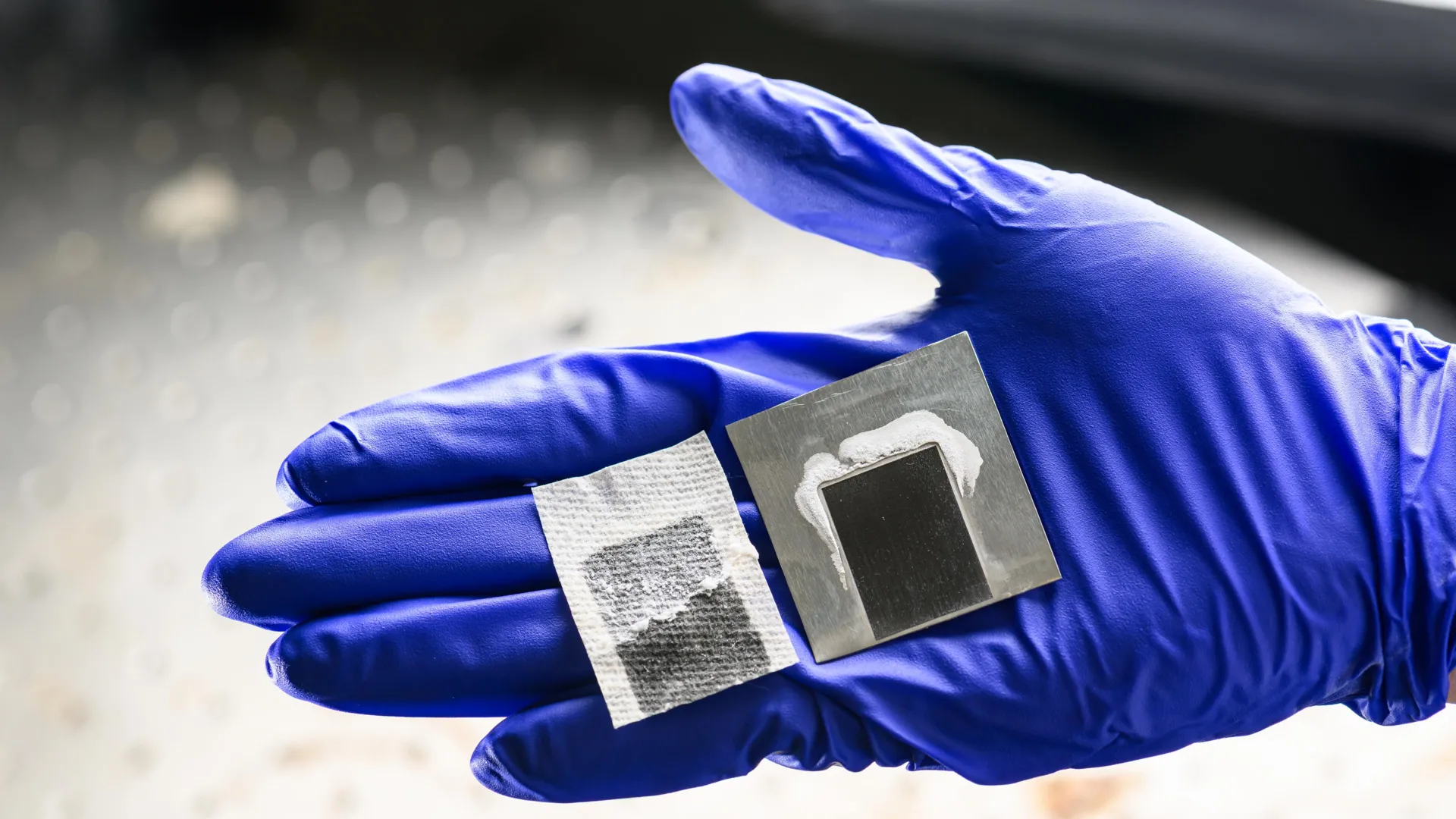
Guo's team took a different path. At the heart of their technology are panels made from black metal treated with femtosecond lasers. These ultrafast pulses carve microscopic structures into the surface, making it incredibly good at absorbing sunlight and also "superwicking" — meaning water spreads across it in a thin film instead of beading into drops.
Each panel draws a tiny layer of seawater across its active region. The dark metal soaks up almost all the solar radiation, heating the water until it evaporates, leaving salts and minerals behind. Here is the clever part: instead of letting that salt build up into a crust that would clog the system, the grooves guide it toward untreated areas along the panel's sides — the passive region.
The team leaned on a physics quirk anyone who has spilled coffee knows. As a coffee drop dries, particles drift to the edge and leave behind a dark ring. "We use that same principle to advance the salts to the passive region," Guo says. The same effect pushes dissolved minerals away from where evaporation happens.
That matters because real seawater is viciously difficult. Earlier lab systems often worked fine with simple artificial saltwater, but real ocean water contains magnesium, calcium, and other substances that crystallize into hard, dense deposits — like the scale inside a shower head, only hundreds of times worse.
Guo's team tested the panels using actual seawater collected from the Pacific, Atlantic, and Indian Oceans — and the design held up, keeping salt from choking the system. It's a promising, low-energy step toward giving more people clean water without harming the oceans they draw it from.