Picture a cold drink on a hot day, beads of water sliding down the outside of the glass. That simple trick of physics is quietly powering some of the world's most important machines — and a team of scientists in South Korea just found a clever way to make it work up to five and a half times better.
Researchers at KAIST (the Korea Advanced Institute of Science and Technology) in Daejeon built an ultrathin polymer coating that supercharges condensation, the moment water vapor turns back into liquid. When steam condenses at a power plant, when seawater becomes fresh drinking water, or when heat is pulled away from a computer chip, those droplets matter enormously. On ordinary metal surfaces, tiny water drops merge into a slippery film that acts like a winter coat, trapping heat and slowing things down. The better approach — called dropwise condensation — keeps water in separate droplets that form, fall away, and leave the surface exposed again, like a vacant seat being filled the moment someone stands up.
But engineers had hit a wall. Rough surfaces gave droplets plenty of places to start, but they also trapped them, making them hard to remove. Smooth surfaces let droplets slide away easily but offered few spots to begin. It seemed you had to choose one or the other.
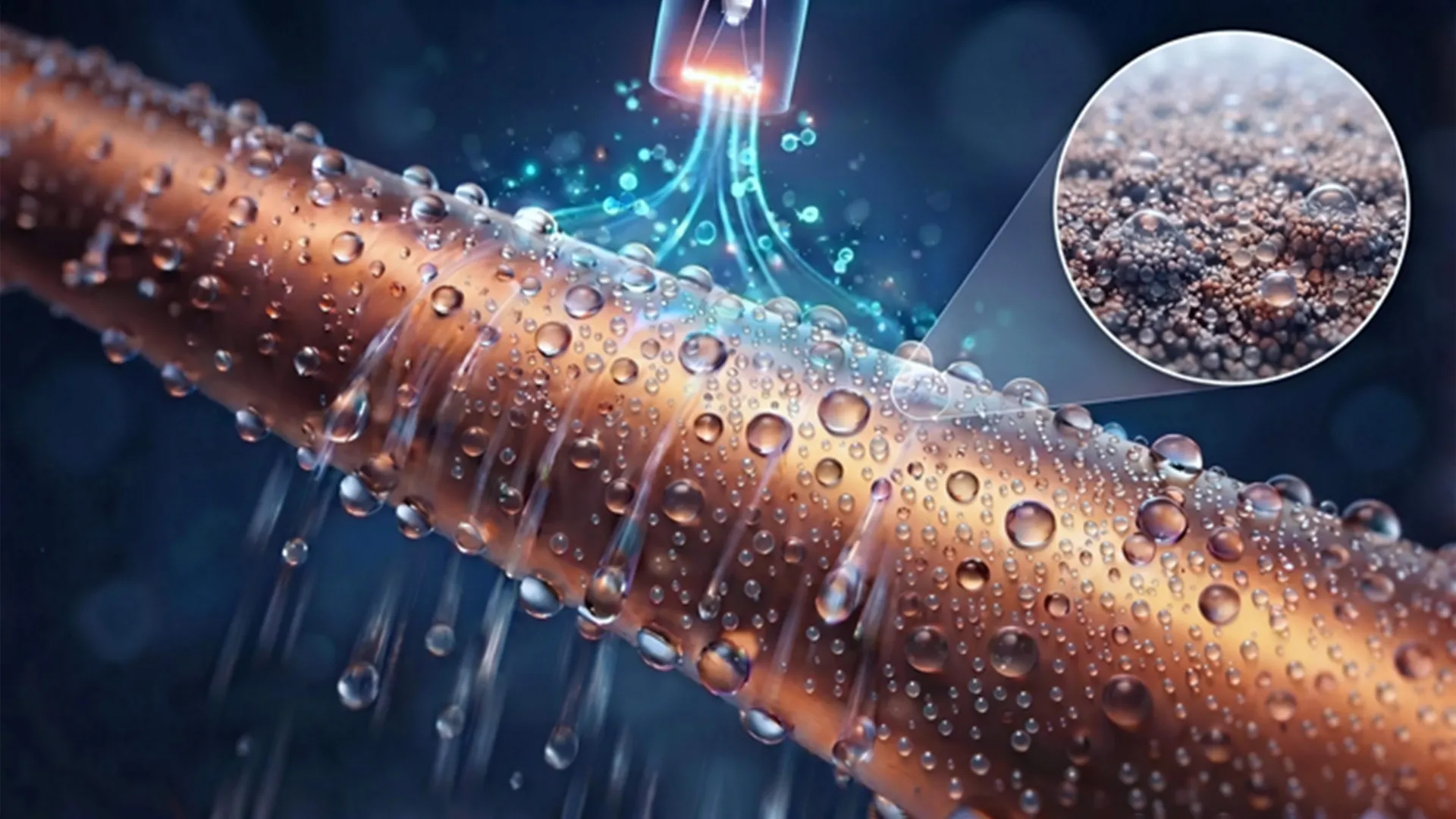
The KAIST team, led by Professors Youngsuk Nam and Sung Gap Im, found a way to have both. They made their polymer coating using a technique called initiated chemical vapor deposition (iCVD), which lays down an incredibly thin layer from gases. As they made the film thinner and thinner, thousands of tiny polymer aggregates appeared across its surface. Past researchers treated these as "defects" to be scrubbed away. This team kept them — and put them to work as nucleation sites where droplets could conveniently form. The thinner films sprouted roughly three times as many droplets as thicker ones.
Then they added a second trick. A heat treatment weakened the force holding each droplet to the coating, so drops detached more easily, often before they grew very large. By controlling droplet birth and droplet departure separately, the team cracked the old trade-off.
Tested on real copper condenser tubes, the coating reached a heat transfer coefficient of about 88 kW·m-2·K-1 — up to 5.5 times better than a conventional water-film-coated copper surface, and more than 50% better than a standard hydrophobic coating. That kind of leap could make power plants, desalination plants, and electronic cooling systems significantly more energy-efficient.
The bigger lesson is one about looking twice at what seems broken. The imperfections earlier scientists wanted to erase turned out to hold the key. Sometimes the best ideas hide in the flaws we've been taught to ignore.