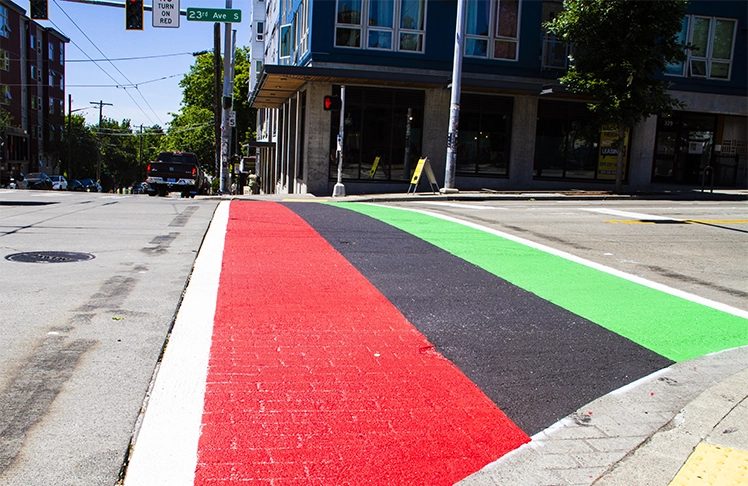
On the corner of 23rd Avenue and Jackson Street in Seattle's Central District, the bold red, black and green stripes of a Pan-African flag crosswalk are being brought back to life—renewed not erased, as some community members feared when removal markings first appeared. The Seattle Department of Transportation is restoring 11 of these historic crosswalks, symbols of Black heritage and cultural identity that emerged from grassroots effort and have become part of the city's public landscape.
The crosswalks began not as city infrastructure, but as a community uprising against invisibility. In 2015, Wyking Garrett, president and CEO of the Africatown Community Land Trust, watched other Seattle neighborhoods receive public recognition through murals and street art while the Central District's history seemed to fade from view. "Our community was being completely erased," Garrett recalled. "It was on a trajectory to be as if we were never here." He issued a call to action, and community members responded by painting the original crosswalks themselves—transforming a neighborhood's struggle for representation into a visible declaration of permanence. The city eventually embraced the project, adopting these community-painted symbols as formal markers of Black presence and resilience.
But weather and daily traffic wore on the vibrant paint. As portions faded and deteriorated, and as restoration crews began their work, alarm spread through the neighborhood. Were these hard-won symbols being removed? "They were getting worn, and I think people saw really, the alarm went up that they were again taking away another representation of us in the community," Garrett said. City officials clarified that the temporary markings signaled preservation, not demolition—a restoration project funded through the Levy to Move Seattle.
The project is more than routine maintenance. Dahvee Enciso, SDOT's decorative marking crew coordinator and senior civil engineer specialist, emphasized the months of collaboration between city officials, the Black Heritage Society of Washington State, the CD Art Association and other community stakeholders. Some locations require only pressure washing and minor repairs, while others are receiving full repainting using liquid thermoplastic materials designed for durability. Restoration work is scheduled to be completed by June 14.
The timing carries symbolic weight. Seattle is preparing to welcome visitors from around the world for the 2026 FIFA World Cup, and Garrett sees the restored crosswalks as cultural landmarks that can serve another purpose: gateways encouraging visitors to explore the neighborhood and support Black-owned businesses. "We know there's potentially hundreds of thousands of people that are gonna be in the city with the World Cup and other tourists coming up," Garrett said. "Hopefully, the crosswalks can help them find their way to supporting Black businesses."
For Enciso, the work carries meaning beyond infrastructure. "Not many people can say they love their job," he reflected. "One of the passions and loves of this job that I have is to work with underserved communities, and I get to learn a lot of different cultures. We're able to bring an identity to the neighborhood by installing beautiful works of art that are sentimental, that mean something to the community." As the Central District's Pan-African crosswalks are renewed, they stand as a reminder that visibility requires constant tending—and that community members will continue to demand recognition on the streets they have inhabited for generations.