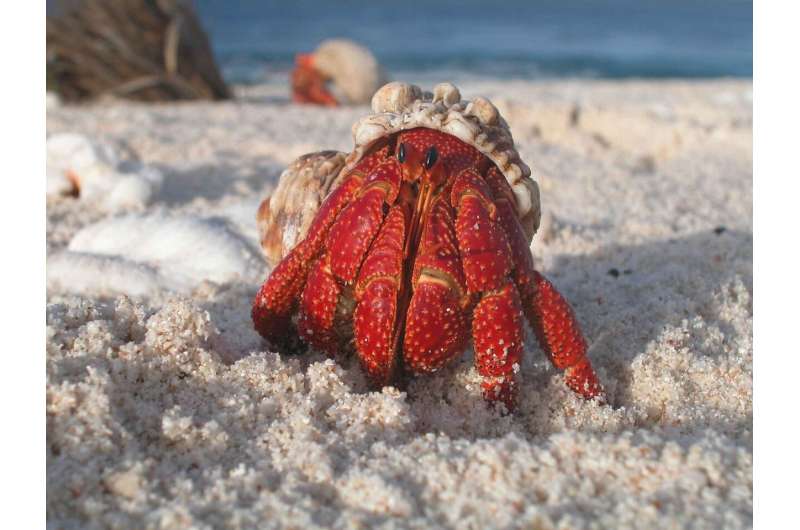
Caitlin Ball watched as dozens of hermit crabs scuttled across lab trays, each one tucked into a shell—some just right, others painfully too small. For years, scientists had known these crustaceans grew slower when cramped, but no one could say exactly how. Now, Ball and her team at Tufts University have uncovered a surprising answer: the crabs aren’t eating less. They’re just getting less out of what they eat.
This discovery matters because it shifts how we understand growth regulation in animals. For decades, the assumption was that limited growth under stress—like living in a too-tight shell—was due to reduced food intake. But Ball’s research, published in Invertebrate Biology, shows that Pagurus longicarpus, a common Atlantic hermit crab, maintains its appetite even when constricted. Instead, it defecates more, expelling nutrients that might otherwise fuel growth. This suggests a sophisticated internal switch: when physical space is limited, the crab’s body chooses not to assimilate as many nutrients, effectively putting growth on hold without changing eating behavior.
The experiment was straightforward but revealing. Researchers paired crabs with either well-fitting shells or deliberately undersized ones, then monitored their feeding and waste. The crabs in small shells ate just as much as their comfortably housed peers—but produced more fecal matter. That excess waste points to reduced nutrient absorption, a physiological strategy never before documented in this context. "For years, people observed the growth slowdown but couldn't identify the mechanism," says Phil Starks, associate professor of biology and senior author on the study. "What we're seeing is consistent with something subtle—the crabs appear to regulate growth by adjusting nutrient assimilation."
This insight opens a window into broader biological principles. Growth isn’t just about how much you eat; it’s about how your body decides to use what you consume. In humans, variations in metabolism, energy storage, and nutrient absorption also play major roles in body composition—though, as Starks notes, we don’t have the same level of control as hermit crabs. Still, the parallel is thought-provoking: across species, the path from food to body mass is more complex than simple intake.
Jan Pechenik, professor emeritus of biology and co-author, calls the findings a breakthrough in invertebrate biology. "We knew the pattern. Now we have opened the door to explore evidence for how it might work." As climate change and habitat disruption alter shell availability in coastal ecosystems, understanding how crabs adapt—biologically, not just behaviorally—could become increasingly important. For now, the hermit crab’s quiet metabolic recalibration stands as a testament to nature’s quiet ingenuity.