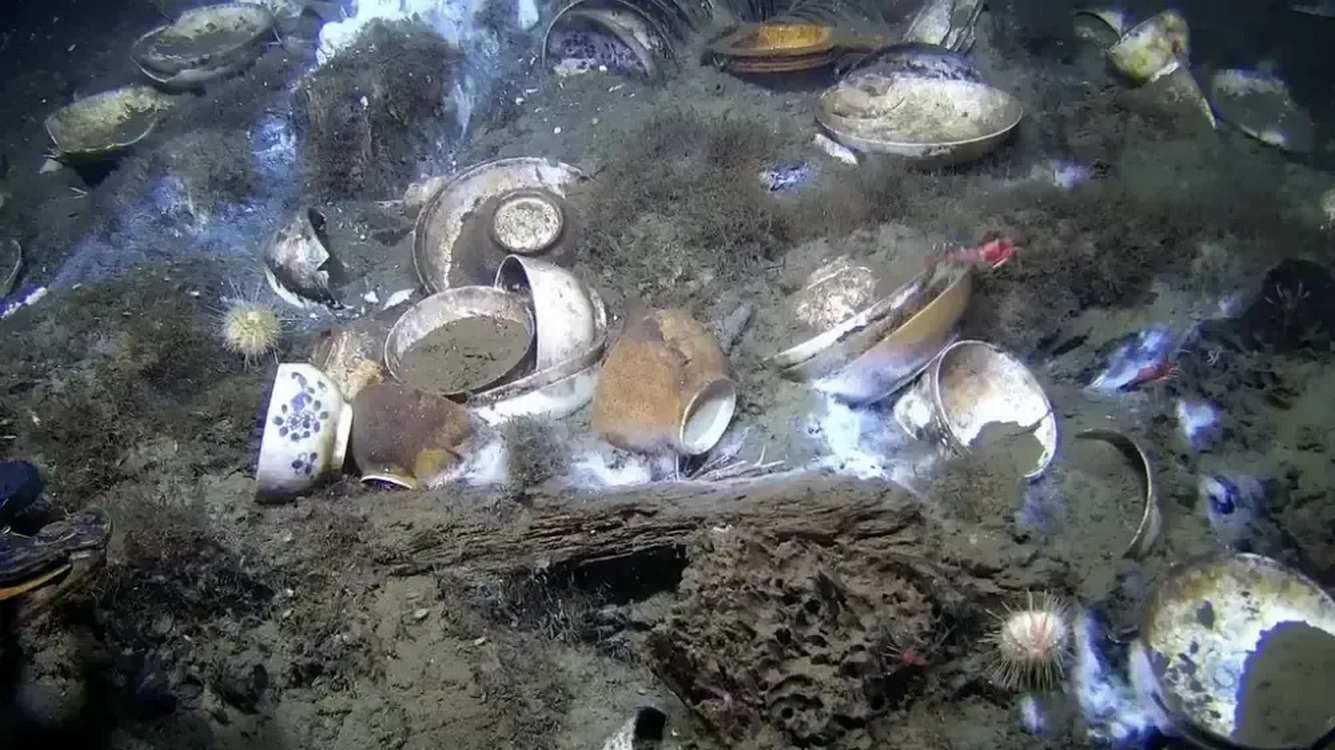
Espen Saastad, a Norwegian watchmaker who moonlights as an underwater surveyor, was piloting his remotely operated vehicle through the Skagerrak Strait between Norway and Sweden when his screens filled with an image that stopped him cold: rows of intact Chinese porcelain gleaming white and blue against the seafloor, undisturbed for nearly three centuries.
The discovery matters because it offers a rare, crystalline window into the machinery of 18th-century global trade—a moment when isolated commerce networks were beginning to knit together into something resembling the interconnected maritime system we know today. The porcelain tells a story not just of goods, but of geopolitics, taste, and the rapid expansion of European middle-class appetite for luxury imports that would reshape economies across the continent.
Saastad contacted the Norwegian Directorate for Cultural Heritage, and a joint expedition descended again to the wreck with a suction-cup-equipped ROV, carefully recovering 40 artifacts from the vessel's hold. The two-masted ship, measuring 72 feet in length, has rested upright roughly 2,000 feet below the surface since sinking around 1750. The cargo itself revealed two distinct styles of Chinese porcelain: Batavia ware with its signature blue decorations, and Dehua ceramics—the luminous white "Blanc de Chine" that commanded premium prices among European collectors. The crates holding them were packed with rice straw, a detail that whispered of their Far Eastern origin, though experts suspect the ship likely picked up the cargo from an intermediary rather than sailing all the way to China.
Beyond porcelain, the hold contained an eclectic inventory of the era's luxuries and necessities: blown and stemmed glassware shaped into platters and chandeliers, barrels of grain, and mysterious containers of biological matter—possibly coffee, tea, cocoa, or medicine—that have since degraded into ambiguity. Among the wreckage lay a single clue to the ship's movements: a brick from Lübeck, in northern Germany, recovered from what had been the galley, or kitchen. Yet even this hint remains tantalizingly imprecise; galleys were often repaired or replaced during a vessel's lifetime, so the brick may tell us more about a repair than the ship's true nationality.
Hanna Geiran, director general of the Norwegian Directorate for Cultural Heritage, captured the sense of astonishment that surrounded the find in a statement that speaks volumes: "I had to rub my eyes when I grasped the scale of this find. It is almost beyond belief." The wreck was discovered last fall, and the recovered artifacts are now the centerpiece of a new exhibition at the Norwegian Maritime Museum in Oslo, where they rest behind glass as tangible proof of a world rapidly shrinking through commerce.
The discovery underscores how much the ocean floor still holds in reserve—how many stories remain sealed in the deep, waiting for the right instrument and the right curiosity to uncover them. Many questions linger unanswered, and much of the cargo continues to rest untouched on the seabed, a reminder that some of history's most vivid truths lie not in archives but in the patient silence of the deep.