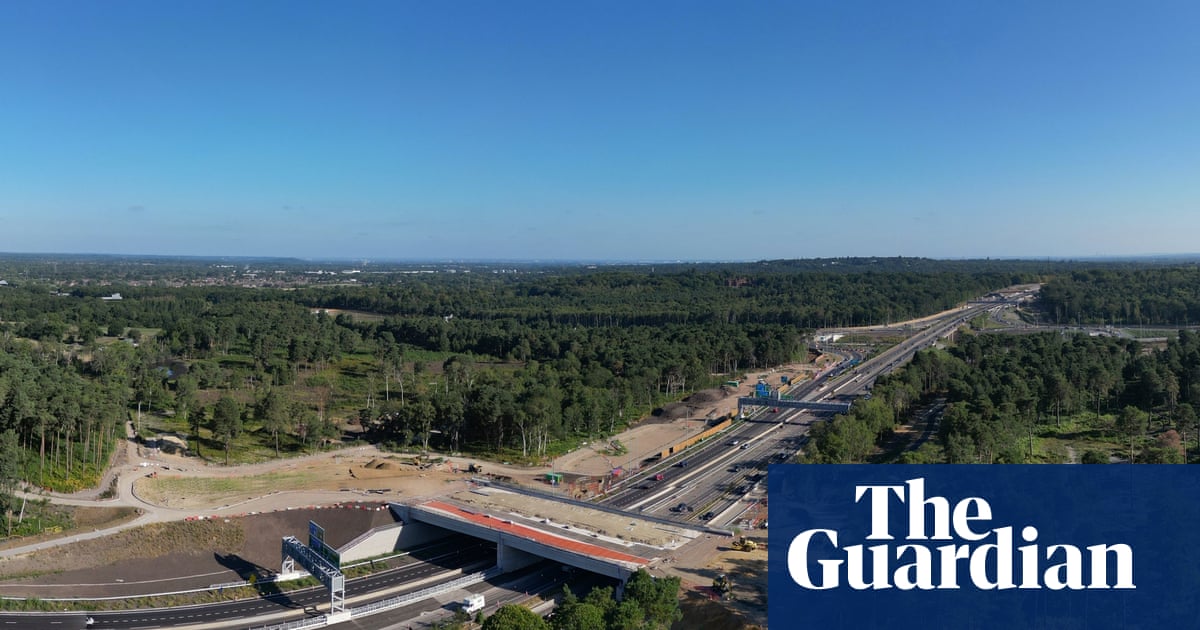
James Herd remembers when the spring walks felt alive with sound: "I'd take the dog around the common and every few hundred metres I'd hear the rustle of a lizard in the undergrowth – and I'd see adders." That was 17 years ago at Wisley Common in Surrey. By eight or nine years back, those walks had turned eerily quiet. The director of reserves management for Surrey Wildlife Trust was walking home without hearing or seeing a single piece of evidence that reptiles still inhabited the internationally important heathland he oversees.
The culprit was impossible to miss: the A3, an arterial road into London that carries hundreds of thousands of vehicles daily and cuts the protected Wisley and Ockham commons directly in half. This rare lowland heath, home for centuries to rich biodiversity including Britain's rarest lizard—the sand lizard—had been fragmented beyond repair. "There's six lanes of tarmac and vehicles doing 70mph in the way," Herd explains of the barrier separating species on opposite sides of the common. The damage deepened when the £317 million M25 improvement scheme began widening the A3 at the Wisley interchange, threatening to dismantle the habitat further.
But construction rubble can birth new hope. To mitigate the project's impact on wildlife, National Highways built the Cockrow Bridge, a lowland heath crossing that reconnects the fractured reserves and offers biodiversity a path to recovery. It is the UK's largest green bridge—a living ribbon of transplanted heathland suspended above the roaring motorway, complete with heather sprouting in purples and yellows, sand piles for breeding sand lizards, and logs providing thermal refuge and shelter for snakes and other reptiles.
The bridge addresses a crisis with real weight behind it. According to the UK's State of Nature report, the average abundance of 753 terrestrial and freshwater species has fallen by roughly 19 percent since 1970. Of more than 10,000 species assessed in Great Britain, 16.1 percent—nearly 1,500 species—are threatened with extinction. While roads aren't always blamed directly, experts agree the links between infrastructure and biodiversity loss are clear. Fragmented habitats mean isolated populations breeding within ever-tightening gene pools, leaving species vulnerable and less equipped to adapt to climate crisis.
Yet wildlife has already claimed the bridge before its official opening. Foxes, roe deer, and adders have been spotted crossing. Ground-nesting birds like nightjars, woodlarks, and Dartford warblers will benefit from the newly connected landscape. Herd emphasizes what often goes unnoticed: "They're doing most of the work here: pollination, decomposition, feeding everything further up the chain." The bridge isn't about saving charismatic species—it's about restoring entire communities of insects that form the heathland's foundation.
The UK, though, is playing catch-up. Ben Hewlett, the senior biodiversity adviser at National Highways who led the Cockrow project, notes that the US has built more than 1,000 animal crossings—overpasses, underpasses, tunnels, bridges—partly because collisions with elk, moose, and bears pose real road safety hazards. The Netherlands, with its smaller landscapes and denser wildlife, has made green bridges "almost routine business" since 1988, building around 80 green bridges including the 800-metre-long Natuurbrug Zanderij Crailoo in Hilversum. The Cockrow Bridge signals a shift: Britain is learning that reconnecting fragmented nature isn't just conservation—it's infrastructure planning that works with ecology instead of against it.