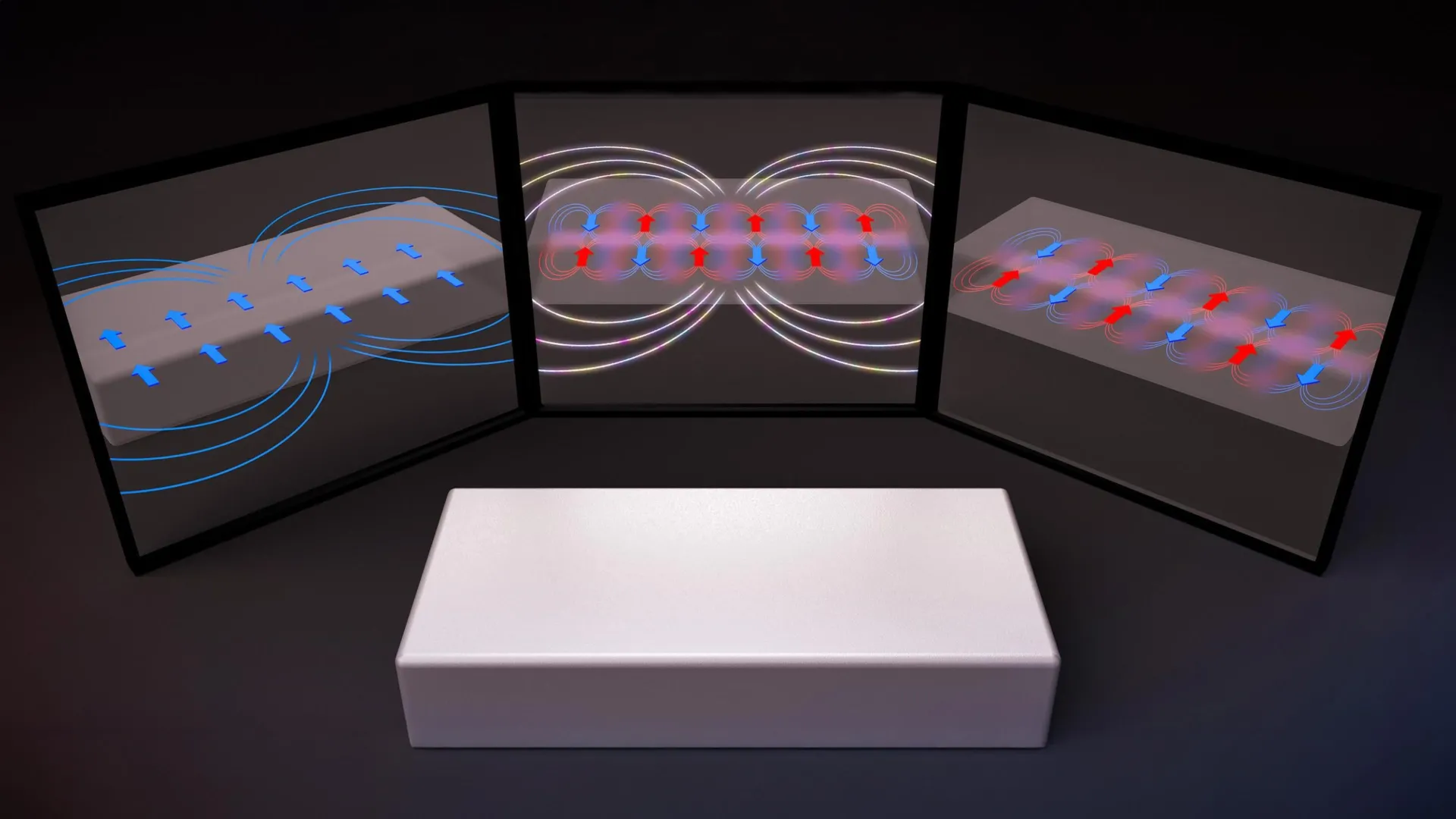
A spiral staircase offers a useful clue to a hidden twist inside manganese telluride, the material at the center of a discovery by scientists at SLAC National Accelerator Laboratory in Menlo Park, California. Their experiments provide strong evidence for altermagnetism, a third kind of magnetic order that physicists had proposed but struggled to prove directly.
For nearly 90 years, scientists sorted magnetic materials into two main groups. In ferromagnets, electron spins point in the same direction, creating an overall magnetic field like the one around a refrigerator magnet. In antiferromagnets, neighboring spins point in opposite directions, so their effects cancel. The new finding challenges that simple divide and could help researchers design materials for future electronics.
The SLAC team studied manganese telluride, or MnTe, which had long been considered an antiferromagnet. Its spins alternate in opposite directions, but the arrangement of atoms around those spins is rotated from one part of the crystal to another. That subtle difference changes how electrons behave. In recent years, researchers found that materials with this pattern could share traits of both familiar magnetic classes, including the ability to carry spin currents. These currents move information through electron spin rather than relying only on electrical charge.
The evidence needed to show that altermagnetism was truly distinct came from chirality, a kind of handedness. A spiral staircase twists in one direction; a chiral magnetic structure has a comparable directional asymmetry. The SLAC researchers identified direct evidence of this feature in MnTe. Lead author Daniel Jost, an associate scientist at SLAC and the Stanford Institute for Materials and Energy Sciences, said earlier results strongly supported the idea, but left a missing piece. The new study, published in the journal Science, presents what the researchers describe as robust experimental confirmation.
The term “altermagnet” was introduced in 2022, after scientists began seeing magnetic behavior that did not fit neatly into the two traditional categories. Confirming the new phase matters beyond settling a question in physics. If researchers learn to control its unusual mix of properties, altermagnetic materials could contribute to advanced memory systems, quantum devices and data centers that use energy more efficiently.
Those uses are possibilities, not products ready for everyday use. The immediate advance is a clearer way to recognize a magnetic state that had been hiding in a familiar material. By showing that MnTe has the distinctive twist researchers were looking for, the SLAC team gives scientists a firmer basis for exploring how altermagnets work and where their properties might prove useful.