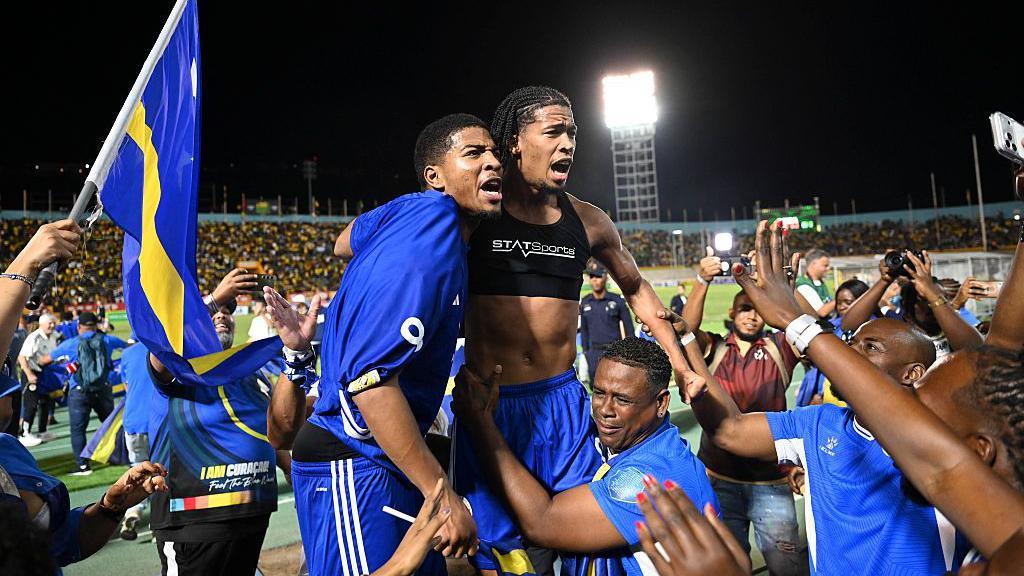
On an island smaller than the Isle of Man, where just 158,000 people call home, Curacao has made history simply by stepping onto the World Cup pitch. The Caribbean nation is the smallest ever, by both size and population, to qualify for football's greatest tournament — and they're not even a fully independent country, remaining part of the Kingdom of the Netherlands. Yet as they prepare to face Germany, Ecuador, and Ivory Coast in Group E, the entire island has turned blue with pride, a transformation that extends far beyond the colourful streets of Willemstad.
For decades, Curacao was perhaps best known for its namesake liqueur and its fiercely independent cultural heritage, a blend of Dutch influence and Caribbean soul. But something shifted when big-name managers started arriving. Patrick Kluivert came in 2015, and with him came a strategic reimagining of the national team — one that drew on the island's most valuable untapped resource: the roughly 158,000 Curacaoans living in the Netherlands. Eloy Room, a 37-year-old goalkeeper now with Miami FC, became the first diaspora player to represent the island that year. Leandro Bacuna, who played for Aston Villa and Cardiff, followed in 2016. By the time this World Cup squad was assembled, 25 of the 26 players were born on the mainland, with only Tahith Chong claiming the island as his birthplace.
The scale of the transformation is staggering. Of the 26-player squad, 18 have represented the Netherlands at youth level, and two — Riechedly Bazoer and Joshua Brenet — have won senior caps for the Dutch national team. The biggest influx came recently, with 15 players making their Curacao debut since 2023. That includes Chong himself, who switched from the Netherlands' under-21 program last year. Brothers Leandro and Juninho Bacuna embody the emotional heart of this journey. Juninho, who has played for Huddersfield, Rangers, and Birmingham, made the switch to Curacao in 2019 specifically to reunite with his older brother on the pitch — fulfilling a childhood dream.
"We've done something so nice for Curacao," Leandro said before their opening match. "I started this journey 10 years ago and wanted to make the people from Curacao proud. The manager keeps saying we are not finished. We want to show people as small as we are, we have a big heart. If you have a big heart I believe you can get far."
Managing this unlikely squad is Dick Advocaat, who at 78 will become the oldest manager in World Cup history. Thousands of fans are expected to travel to Houston for their debut, some on same-day charter flights from the island. The Curacao Football Federation president Gilbert Martina captured the mood simply: "It brings so much joy and pride to the island that you can't describe it. The whole island is turning blue."
What makes Curacao's moment even more remarkable is the broader context. They are one of only six non-independent nations ever to qualify for the World Cup — alongside England, Wales, Scotland, Northern Ireland, and the Dutch East Indies in 1938. For an island where the diaspora is nearly as large as the resident population, the national team represents something deeper than sport. It is proof that geography need not limit dreams, and that a small island with a big heart can stand alongside the world's giants.