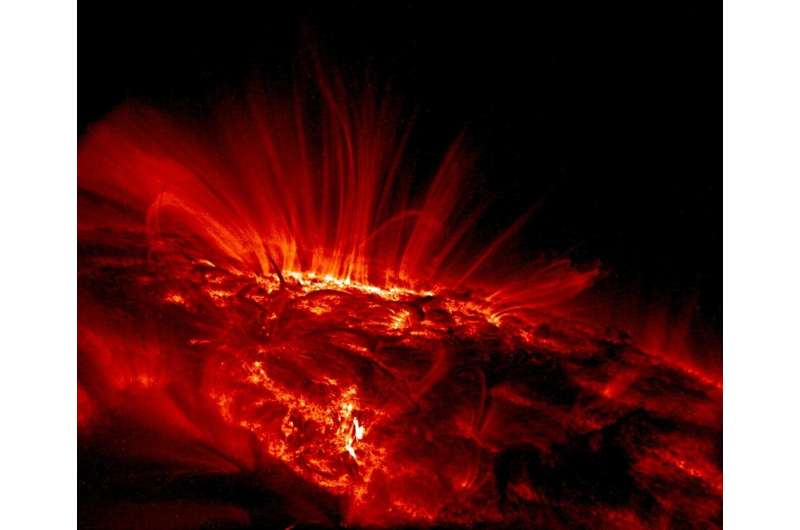
Every 11 years, the sun sheds its composure—and the transformation is as dramatic as flipping a switch on a subterranean dynamo. What was once an orderly magnetic dipole, as neat and predictable as a bar magnet held vertically, dissolves into what scientists call tangled spaghetti: a chaotic web of magnetic field lines writhing across the solar atmosphere. This cyclical transformation, known as the Schwabe Cycle, is the sun's rhythm, and understanding it is crucial for predicting the space weather that can disrupt satellites, power grids, and communications systems on Earth.
The sun is fundamentally a dynamic engine of plasma—a hot, ionized gas about 70 percent hydrogen and 28 percent helium by mass. Deep in its core, nuclear fusion releases staggering amounts of energy. That energy travels outward through the radiative zone, then reaches the tachocline, a thin boundary layer that separates the sun's stable interior from its more fluid outer regions. Above this boundary lies the convective zone, where hot plasma rises toward the sun's surface, cools, contracts, and sinks back down again in an endless cycle. This churning motion, called convection, is paired with another force: the sun's rotation. Together, these two processes generate the magnetic fields that dance across the solar atmosphere.
But the sun does not rotate as a single, unified ball. In what scientists call differential rotation, the solar equator spins considerably faster than the poles—taking just 25 days to complete one rotation compared to 35 days at the poles. This differential motion stretches the sun's vertical magnetic field lines like taffy, wrapping them horizontally around the sun in a process called the Omega Effect. Meanwhile, a second force, the Alpha Effect, emerges from the interaction of convection and rotation below the sun's surface, further tangling those field lines as the cycle progresses.
At the start of each cycle, during solar minimum, the sun's magnetic configuration is clean and organized—a dipole field with clear poles and structure, much like Earth's own magnetic field. But as the 11 years unfold, the Omega and Alpha effects work in concert, twisting and tangling those field lines until they become impossibly snarled. This is solar maximum, when the sun's atmosphere truly resembles tangled spaghetti, with magnetic field lines crossing and recrossing in chaotic patterns. At this peak of disorder, coronal mass ejections burst forth more frequently, and solar flares crackle across the solar surface. Some of this activity reaches Earth, producing the stunning auroras we know as the Northern Lights, though the same disturbances can pose real risks to the technology we depend on.
What makes this cycle so remarkable is its reliability. For centuries, solar observers have watched the sun's spots multiply and fade in this predictable rhythm. Understanding that the cycle is driven by two fundamental physical processes—convection in the sun's outer layer and the sun's own differential rotation—gives researchers a foundation for prediction. As solar activity climbs toward the next maximum or settles into a quieter minimum, scientists can track these patterns and forecast what kind of space weather Earth will face. In a world increasingly dependent on satellites and long-distance power transmission, reading the sun's 11-year rhythm has become essential to modern life.